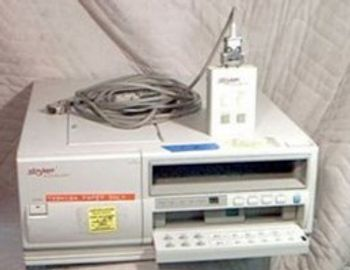
Stryker 240 010 300
 Stryker · Model 240 010 300
Digital status display. On screen cursor control and menus. Memory mode. Memory split. Frame a/b. Adjustable brightness, color, contrast and tint. Selectable sync source. AGC on/off. Input / output: RGB, sync, video, vd, s-video.
Key tips
- ·When no category-specific guidance fits, default to the manufacturer's own service manual and the general troubleshooting method in the Engineer's Guide.
- ·Run an incoming and annual electrical safety test regardless of how niche the device is.
Typical Failure Modes
Compiled for this model from its own documentation and established engineering knowledge for this equipment class - not from a verified service record. Confirm against the manufacturer's service manual.
Poor print quality
HighSymptoms: Density too light / dark, banding, streaks, non-uniform image, blotches.
Root cause: Print head / laser optics contamination, film / cartridge issue, or density-calibration drift.
Film jam / transport fault
MediumSymptoms: Film jams in the pick-up or transport, mis-feeds, or multi-feeds.
Root cause: Worn pick-up rollers, a transport-roller fault, or a mis-loaded film cartridge.
Density / calibration fault
MediumSymptoms: Prints do not match the reference, calibration fails, densitometer error.
Root cause: Internal densitometer or the calibration routine.
DICOM / queue fault
MediumSymptoms: Jobs stuck in the queue, printer offline to modalities, association failures.
Root cause: Network / DICOM configuration or the controller board.
Thermal head / laser fault
MediumSymptoms: Whole-image defect, print-engine error.
Root cause: Thermal print head or the laser / optics module.
Serviceable Parts & Consumables
Serviceable items for this model, compiled from its documentation and engineering knowledge for this equipment class. Service class and relative cost are estimates, not manufacturer figures; no part numbers are given. Confirm intervals and pricing against the manufacturer.
Pick-up / transport rollers
Class Periodic replacementRel. cost $$R&R Moderate
Thermal print head / laser optics
Class Periodic replacementRel. cost $$$R&R Difficult
Internal densitometer
Class Major service partRel. cost $$R&R Moderate
Controller / network board
Class Major service partRel. cost $$R&R Moderate
Film (media)
Class ConsumableRel. cost $$R&R Easy
| Part | Service class | Relative cost | R&R difficulty |
|---|---|---|---|
| Pick-up / transport rollers | Periodic replacement | $$ | Moderate |
| Thermal print head / laser optics | Periodic replacement | $$$ | Difficult |
| Internal densitometer | Major service part | $$ | Moderate |
| Controller / network board | Major service part | $$ | Moderate |
| Film (media) | Consumable | $$ | Easy |
Relative cost: $ lowest · $$$$ highest service-part cost for this equipment class. Not a price.
PM Checklist
Preventive-maintenance tasks typical of this equipment class. Perform to the manufacturer's procedure and your facility's policy - this is general reference, not a schedule for this specific unit.
- ·Follow the manufacturer's PM schedule
- ·Perform incoming and annual electrical safety testing per facility biomedical program
Troubleshooting Approach
A starting sequence for this model, compiled from its documentation and engineering knowledge for this equipment class. Follow the manufacturer's service documentation for the actual procedure.
Symptom: Poor print quality
- Print the built-in test / SMPTE pattern.
- Run the density calibration.
- Clean the print head / laser optics per the manual.
- Confirm the film type / cartridge matches the printer setting.
- Replace the print head or optics module if a whole-image defect persists.
Symptom: Film jam or jobs stuck
- Clear the jam and note the location.
- Inspect and clean the pick-up and transport rollers.
- For queue problems, check the DICOM association and network.
- Restart the print controller.
- Send a test job from a modality to confirm.
Technical Specs
- Height
- 8 in
- Length
- 19 in
- Power Requirements
- 120 VAC
- Weight
- 60 lbs
- Width
- 17 in
Typical Location
Where this class of equipment is typically deployed - general reference, not this unit's own placement record.
- Varies by device - check the unit's own manual for facility placement guidance
Documents & Manuals
No documents available for this device yet.
Safety & Recalls
Synced live from the FDA openFDA API.
- RECALL
There is a potential for blister seals on the product to present a bubble on the seal area of the packaging. This seal acts as a sterile barrier and, in this event, indicates that the sterility seal has been breached.
- RECALL
An error was identified on the expiration date of the product label. The shelf life for the products impacted is 36 months (3 years) however the product label represents a 54 month (4.5 year) shelf life.
- RECALL
A change to the Preparation for Use section was identified where 2.5cc was replaced with 2cc-3cc volume and was not approved
- RECALL
The electrical cord power plug design may allow the prongs to develop a fracture inside or outside the plug, if the plug is misused.
- RECALL
Potential for health care provider/hospital staff member to sustain injury to fingers or hands when removing/handling the headrest component of the VERTIER Surgical Table.
- RECALL
Instruction for use incorrect: There are no statements or warning on labels or Instructions for Use that 8, 9 and 10 mm diameter MRS Cemented Stems are indicated only for use in the GMRS Proximal Tibial and Distal Femoral Components.
- RECALL
Bur guards were distributed without an expiration date, and if they are used after they have expired it could result in the patient or operating room staff experiencing a burn or laceration.
- RECALL
Product package may crack and cause loss of sterility.
- RECALL
Slider Lock Failure - The ACL Workstation slider, a component of the ACL workstation, does not consistently lock into the ACL Workstation Base.
- RECALL
A component of the device is a Dell laptop computer, which contains batteries that are under recall because they can overheat and cause a fire.
- RECALL
The device does not have an oblong hole for dynamic locking as required.
Troubleshoot this device with Bio
Describe a symptom or error code. Bio answers from this device's own documented error codes, failure modes, parts, and guides.
Ask Bio