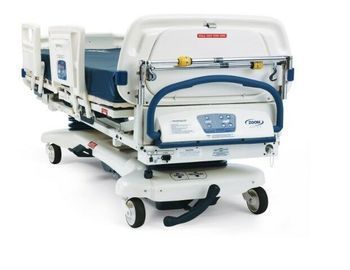
Stryker 2040 ZOOM & 2040 ZOOM II Critical Care Bed
 Stryker · Model 2040 ZOOM & 2040 ZOOM II Critical Care Bed
Split, zero transfer-gap side-rails (articulating). Side-rail and footboard positioning controls. Cardiac chair, emergency drop. Backrest/Trend. angle display. High/low, Trend./reverse Trend. Radiolucent from neck through pelvic region. Scale-isolated drainage bag hooks/head-end IV poles. Integrated 8" (20 cm) bed extender. Four-wheel, steel-ring brake system with centrally-located activation pedals. 90° backrest for upright chest imaging. Dual pedestal design. CPR release for backrest and knee. 6" (15 cm) casters. Locking-caster steering. Four traction sockets. Four IV receptacles (scale isolated at head end). Electric function lock-out controls. In-rail backrest/knee gatch controls. Removable CPR board.
Key tips
- ·Mounting and securement hardware takes real fatigue from vibration and road shock - inspect it as carefully as the device itself.
- ·Post-call battery and function checks catch transport-induced faults that a scheduled PM would miss for months.
Typical Failure Modes
Compiled for this model from its own documentation and established engineering knowledge for this equipment class - not from a verified service record. Confirm against the manufacturer's service manual.
A powered bed function will not run
HighSymptoms: Backrest, knee, height, Trendelenburg or the boost / turn assist will not move from the siderail or caregiver controls.
Root cause: Failed linear actuator, a control-board fault, a control-panel fault, or a pinched / damaged control cable.
Brake / castor-lock fault
MediumSymptoms: Bed will not brake or release, drifts, central brake pedal ineffective.
Root cause: Worn central-brake linkage or castor.
Integrated scale / bed-exit fault
MediumSymptoms: Weight reads implausibly or will not zero, bed-exit alarm false-triggers or fails.
Root cause: Load-cell drift or damage, or a scale-control fault.
Battery back-up fault
MediumSymptoms: Functions and alarms do not work during a power interruption, battery-fault indicator.
Root cause: Aged back-up battery or a charger fault.
Siderail / CPR-release / mechanical fault
LowSymptoms: Siderail will not latch, rattles, or the CPR release is slow / stiff.
Root cause: Worn siderail latch or the CPR mechanism.
Serviceable Parts & Consumables
Serviceable items for this model, compiled from its documentation and engineering knowledge for this equipment class. Service class and relative cost are estimates, not manufacturer figures; no part numbers are given. Confirm intervals and pricing against the manufacturer.
Linear actuator (backrest / knee / height)
Class Major service partRel. cost $$$R&R Difficult
Central-brake / castor assembly
Class Major service partRel. cost $$R&R Difficult
Load cell / scale sensor set
Recalibrate the scale after replacement.
Class Major service partRel. cost $$$R&R Difficult
Back-up battery
Class Periodic replacementRel. cost $$R&R Fairly easy
Siderail control panel / control board
Class Major service partRel. cost $$$R&R Moderate
| Part | Service class | Relative cost | R&R difficulty |
|---|---|---|---|
| Linear actuator (backrest / knee / height) | Major service part | $$$ | Difficult |
| Central-brake / castor assembly | Major service part | $$ | Difficult |
| Load cell / scale sensor set Recalibrate the scale after replacement. | Major service part | $$$ | Difficult |
| Back-up battery | Periodic replacement | $$ | Fairly easy |
| Siderail control panel / control board | Major service part | $$$ | Moderate |
Relative cost: $ lowest · $$$$ highest service-part cost for this equipment class. Not a price.
PM Checklist
Preventive-maintenance tasks typical of this equipment class. Perform to the manufacturer's procedure and your facility's policy - this is general reference, not a schedule for this specific unit.
- ·Post-call function and battery check
- ·Mounting / securement inspection
- ·Annual full PM and vibration-tolerance check
Troubleshooting Approach
A starting sequence for this model, compiled from its documentation and engineering knowledge for this equipment class. Follow the manufacturer's service documentation for the actual procedure.
Symptom: A powered function will not run (backrest / knee / height / Trendelenburg / boost)
- Confirm the bed is plugged in and the battery is charged, and that no function lock-out is set on the caregiver panel.
- Try the function from both the siderail control and the caregiver control to separate the control from the actuator.
- Inspect the control cable / harness for pinch damage along the articulating frame.
- Listen for the actuator; measure its supply at the control box.
- Replace the actuator or the control board as isolated, then load-test to the rated capacity.
Symptom: Brake / castor-lock will not hold or release / bed drifts
- Check the central brake pedal travel and the linkage to each castor.
- Adjust the central-brake linkage per the manual.
- Replace worn castors and the fifth-wheel / steer components.
- Confirm the brake holds on a slope with a load.
- Check all castors engage evenly.
Symptom: Integrated scale reads wrong / bed-exit alarm false-triggers or fails
- Remove all load and confirm the scale zeros and can be tared.
- Place a known reference weight and check the reading.
- Inspect the load-cell mounts for binding, debris or a pinched cable.
- Recalibrate the scale per the service procedure.
- Replace the load-cell set if it will not hold calibration; re-test the bed-exit zones.
Symptom: Functions / alarms dead on a power interruption (battery back-up)
- Check the battery-fault indicator and the charge state.
- Run a battery test if the bed supports one.
- Inspect the battery connector and charger.
- Replace the back-up battery.
- Confirm functions and alarms work on battery after replacement.
Typical Location
Where this class of equipment is typically deployed - general reference, not this unit's own placement record.
- Ambulance / transport vehicles
- Emergency Department
- Inter-facility transport teams
Documents & Manuals
Safety & Recalls
Synced live from the FDA openFDA API.
- RECALL
The hydraulic jack assemblies (PN: 0753-002-101, 0753-002-070, 0753-002-001, and 0753-002-001) were manufactured using the incorrect oil. The oil used does not contain the same wear resistance additives as the specified oils and therefore its use increases the potential for wear which may cause a leak event or jack drift. Testing was done to evaluate the jacks with incorrect oil and leak events we
- RECALL
Two product complaints reported that the Glenoid Reamer Spanner (Lot F3W7017) would not properly connect to the Glenoid Spherical Reamer.
- RECALL
The retractable cord stretchers were fitted with power cords, manufactured by Electri-Cord, whose prongs have the potential to fracture inside the molded section of the plug, causing melting and charring.
- RECALL
The brake cams may crack or develop excessive wear, resulting in the brakes not locking the wheels, or the stretcher not being locked firmly in position.
Troubleshoot this device with Bio
Describe a symptom or error code. Bio answers from this device's own documented error codes, failure modes, parts, and guides.
Ask Bio