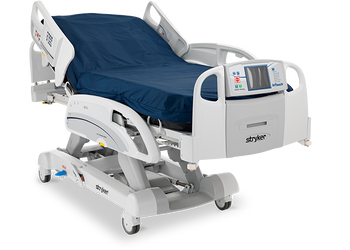
Stryker 2010 Critical Care Bed
 Stryker · Model 2010 Critical Care Bed
Critical care bed Superior capabilities, like the centrally located touch screen, offer tools to enhance the patient experience. InTouch provides a platform to meet the basic needs for the physical and time demands on a caregiver in a complex ICU environment. The bed has tools to help simplify care intervention with the goal of improved patient outcomes. Stryker designs and manufactures advanced patient care and handling equipment that has evolved from years of research and close collaboration with practitioners and caregivers. Through this collaboration and unprecedented investments of talent and resources, Stryker has developed a solutions-based approach focused on preventing and addressing many of the major issues in healthcare today.
Key tips
- ·Casters and the wheel-lock brake take the most day-to-day wear - check both every PM, not just on complaint.
- ·A cracked weld or loose frame joint is a safety-critical finding - pull the unit from service until it's repaired.
Typical Failure Modes
Compiled for this model from its own documentation and established engineering knowledge for this equipment class - not from a verified service record. Confirm against the manufacturer's service manual.
A powered bed function will not run
HighSymptoms: Backrest, knee, height, Trendelenburg or the boost / turn assist will not move from the siderail or caregiver controls.
Root cause: Failed linear actuator, a control-board fault, a control-panel fault, or a pinched / damaged control cable.
Brake / castor-lock fault
MediumSymptoms: Bed will not brake or release, drifts, central brake pedal ineffective.
Root cause: Worn central-brake linkage or castor.
Integrated scale / bed-exit fault
MediumSymptoms: Weight reads implausibly or will not zero, bed-exit alarm false-triggers or fails.
Root cause: Load-cell drift or damage, or a scale-control fault.
Battery back-up fault
MediumSymptoms: Functions and alarms do not work during a power interruption, battery-fault indicator.
Root cause: Aged back-up battery or a charger fault.
Siderail / CPR-release / mechanical fault
LowSymptoms: Siderail will not latch, rattles, or the CPR release is slow / stiff.
Root cause: Worn siderail latch or the CPR mechanism.
Serviceable Parts & Consumables
Serviceable items for this model, compiled from its documentation and engineering knowledge for this equipment class. Service class and relative cost are estimates, not manufacturer figures; no part numbers are given. Confirm intervals and pricing against the manufacturer.
Linear actuator (backrest / knee / height)
Class Major service partRel. cost $$$R&R Difficult
Central-brake / castor assembly
Class Major service partRel. cost $$R&R Difficult
Load cell / scale sensor set
Recalibrate the scale after replacement.
Class Major service partRel. cost $$$R&R Difficult
Back-up battery
Class Periodic replacementRel. cost $$R&R Fairly easy
Siderail control panel / control board
Class Major service partRel. cost $$$R&R Moderate
| Part | Service class | Relative cost | R&R difficulty |
|---|---|---|---|
| Linear actuator (backrest / knee / height) | Major service part | $$$ | Difficult |
| Central-brake / castor assembly | Major service part | $$ | Difficult |
| Load cell / scale sensor set Recalibrate the scale after replacement. | Major service part | $$$ | Difficult |
| Back-up battery | Periodic replacement | $$ | Fairly easy |
| Siderail control panel / control board | Major service part | $$$ | Moderate |
Relative cost: $ lowest · $$$$ highest service-part cost for this equipment class. Not a price.
PM Checklist
Preventive-maintenance tasks typical of this equipment class. Perform to the manufacturer's procedure and your facility's policy - this is general reference, not a schedule for this specific unit.
- ·Caster / wheel and brake function check
- ·Frame, weld, and mounting-hardware inspection
- ·Upholstery / surface condition check
- ·Annual full PM
Troubleshooting Approach
A starting sequence for this model, compiled from its documentation and engineering knowledge for this equipment class. Follow the manufacturer's service documentation for the actual procedure.
Symptom: A powered function will not run (backrest / knee / height / Trendelenburg / boost)
- Confirm the bed is plugged in and the battery is charged, and that no function lock-out is set on the caregiver panel.
- Try the function from both the siderail control and the caregiver control to separate the control from the actuator.
- Inspect the control cable / harness for pinch damage along the articulating frame.
- Listen for the actuator; measure its supply at the control box.
- Replace the actuator or the control board as isolated, then load-test to the rated capacity.
Symptom: Brake / castor-lock will not hold or release / bed drifts
- Check the central brake pedal travel and the linkage to each castor.
- Adjust the central-brake linkage per the manual.
- Replace worn castors and the fifth-wheel / steer components.
- Confirm the brake holds on a slope with a load.
- Check all castors engage evenly.
Symptom: Integrated scale reads wrong / bed-exit alarm false-triggers or fails
- Remove all load and confirm the scale zeros and can be tared.
- Place a known reference weight and check the reading.
- Inspect the load-cell mounts for binding, debris or a pinched cable.
- Recalibrate the scale per the service procedure.
- Replace the load-cell set if it will not hold calibration; re-test the bed-exit zones.
Symptom: Functions / alarms dead on a power interruption (battery back-up)
- Check the battery-fault indicator and the charge state.
- Run a battery test if the bed supports one.
- Inspect the battery connector and charger.
- Replace the back-up battery.
- Confirm functions and alarms work on battery after replacement.
Typical Location
Where this class of equipment is typically deployed - general reference, not this unit's own placement record.
- Ambulance / transport vehicles
- Emergency Department
- Inter-facility transport teams
Documents & Manuals
Safety & Recalls
Synced live from the FDA openFDA API.
- RECALL
Stryker has issued a voluntary recall of certain MV3 beds and Arise 1000EX mattresses because some of these products have been sold in close proximity, suggesting a potential intent for them to be used together. These products have not been tested for compatibility and thus are not designed to be used together. The combination of both is not recommended by Stryker.
- RECALL
Patient beds are missing test values for electrical safety tests presenting risk of tissue burn or electrical shock.
- RECALL
Certain 2860 IsoFlex LAL support surfaces were assembled with a non-conforming fire barrier.
- RECALL
The power load floor plates which hold the ambulance cot anchors in place during patient transport, may be broken.
- RECALL
CPU board failures cause fowler (backrest) electronic controls to stop working.
- RECALL
It was identified by a customer complaint that some I.V. poles were retracting/lowering from an extended position to the low height unexpectedly. An investigation was initiated which identified that the I.V. Latch Housing was nonconforming. potential hazards: " Suspended I.V. pole retracts unexpectedly " Suspended I.V. pole retracts unexpectedly with pump/bags attached
- RECALL
Stryker has received complaints from the field alleging instances where the In Touch beds are hoisted or lifted from the floor and the casters have fallen off. The investigations into these casters have shown that in these cases the caster has broken on the top of the caster stem where the brake rod inserts into the caster. If more than one caster on a unit is damaged, brake functions can be affec
- RECALL
During the use of the SHAPE Arm there is the potential for the monitor mount to come off of the SHAPE Arm if the lock washer and screw are not present.
- RECALL
Stryker Medical has identified a potential issue associated with Secure II and S3 Med/Surg beds built between April 2nd, 2005 and July 26th, 2011. The affected beds have the potential to experience damage to the Foot End Cover and/or Power Coil Cable due to reduced clearance between the Foot End Cover and Foot End Lift Header.
- RECALL
It was reported that the siderail may appear latched when it is not, due to lack of proper preventive maintenance. This might result in bruises and/or lacerations to a patient who is leaning against the siderails if the siderail releases. Additionally, the siderail may not effectively constrain a patient to prevent them from rolling or falling off the bed.
- RECALL
The nurse call cable (Part Number: QDF23-0571) on the FL23SE Bed is located right under the opening of the bed head box. If an accessory (i.e. IV pole) is inserted into this slot, the circuit directing the nurse call system can be damaged.
- RECALL
Stryker Medical Model 3002S3EX and Model 3005S3EX beds built between March 15, 2012 and May 23, 2012. The affected beds may have been built with brake rings that do not meet specifications, negatively impacting the holding force of the brakes.
- RECALL
An adverse trend of scale and bed exit service reports/complaints were detected for the GoBed+, GoBed II, Rose, and MA204 model beds. Investigation found an abnormally high failure rate of loadcells, an integral component in scale and bed exit function. The scale faults are manifested as a fluctuating scale reading, a scale error causing the scale system to be disabled until serviced, or an inac
- RECALL
Stryker Medical has determined that units manufactured between September 1, 2004 through November 30, 2007, did not receive updated preventive maintenance information. (Failure to maintain the bed brakes including the brake plate kits, may result in reduced brake holding force. Reduced braking force may result in a patient fall or caregiver muscle strain, either of which may require medical int
- RECALL
The Fowler mechanism may malfunction, preventing it from being lowered into a flat position.
- RECALL
The backrest of the bed may not stay in an upright position (may drift down when left raised).
- RECALL
The touch screen on the footboard may display a "tilt over range" error, resulting in a precautionary stop of the bed motions which result in the bed appearing to have locked out some of its bed positioning features.
- RECALL
The brakes may not have adequate holding power to lock the bed in place.
- RECALL
Multiple defects: 1) beds exhibit reverse motions when the Fowler, gatch or foot section is activated 2) a battery charging defect which may result in a depletion of battery power 3) the touch screen on the footboard freezing, resulting in controls to powered, pressure-relief mattresses being difficult to access 4) beds equipped with zoom drive systems may have an overdrive problem which could re
- RECALL
The bed exit may not alarm as appropriate.
- RECALL
Trendelenburg and reverse trendelenburg features may not function.
- RECALL
A potential shock hazard exists if the night light is damaged.
- RECALL
A wire may break at the crimp and present a potential electric shock hazard.
Troubleshoot this device with Bio
Describe a symptom or error code. Bio answers from this device's own documented error codes, failure modes, parts, and guides.
Ask Bio