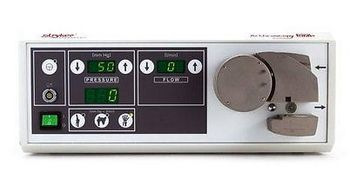
Stryker 2.0L Inflow Arthroscopy Pump
 Stryker · Model 2.0L Inflow Arthroscopy Pump
2.0L/M Inflow Arthroscopy Pump.
Key tips
- ·Never defeat or bypass a return-electrode monitoring (REM) alarm to finish a case - it's a direct burn risk.
- ·Verify OR table battery backup - a table that loses power mid-procedure is a real, documented incident type.
- ·Track surgical light lamp-hours rather than waiting for failure - a sudden failure mid-case is avoidable.
Typical Failure Modes
Compiled for this model from its own documentation and established engineering knowledge for this equipment class - not from a verified service record. Confirm against the manufacturer's service manual.
Will not reach or hold set joint / cavity pressure
HighSymptoms: Pressure droops or overshoots, poor distension, pressure or flow alarm.
Root cause: Pump-head / roller wear, a pressure-sensor fault, a leak in the tubing / inflow-outflow, or a blocked cannula.
Tubing / cassette-detection fault
MediumSymptoms: Cassette / tubing not recognised, will not prime, leaks at the pump head.
Root cause: Cassette-detection switch or worn pump-head seals.
Outflow / suction-control fault
MediumSymptoms: Poor outflow, cannot clear debris, outflow alarm.
Root cause: Outflow pump / valve or a blocked suction line.
Shaver / handpiece fault (shaver systems)
MediumSymptoms: Blade will not oscillate / rotate, weak cut, handpiece not recognised, footswitch dead.
Root cause: Worn shaver handpiece / motor, or its cable / footswitch.
Display / control fault
LowSymptoms: Unresponsive touchscreen or keys, will not power on.
Root cause: Display / control board or power supply.
Serviceable Parts & Consumables
Serviceable items for this model, compiled from its documentation and engineering knowledge for this equipment class. Service class and relative cost are estimates, not manufacturer figures; no part numbers are given. Confirm intervals and pricing against the manufacturer.
Pump-head rollers / seals
Class Periodic replacementRel. cost $$R&R Moderate
Pressure sensor / transducer
Class Major service partRel. cost $$R&R Moderate
Cassette-detection switch
Class Periodic replacementRel. cost $$R&R Moderate
Shaver handpiece / motor (shaver systems)
Class Periodic replacementRel. cost $$$R&R Moderate
Footswitch
Class Periodic replacementRel. cost $$R&R Fairly easy
| Part | Service class | Relative cost | R&R difficulty |
|---|---|---|---|
| Pump-head rollers / seals | Periodic replacement | $$ | Moderate |
| Pressure sensor / transducer | Major service part | $$ | Moderate |
| Cassette-detection switch | Periodic replacement | $$ | Moderate |
| Shaver handpiece / motor (shaver systems) | Periodic replacement | $$$ | Moderate |
| Footswitch | Periodic replacement | $$ | Fairly easy |
Relative cost: $ lowest · $$$$ highest service-part cost for this equipment class. Not a price.
PM Checklist
Preventive-maintenance tasks typical of this equipment class. Perform to the manufacturer's procedure and your facility's policy - this is general reference, not a schedule for this specific unit.
- ·Pre-case functional check
- ·Electrosurgical return-electrode cable inspection
- ·Table hydraulic / mechanical inspection
- ·Annual electrical safety test and full PM
Troubleshooting Approach
A starting sequence for this model, compiled from its documentation and engineering knowledge for this equipment class. Follow the manufacturer's service documentation for the actual procedure.
Symptom: Will not hold set pressure / poor distension
- Fit a fresh tubing set / cassette and re-prime.
- Confirm the inflow and outflow cannulae are patent and connections are tight.
- Run the pump self-test and verify the set pressure against a gauge if possible.
- Inspect the pump-head rollers / seals for wear.
- Replace the pump head or pressure sensor as isolated.
Symptom: Shaver will not run (shaver systems)
- Swap the shaver handpiece and cable.
- Check the footswitch and its connection.
- Confirm the console recognises the handpiece.
- Test forward / reverse / oscillate modes.
- Replace the handpiece or refer the console output as isolated.
Typical Location
Where this class of equipment is typically deployed - general reference, not this unit's own placement record.
- Operating rooms
- Procedure rooms
- Interventional suites
Documents & Manuals
No documents available for this device yet.
Safety & Recalls
Synced live from the FDA openFDA API.
- RECALL
The firm has become aware of a potential problem that their Catheters may break/fracture and/or kink/bend if improperly removed from the packaging/dispenser hoop or during catheter use.
- RECALL
The T/Pump Operations Manual and Maintenance Manual were incorrectly revised to add the sentence, Temperature therapy can also be for heat conservation for normothermia maintenance to the Indications for Use statement.
- RECALL
Stryker Medical has identified that on some units of the MTA7900, there is a lack of a water temperature display while the unit is in Auto mode. While in Auto mode, only the patient temperature is displayed along with the set point. The water display will be blank during Auto mode. If the user wants to see the water temperature displayed and switches out of Auto mode to Manual mode, then back to
- RECALL
Reports that the AC Power Adaptor may not operate due to wires coming loose in the unit.
- RECALL
Three complaints have been reported indicating that the product inside the package did not match the label description. The units had quick connectors instead of luer lock connectors as stated in the label description.
- RECALL
Insufficient cleaning instruction were included for the Inflow/outflow Cannula in the user manual.
- RECALL
This recall is related to the Electi-cord recall. There is a risk when excessive force is applied to the plugs, a fracture can develop on the prongs inside the molded section of the plug. Over time the fracture may lead to arcing inside of the molded sction of the plug and a build up of heat which can cause charring, electric shock or fire. To this date there have been zero complaint for this fa
- RECALL
Defects include, but not limited to: Not sterile, not properly labeled, drugs and swabs may be ineffective, and catheter tips may break in patients.
- RECALL
Failure to infuse and potential compromised sterility: The seal on the tyvek tray cover may fail, compromising sterility, and the device may fail to infuse the drug, resulting in a loss of pain mitigation.
- RECALL
Unable to pump fluids. Silicone tubing is stiffer than usual, resulting in motor defect message, leading to inability to pump saline through tubes for surgery.
Troubleshoot this device with Bio
Describe a symptom or error code. Bio answers from this device's own documented error codes, failure modes, parts, and guides.
Ask Bio