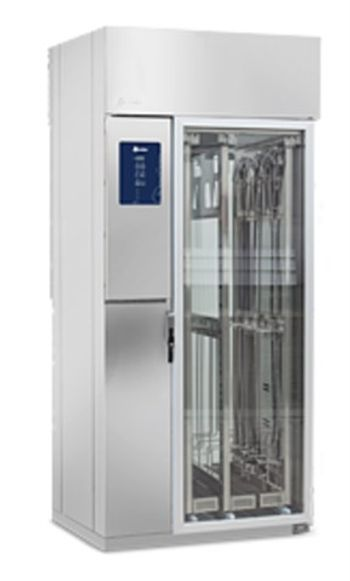
Steelco ED 150
 Steelco · Model ED 150
Capacity: up to 9 endoscopes can be stored at a time vertically hanging on easy acces vertical drawers with fast connections. Frame and panels in stainless steel AISI 304. Door made in HST temperate glass. Glass lockable doors are reversible and therefore can be configured right or left opening also during installation. Single or double interlocked doors pass through versions. Double door version opening depends on control panel. Single door version can be key locked. High level HEPA H14 air filtering - 3 programmable cycles.
Key tips
- ·A failed leak test means the scope does not get reprocessed or used - send it for repair, full stop.
- ·A shortened reprocessing cycle is a real infection-control failure, not a minor deviation - follow AAMI ST91 exactly.
- ·Track light-source lamp-hours against the manufacturer's limit rather than running to failure.
Typical Failure Modes
Compiled for this model from its own documentation and established engineering knowledge for this equipment class - not from a verified service record. Confirm against the manufacturer's service manual.
Cycle fault / abort
HighSymptoms: Cycle stops with a fault code, scope not high-level disinfected, must be re-run.
Root cause: Water fill / drain fault, a leak-test failure, a channel-flow / pressure fault, or a chemistry-delivery fault.
Channel-flow / connector fault
MediumSymptoms: Low-flow or occlusion alarm on a scope channel, incomplete flushing.
Root cause: Wrong or worn hook-up connector, a blocked channel, or a flow-sensor fault.
Leak-test failure
HighSymptoms: The reprocessor's automated leak test fails.
Root cause: A genuine scope leak, or a worn leak-test connector / pump.
Chemistry / disinfectant concentration fault
MediumSymptoms: Low-concentration alarm, MEC test fails, dosing alarm.
Root cause: Empty or expired disinfectant, a dosing-pump fault, or a concentration-monitor fault.
Water-quality / filtration fault
MediumSymptoms: Water-quality alarm, poor rinse, filter-change overdue.
Root cause: Loaded pre-filter / final micron filter, or an RO / water-supply issue.
Serviceable Parts & Consumables
Serviceable items for this model, compiled from its documentation and engineering knowledge for this equipment class. Service class and relative cost are estimates, not manufacturer figures; no part numbers are given. Confirm intervals and pricing against the manufacturer.
Water filters (pre-filter & final micron)
Class Frequent wear itemRel. cost $$R&R Easy
Scope hook-up / channel connectors
Class Frequent wear itemRel. cost $$R&R Easy
Dosing / circulation pump
Class Periodic replacementRel. cost $$$R&R Difficult
Leak-test pump / connector
Class Periodic replacementRel. cost $$R&R Moderate
Door / chamber seal
Class Periodic replacementRel. cost $$R&R Moderate
| Part | Service class | Relative cost | R&R difficulty |
|---|---|---|---|
| Water filters (pre-filter & final micron) | Frequent wear item | $$ | Easy |
| Scope hook-up / channel connectors | Frequent wear item | $$ | Easy |
| Dosing / circulation pump | Periodic replacement | $$$ | Difficult |
| Leak-test pump / connector | Periodic replacement | $$ | Moderate |
| Door / chamber seal | Periodic replacement | $$ | Moderate |
Relative cost: $ lowest · $$$$ highest service-part cost for this equipment class. Not a price.
PM Checklist
Preventive-maintenance tasks typical of this equipment class. Perform to the manufacturer's procedure and your facility's policy - this is general reference, not a schedule for this specific unit.
- ·Leak testing before each reprocessing cycle
- ·Scope reprocessing per AAMI ST91
- ·Light source lamp-hour tracking
- ·Annual full PM
Troubleshooting Approach
A starting sequence for this model, compiled from its documentation and engineering knowledge for this equipment class. Follow the manufacturer's service documentation for the actual procedure.
Symptom: Cycle fault / abort
- Note the fault code and the phase it aborted in.
- Confirm the correct hook-up connectors for that scope model and that all channels are connected.
- Check the water supply, the pre-filter and final micron filters, and the drain.
- Run the MEC / disinfectant-concentration test.
- Follow the service manual for the specific code.
Symptom: Leak-test failure
- Repeat the manual / bench leak test on the scope to confirm a genuine leak.
- If the scope passes, inspect the reprocessor's leak-test connector and pump.
- Replace the leak-test connector.
- Re-run the automated leak test.
- Quarantine and send the scope for repair if it genuinely leaks.
Symptom: Channel-flow / connector alarm / incomplete flushing
- Confirm the correct connectors and that they are seated.
- Check the channel for a blockage and the flow sensors.
- Descale / clean the water path per the manual.
- Verify each channel flow against the spec.
- Replace worn connectors or refer a flow-sensor fault.
Symptom: Low disinfectant concentration / MEC test fails / water-quality alarm
- Confirm the disinfectant is in date and not expended.
- Check the dosing pump and its tubing.
- Replace the water filters if the change is overdue.
- Run the concentration monitor's own check.
- Replace the dosing pump or concentration monitor as isolated.
Technical Specs
- Height
- 2270 mm
- Width
- 962 mm
Typical Location
Where this class of equipment is typically deployed - general reference, not this unit's own placement record.
- Endoscopy suite / GI lab
- Operating Room
- Bronchoscopy suite
Documents & Manuals
Troubleshoot this device with Bio
Describe a symptom or error code. Bio answers from this device's own documented error codes, failure modes, parts, and guides.
Ask Bio