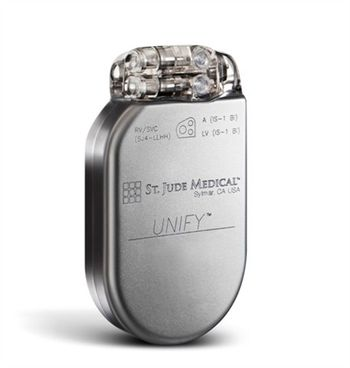
St. Jude Medical, Inc. Unify CRT-D
 ST. JUDE MEDICAL, INC. · Model Unify CRT-D
DF4 connector is designed to simplify implants by streamlining defibrillation connections into a single terminal pin and reducing the number of set screws Decreased device footprint and volume with the most narrow (40 mm) design available for greater patient comfort and range of motion during activity BiVCap®, LVCap™, RVCap® and ACap® Confirm features promote patient safety by automatically ensuring capture of the myocardium in response to pacing stimuli in the left ventricle, right ventricle and right atrium Triggered Pacing with BiV Trigger Mode helps maintain a high percentage of BiV pacing by triggering pacing in both the left and right ventricles in response to a sensed ventricular event Negative AV hysteresis with search promotes ventricular pacing by automatically reducing the AV delay when intrinsic activity is present, thereby promoting a high degree of ventricular pacing QuickOpt® timing cycle optimization provides quick and effective optimization for more patients at the push of a button The low frequency attenuation filter is designed to enhance sensing performance and may reduce the possibility of over sensing T waves Unique AF Suppression™ algorithm is clinically proven to suppress episodes of paroxysmal and persistent AF. Studies show a 25% decrease in symptomatic AF burden DeFT Response® technology tools provide more clinically proven, noninvasive options for managing high DFTs.
Key tips
- ·Never skip the daily/shift ready-check - a defibrillator found dead during a code is a real, repeated root-cause finding.
- ·Pads and batteries have real expiration dates - check them on every PM, not just at annual service.
- ·Verify energy-delivery accuracy with a real defibrillator analyzer, not just a self-test pass.
Typical Failure Modes
Compiled for this model from its own documentation and established engineering knowledge for this equipment class - not from a verified service record. Confirm against the manufacturer's service manual.
Fails the delivered-energy / discharge test
HighSymptoms: Delivered energy outside tolerance on the analyser, will not charge, or charges slowly.
Root cause: HV capacitor / charging-circuit ageing, or an output-relay fault.
Battery will not hold charge / fails readiness
HighSymptoms: Short standby, readiness indicator shows service, unit fails the self-test on battery.
Root cause: Aged battery pack or a charging fault.
Therapy cable / pads or paddles fault
MediumSymptoms: "Check pads", "connect electrodes", no ECG through pads, poor paceing capture.
Root cause: Worn therapy cable, expired pads, or a paddle / connector fault.
ECG / SpO2 / NIBP / CO2 parameter fault (defib-monitors)
MediumSymptoms: A monitoring parameter drops or is implausible.
Root cause: Patient cable / sensor or the parameter module.
Recorder / data fault
LowSymptoms: No printout, event data will not transfer.
Root cause: Thermal recorder or the data / Wi-Fi interface.
Serviceable Parts & Consumables
Serviceable items for this model, compiled from its documentation and engineering knowledge for this equipment class. Service class and relative cost are estimates, not manufacturer figures; no part numbers are given. Confirm intervals and pricing against the manufacturer.
Battery pack
Class Periodic replacementRel. cost $$R&R Easy
Therapy / defib cable
Class Periodic replacementRel. cost $$R&R Fairly easy
Multifunction pads
Class Frequent wear itemRel. cost $R&R Easy
HV / charging board
Class Major service partRel. cost $$$$R&R Difficult
Thermal recorder / print head
Class Periodic replacementRel. cost $$R&R Fairly easy
| Part | Service class | Relative cost | R&R difficulty |
|---|---|---|---|
| Battery pack | Periodic replacement | $$ | Easy |
| Therapy / defib cable | Periodic replacement | $$ | Fairly easy |
| Multifunction pads | Frequent wear item | $ | Easy |
| HV / charging board | Major service part | $$$$ | Difficult |
| Thermal recorder / print head | Periodic replacement | $$ | Fairly easy |
Relative cost: $ lowest · $$$$ highest service-part cost for this equipment class. Not a price.
PM Checklist
Preventive-maintenance tasks typical of this equipment class. Perform to the manufacturer's procedure and your facility's policy - this is general reference, not a schedule for this specific unit.
- ·Daily/shift visual and self-test check (AAMI EQ56 daily-ready standard)
- ·Battery and pad expiration-date tracking
- ·Energy-delivery accuracy test against a defibrillator analyzer
- ·Paddle/cable continuity check
- ·Annual full PM
Troubleshooting Approach
A starting sequence for this model, compiled from its documentation and engineering knowledge for this equipment class. Follow the manufacturer's service documentation for the actual procedure.
Symptom: Fails the discharge / energy test
- Run the full delivered-energy test at several settings with a defib analyser.
- Test synchronised cardioversion and, if fitted, pacing.
- Check the therapy cable and paddles.
- If energy is out of tolerance or charge time is long, remove from service.
- Refer the HV / charging board to the OEM.
Symptom: Fails readiness or dies on battery
- Fit a fully charged battery and repeat the self-test.
- Run a battery capacity test / calibration.
- Confirm the charger and charging contacts.
- Replace the battery pack when capacity is low.
- Log the readiness self-test result before returning to service.
Typical Location
Where this class of equipment is typically deployed - general reference, not this unit's own placement record.
- Crash carts (every unit)
- Emergency Department
- ICU
- OR
- Code-blue response areas
Documents & Manuals
Safety & Recalls
Synced live from the FDA openFDA API.
- RECALL
The device may exhibit premature battery depletion.
- RECALL
New pacemaker firmware was developed to further mitigate the risk of unauthorized access to our pacemakers that utilize radio frequency (RF) communications.
- RECALL
Visual observations of externalized conductors due to abrasion of the silicone insulation in the distal portion of these QuickSite and QuickFlex leads.
- RECALL
St. Jude Medical has confirmed the failures associated with all cause insulation failure on the St. Jude Medical Riata and Riata ST Silicone Endocardial Defibrillation Leads with specific emphasis on externalized conductors.
- RECALL
St. Jude Medical has received reports of out of range pacing lead impedance (PLI) measurements. These measurements are low and out of range (<200 ohms) but measure in range during visits to the clinic. The out of range readings are concluded as false.
- RECALL
Device Separation- product may separate at the mapping collar transition joint located at the proximal (light blue) marker band end of the tool during the implant procedure.
Troubleshoot this device with Bio
Describe a symptom or error code. Bio answers from this device's own documented error codes, failure modes, parts, and guides.
Ask Bio