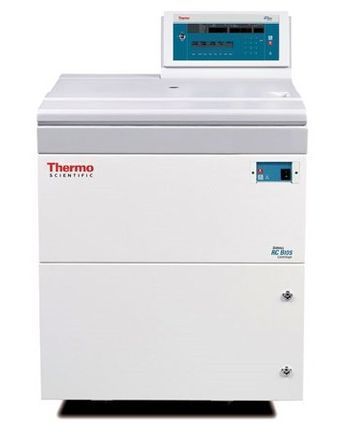
Sorvall RC BIOS
Sorvall · Model RC BIOS
Accelerates Bioprocessing. High throughput: Spin up to 6 x 1L bottles in a single spin. High performance: Spin at 8,500rpm and 15,860 x g in as little as nine minutes. Load tubes directly into the rotor, eliminating multi-canister assemblies which can be misplaced or damaged Improves Productivity and Efficiency. Simplifies processing with operator friendly controls. Optimizes performance for laboratory workflows. Robust and Reliable. New and enhanced security features help minimize risks of errors and system failures. Reduces variability in operating parameters Versatile Accessory System. True Fit 1L Nalgene* Bottles. Array of adapters for Oak Ridge* and conical tubes facilitate tube versatility from 3mL to 1L Fiberlite* Carbon Fiber Rotors. An advanced alternative to metal rotors, offering superior durability, high performance and a higher level of safety for worry-free operation spin after spin. Fatigue resistant - Carbon fiber provides unequalled structural integrity, eliminating the need to derate or limit the speed over the rotor's lifespan. Non-corrosive - Protects against ever-present hazard due to moisture, chemicals, alkaline solutions or other salts in the laboratory. Lightweight and easy to handle, improving ergonomics for a safer work environment and minimizing the risk of damage to centrifuge equipment. Repairable in the unlikely event of a mishap. Superior insulation - With naturally insulating properties, carbon fiber ensures constant sample temperature Safety Features. Automatic lid lock. Imbalance detection. Steel armored guard ring. Security key switch.
Key tips
- ·Run QC controls before trusting any repair - an analyzer that passes self-test can still report clinically wrong results.
- ·Rule out a reagent lot change before opening the instrument - it can look exactly like a hardware fault.
- ·Centrifuge rotors have a hard retirement age/cycle limit regardless of visible condition - don't eyeball it.
Typical Failure Modes
Compiled for this model from its own documentation and established engineering knowledge for this equipment class - not from a verified service record. Confirm against the manufacturer's service manual.
Will not start / error at start
HighSymptoms: Error code, run will not begin, or aborts shortly after start.
Root cause: Set speed exceeds the rotor maximum, an imbalanced load, the lid / door not locked, an unapproved rotor, or a drive / control fault.
Will not reach speed / excessive noise or vibration
MediumSymptoms: Slow spin-up, rumble, or vibration during a run.
Root cause: Load imbalance, worn drive / motor bearings, a worn drive coupling, or (older units) worn motor brushes.
Timer / speed inconsistency
MediumSymptoms: Run ends early / late, or RPM does not match the setting.
Root cause: Tacho / speed-sensor drift or a control-board fault.
Lid / door will not open or lock
MediumSymptoms: Lid-lock error, will not open after a run, or will not lock to start.
Root cause: Lid-lock solenoid / switch fault, or a run still winding down.
Rotor / bucket wear or corrosion
MediumSymptoms: Visible corrosion, cracks, or a bucket that will not swing; imbalance trips.
Root cause: Rotor / bucket ageing - a safety-critical wear item with a use-life limit.
Serviceable Parts & Consumables
Serviceable items for this model, compiled from its documentation and engineering knowledge for this equipment class. Service class and relative cost are estimates, not manufacturer figures; no part numbers are given. Confirm intervals and pricing against the manufacturer.
Drive / motor bearings & coupling
Class Major service partRel. cost $$$R&R Difficult
Lid-lock solenoid / switch
Class Major service partRel. cost $$R&R Moderate
Speed sensor / control board
Class Major service partRel. cost $$R&R Moderate
Motor brushes (older units)
Class Periodic replacementRel. cost $R&R Moderate
Rotor / bucket set & O-rings
Log rotor runs; retire per the manufacturer's rotor-life programme.
Class Major service partRel. cost $$$R&R Easy
| Part | Service class | Relative cost | R&R difficulty |
|---|---|---|---|
| Drive / motor bearings & coupling | Major service part | $$$ | Difficult |
| Lid-lock solenoid / switch | Major service part | $$ | Moderate |
| Speed sensor / control board | Major service part | $$ | Moderate |
| Motor brushes (older units) | Periodic replacement | $ | Moderate |
| Rotor / bucket set & O-rings Log rotor runs; retire per the manufacturer's rotor-life programme. | Major service part | $$$ | Easy |
Relative cost: $ lowest · $$$$ highest service-part cost for this equipment class. Not a price.
PM Checklist
Preventive-maintenance tasks typical of this equipment class. Perform to the manufacturer's procedure and your facility's policy - this is general reference, not a schedule for this specific unit.
- ·Daily QC controls run and reviewed
- ·Calibration verification per assay
- ·Routine cleaning and decontamination
- ·Scheduled reagent-path and pump-tubing maintenance
Troubleshooting Approach
A starting sequence for this model, compiled from its documentation and engineering knowledge for this equipment class. Follow the manufacturer's service documentation for the actual procedure.
Symptom: Will not start / error at start
- Confirm mains power, the mains switch, and check the instrument fuse / circuit breaker - replace a blown fuse (a second blown fuse means an internal fault).
- Confirm the lid is fully closed and the lid interlock is engaging.
- Confirm a speed and time (and an approved rotor) are set.
- Note any displayed error code and look it up in the manual's error table.
- Re-balance the load if an imbalance is indicated.
Symptom: Lid will not open
- Confirm the rotor has fully stopped and mains power is present.
- Press down on the front of the lid while pressing the release button.
- If a power failure, use the mechanical emergency lid release per the manual.
- Inspect the lid-lock solenoid / latch and its micro-switch.
- Replace a jammed or faulty lid-lock assembly.
Symptom: Excess vibration / will not reach speed / noise
- Stop and re-load the rotor symmetrically - opposing positions equally loaded, all carriers fitted.
- Inspect the rotor pockets and chamber for debris or a broken tube.
- Confirm the rotor is fully seated and not corroded or cracked (retire per its use-life log).
- Turn the rotor by hand and feel the drive bearing; on belt-drive units check belt tension and, on older units, the motor brushes.
- Verify speed with a tachometer after any drive work.
Technical Specs
- Height
- 46.3 in
- Length
- 35.6 in
- Orientation
- Floor Standing
- Weight
- 1036 lbs
- Centrifuge Type
- Low Speed
- Maximum Speed
- 8500 rpm
- Width
- 31.5 in
Typical Location
Where this class of equipment is typically deployed - general reference, not this unit's own placement record.
- Central / core laboratory
- Point-of-care testing stations
- Blood bank
- Microbiology lab
Documents & Manuals
Related calculators
From BioLab, for work done with this kind of equipment.
Troubleshoot this device with Bio
Describe a symptom or error code. Bio answers from this device's own documented error codes, failure modes, parts, and guides.
Ask Bio