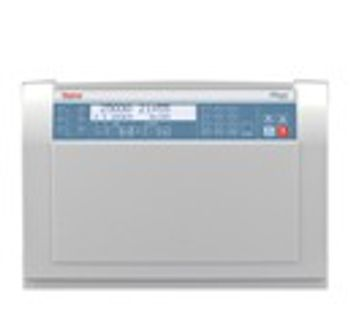
Sorvall Legend X1
Sorvall · Model Legend X1
Advanced, Intuitive Programmable Controls - The latest user interface and control technology maximize run performance and reproducibility. Easily adjust speed, time and temperature, even during the run with our convenient keyboard for direct input. With dedicated program keys immediately store and access your most frequently used programs. Protection for Temperature Sensitive Samples - For high-performance applications with temperature-sensitive samples, the chamber and sample control is available between -10° and +40°C. Space-Savings Design - Realize exceptional capability in compact dimensions for maximized workspace, and with ergonomic height and curved design ensure comfortable loading and unloading of samples and cleaning of the unit. Auto-Lock® III Rotor System - With simple push-button installation, exchange from swing-out to superspeed applications in less than 3 seconds. Also, easy access to the chamber enables cleaning convenience, reducing contamination risk and leading to improved research and a healthier working environment. ClickSeal® Bucket Sealing System - Thermo Scientific's certified biocontainment solution features glove-friendly, one-handed open/close capability, eliminating screw caps and complicated clips. Motorized Lid Latch - This patented technology enables one finger downward motion for easiest closing and locking of centrifuge lid, improving closure time and reducing wear. Password protection and optional automatic lid opening at the end of the run. SMARTSpin® Technology - Advanced rotor management system ensures safety and reproducible runs by optimizing acceleration, braking and residual load imbalance for each rotor and bucket option. Innovative Temperature Control - The exclusive temperature toggle function enables monitoring of the air temperature in the chamber, as well as the sample temperature, for ultimate control of the sample temperature during the run, and the best chamber pre-cooling conditions.
Key tips
- ·Run QC controls before trusting any repair - an analyzer that passes self-test can still report clinically wrong results.
- ·Rule out a reagent lot change before opening the instrument - it can look exactly like a hardware fault.
- ·Centrifuge rotors have a hard retirement age/cycle limit regardless of visible condition - don't eyeball it.
Typical Failure Modes
Compiled for this model from its own documentation and established engineering knowledge for this equipment class - not from a verified service record. Confirm against the manufacturer's service manual.
Will not start / error at start
HighSymptoms: Error code, run will not begin, or aborts shortly after start.
Root cause: Set speed exceeds the rotor maximum, an imbalanced load, the lid / door not locked, an unapproved rotor, or a drive / control fault.
Will not reach speed / excessive noise or vibration
MediumSymptoms: Slow spin-up, rumble, or vibration during a run.
Root cause: Load imbalance, worn drive / motor bearings, a worn drive coupling, or (older units) worn motor brushes.
Timer / speed inconsistency
MediumSymptoms: Run ends early / late, or RPM does not match the setting.
Root cause: Tacho / speed-sensor drift or a control-board fault.
Lid / door will not open or lock
MediumSymptoms: Lid-lock error, will not open after a run, or will not lock to start.
Root cause: Lid-lock solenoid / switch fault, or a run still winding down.
Rotor / bucket wear or corrosion
MediumSymptoms: Visible corrosion, cracks, or a bucket that will not swing; imbalance trips.
Root cause: Rotor / bucket ageing - a safety-critical wear item with a use-life limit.
Serviceable Parts & Consumables
Serviceable items for this model, compiled from its documentation and engineering knowledge for this equipment class. Service class and relative cost are estimates, not manufacturer figures; no part numbers are given. Confirm intervals and pricing against the manufacturer.
Drive / motor bearings & coupling
Class Major service partRel. cost $$$R&R Difficult
Lid-lock solenoid / switch
Class Major service partRel. cost $$R&R Moderate
Speed sensor / control board
Class Major service partRel. cost $$R&R Moderate
Motor brushes (older units)
Class Periodic replacementRel. cost $R&R Moderate
Rotor / bucket set & O-rings
Log rotor runs; retire per the manufacturer's rotor-life programme.
Class Major service partRel. cost $$$R&R Easy
| Part | Service class | Relative cost | R&R difficulty |
|---|---|---|---|
| Drive / motor bearings & coupling | Major service part | $$$ | Difficult |
| Lid-lock solenoid / switch | Major service part | $$ | Moderate |
| Speed sensor / control board | Major service part | $$ | Moderate |
| Motor brushes (older units) | Periodic replacement | $ | Moderate |
| Rotor / bucket set & O-rings Log rotor runs; retire per the manufacturer's rotor-life programme. | Major service part | $$$ | Easy |
Relative cost: $ lowest · $$$$ highest service-part cost for this equipment class. Not a price.
PM Checklist
Preventive-maintenance tasks typical of this equipment class. Perform to the manufacturer's procedure and your facility's policy - this is general reference, not a schedule for this specific unit.
- ·Daily QC controls run and reviewed
- ·Calibration verification per assay
- ·Routine cleaning and decontamination
- ·Scheduled reagent-path and pump-tubing maintenance
Troubleshooting Approach
A starting sequence for this model, compiled from its documentation and engineering knowledge for this equipment class. Follow the manufacturer's service documentation for the actual procedure.
Symptom: Will not start / error at start
- Confirm mains power, the mains switch, and check the instrument fuse / circuit breaker - replace a blown fuse (a second blown fuse means an internal fault).
- Confirm the lid is fully closed and the lid interlock is engaging.
- Confirm a speed and time (and an approved rotor) are set.
- Note any displayed error code and look it up in the manual's error table.
- Re-balance the load if an imbalance is indicated.
Symptom: Lid will not open
- Confirm the rotor has fully stopped and mains power is present.
- Press down on the front of the lid while pressing the release button.
- If a power failure, use the mechanical emergency lid release per the manual.
- Inspect the lid-lock solenoid / latch and its micro-switch.
- Replace a jammed or faulty lid-lock assembly.
Symptom: Excess vibration / will not reach speed / noise
- Stop and re-load the rotor symmetrically - opposing positions equally loaded, all carriers fitted.
- Inspect the rotor pockets and chamber for debris or a broken tube.
- Confirm the rotor is fully seated and not corroded or cracked (retire per its use-life log).
- Turn the rotor by hand and feel the drive bearing; on belt-drive units check belt tension and, on older units, the motor brushes.
- Verify speed with a tachometer after any drive work.
Technical Specs
- Height
- 36 cm
- Length
- 60.5 cm
- Weight
- 57.5 kg
- Width
- 44 cm
Typical Location
Where this class of equipment is typically deployed - general reference, not this unit's own placement record.
- Central / core laboratory
- Point-of-care testing stations
- Blood bank
- Microbiology lab
Documents & Manuals
Related calculators
From BioLab, for work done with this kind of equipment.
Troubleshoot this device with Bio
Describe a symptom or error code. Bio answers from this device's own documented error codes, failure modes, parts, and guides.
Ask Bio