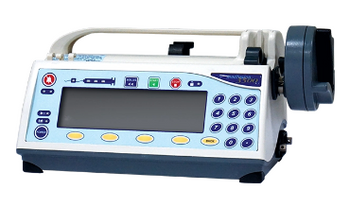
Smiths Medical Medfusion 3500
 Smiths Medical · Model Medfusion 3500
The Medfusion® 3500 auto-default feature promotes your facility’s policies and procedures for medication administration and safety. From the moment the pump is powered on, the pump defaults to use the established drug protocols set by your hospital’s pharmacists, so that nursing staff are able to quickly start an infusion with the safety of drug libraries supporting them. Hard and soft limits set by your Pharmacist, for each drug and profile, protect against medication errors regardless of your patient’s size or where in the hospital they are receiving care. FlowSentry™ monitor provides unmatched pressure sensing technology for earlier clinical intervention. Automatically detects various syringe types and sizes, from 1mL to 60mL. A compatible syringe list can be updated to current syringe models from major manufacturers. Ergonomic, easy-to-use, horizontal design helps protect the entire syringe barrel and allows single-handed loading of the syringe. The large screen, features high visibility TALL man lettering that displays the full drug name to differentiate look-alike, sound-alike drug names and concentrations.
Key tips
- ·Free-flow protection must be verified on every PM - a failed anti-free-flow clamp is a direct overdose risk.
- ·Test occlusion alarms in both directions - failing to alarm when it should is more dangerous than a false alarm.
- ·Battery run-time complaints are the most common real-world nuisance call - a full charge/discharge cycle test catches most of them.
Typical Failure Modes
Compiled for this model from its own documentation and established engineering knowledge for this equipment class - not from a verified service record. Confirm against the manufacturer's service manual.
Failure message / error code
HighSymptoms: The pump displays a failure message and stops; the Service Manual lists each message with the problem and solution.
Root cause: A subsystem fault - motor / drive, plunger-force sensor, syringe-detection, occlusion sensor, or a board.
Occlusion alarm / pressure fault
MediumSymptoms: Repeated occlusion alarms, delivery stops, or an occlusion is missed.
Root cause: Kinked or clamped line, a positional patient IV, plunger-force-sensor drift, or a syringe not seated correctly.
Syringe not detected / size wrong
MediumSymptoms: Pump will not confirm the syringe, or selects the wrong brand / size.
Root cause: Worn syringe-detection mechanism / barrel clamp, or the wrong syringe brand selected.
Flow / delivery accuracy drift
MediumSymptoms: Delivered volume outside tolerance on the annual test, especially at low rates.
Root cause: Worn drive train / leadscrew or plunger grip.
Battery will not hold charge
MediumSymptoms: Short run time, low-battery early.
Root cause: Aged battery pack.
Serviceable Parts & Consumables
Serviceable items for this model, compiled from its documentation and engineering knowledge for this equipment class. Service class and relative cost are estimates, not manufacturer figures; no part numbers are given. Confirm intervals and pricing against the manufacturer.
Battery pack
Class Periodic replacementRel. cost $$R&R Fairly easy
Syringe barrel clamp / detection assembly
Class Major service partRel. cost $$R&R Moderate
Plunger grip / force-sensor assembly
Class Major service partRel. cost $$$R&R Difficult
Drive train / leadscrew
Class Major service partRel. cost $$$R&R Difficult
Syringe / extension set
Class ConsumableRel. cost $R&R Easy
| Part | Service class | Relative cost | R&R difficulty |
|---|---|---|---|
| Battery pack | Periodic replacement | $$ | Fairly easy |
| Syringe barrel clamp / detection assembly | Major service part | $$ | Moderate |
| Plunger grip / force-sensor assembly | Major service part | $$$ | Difficult |
| Drive train / leadscrew | Major service part | $$$ | Difficult |
| Syringe / extension set | Consumable | $ | Easy |
Relative cost: $ lowest · $$$$ highest service-part cost for this equipment class. Not a price.
PM Checklist
Preventive-maintenance tasks typical of this equipment class. Perform to the manufacturer's procedure and your facility's policy - this is general reference, not a schedule for this specific unit.
- ·Occlusion pressure and flow-rate accuracy verification
- ·Battery conditioning cycle
- ·Door latch and air-in-line sensor inspection
- ·Post-drop functional check before return to service
- ·Annual PM per manufacturer schedule
Error Codes
Extracted directly from this unit's own service manual.
Battery Communication timeoutPump has sensed battery current present, but the battery gauge on the battery pack is not communicating.
Check connections from main board, to interconnect, to battery pack.
Battery not ChargingPump has sensed AC or DC external power is present, but the battery is not charging.
Use Biomed > Diagnostics and run Monitor Battery Status to review battery function. Check battery connections and battery charge circuit on the interconnect board.
Battery not WorkingPump has found no battery present – no charge current and no battery gage communication.
Battery may be unplugged.
Check Clutch / Plunger leverSoftware uses position potentiometer to monitor motion of the plunger driver during delivery. If the motion is not correct this alarm is generated.
May be caused because pump was not primed and clutches took too long to engage, or may occur when user squeezes the plunger lever and moves plunger head. May also occur if position pot is not calibrated or is contaminated – use Biomed > Utilities and run View Alarm History to check if failure occurs at same position reading.
Check Syringe Barrel ClampCertain syringe brands and sizes may cause the barrel clamp sensor to have difficulty in verifying the clamp is in position.
Use Biomed > Diagnostics and run Monitor Digital Sensors to check function of barrel sensor.
Check Syringe flange SensorAt power-up, software has sensed the flange is loaded when no syringe is loaded in the pump (as sensed by the barrel clamp size sensor).
Use Biomed > Diagnostics and run Monitor Digital Sensors to check function of flange sensor.
Check Syringe Plunger SensorAt power-up, software has sensed the plunger is loaded when no syringe is loaded in the pump (as sensed by the barrel clamp size sensor).
Use Biomed > Diagnostics and run Monitor Digital Sensors to check function of both plunger sensors.
Clear TVD to Start infusionTotal volume delivered (TVD) or total dose delivered (TDD) needs to be cleared to start an infusion when TVD/TDD exceeds the volume limit setting.
Completing System initializationAt power-up, if all settings are entered by the user and É is pressed before background self-tests are completed, then this message appears.
Wait a few seconds until self-testing is completed and then press É to begin infusion.
Depleted BatteryBattery voltage measured by the gauge on the battery pack is too low. Software then stops delivery and allows watchdog to generate alarm.
Plug pump into AC power, cycle power on the pump, then use Recall Last Settings to recall delivery settings and resume delivery. If problem is chronic, check battery pack function or perform battery calibration.
Force Sensor Bgnd TestBackground self-test has found the force sensor signal out-of-range or the force sensor signal did not change when bridge-test signal was asserted.
Press ë to turn the pump off. Use Biomed > Diagnostics > Monitor Analog Sensors to check operation of plunger force sensor. Open plunger head and check plunger cable and force sensor cable on the plunger board. Replace plunger board, plunger cable or force sensor.
Infusion CompleteInfusion has reached the set volume limit and delivery has stopped.
Invalid infusion Parameter CombinationThe user has attempted to set a combination of infusion values that does not allow a valid flow rate to be calculated.
Press â and enter a different set of values.
Invalid library entryThe library entry was not defined correctly when it was created.
Review the library entry using the PharmGuard® Toolbox and correct the problem.
Invalid Syringe SizeSyringe size (barrel clamp potentiometer sensor) does not match selected manufacturer or when barrel clamp is lifted during delivery.
If there is any question about this sensor’s function perform PM check of barrel clamp calibration.
KVO in ProgressInfusion has reached the set volume limit and delivery changed to KVO rate.
Low Battery (initial Signal)Plug in the power cord and run the pump on AC Mains while recharging battery.
Motor rate errorThe stepper motor moving at the wrong speed.
Clear any obstructions to proper motor operation. If the message reoccurs...
Troubleshooting Approach
A starting sequence for this model, compiled from its documentation and engineering knowledge for this equipment class. Follow the manufacturer's service documentation for the actual procedure.
Symptom: Failure message / error code
- Note the exact failure message.
- Look it up in the Troubleshooting section of the Medfusion 3500 Service Manual.
- Use the Biomed Diagnostics & Utilities to test the affected subsystem.
- Follow the manual's parts-replacement procedure.
- Run the scheduled-maintenance test set after any repair.
Symptom: Occlusion / syringe-detection problem
- Check the line for kinks and the patient IV site.
- Reseat the syringe fully in the barrel clamp and confirm the correct brand / size.
- Run the plunger-force / occlusion-sensor test in diagnostics.
- Replace the barrel clamp / detection assembly if worn.
- Verify occlusion response and flow accuracy after repair.
Technical Specs
- Flow Accuracy
- 2 %
- Infusion Pump Type
- Ambulatory
Typical Location
Where this class of equipment is typically deployed - general reference, not this unit's own placement record.
- Patient care floors
- ICU
- OR
- Oncology / infusion centers
- Home health (portable pumps)
Documents & Manuals
- Smiths Medical Medfusion 3500 Operation ManualUser Manual · External
- Smiths Medical Medfusion 3500 User ManualUser Manual · External
- Smiths Medfusion 3500 Syringe Infusion Pump BrochureBrochure · External
- Medfusion-3500-Technical-Manual.pdfDocument · External
- Medical Device RecallDocument · External
- Smiths Medical Medfusion 3500 Config ManualDocument · External
- Smiths Medical Medfusion 3500 Software Version 5.0.0Document · External
- --Technical-Manual.pdfDocument · External
Safety & Recalls
Synced live from the FDA openFDA API.
- RECALL
Medfusion syringe pumps, with software versions before v6.0.0, may have the following issues:1. Delivery During Motor Not Running High Priority Alarm, 2. Infusion Restarted with Incorrect Parameters, 3. Screen Lock, 4. Interruption of Bolus or Loading Dose Delivery, 5. Pump Displays Incorrect Bolus/Loading Dose, 6. Loading/Bolus Dose Below the Minimum Recommended Rate, 7. Motor Rate Error, 8. Incorrect Recall Last Settings, 9. Corrupt Configuration, 10. Auto Lock, 11. Toolbox Configuration Loading Dose Time Values. Smiths Medical corrected all issues included in this notification in previous software updates and the corrections were carried forward into all subsequent software releases. Please ensure you have the most recent Medfusion software (v6.0.0) installed on your pumps.
- RECALL
Medfusion Model 4000 syringe infusion pumps, with the following software versions, may have the following issues: 1. Delivery During Motor Not Running High Priority Alarm (v1.0.0, v1.1.0, v1.1.1, v1.1.2), 2. Re-administered Loading Dose (v1.0.0, v1.1.0, v1.1.1, v1.1.2), 3. Incorrect Critical Data Failure Alarm, 4. Interruption of Bolus or Loading Dose Delivery (v1.0.0, v1.1.0, v1.1.1, v1.1.2), 5. Incorrect Total Bolus/Loading Dose Displayed (v1.1.0, v1.1.1, v1.1.2), 6. Volume Limit Before Bolus/Loading Dose Complete (v1.1.2), 7. Drug Library Lower Limit Displayed Incorrectly (v1.6.0, v1.6.1), 8. Depleted Battery Alarm (All versions previous to v1.6.5), 9. Loss of Wireless Connectivity (v1.5.0, v1.5.1, v1.6.0, v1.6.1, v1.6.4), 10. PharmGuard Server Password (v2.3, v2.4, v2.5). Smiths Medical corrected all issues included in this notification in previous software updates and the correct
- RECALL
Medfusion Model 4000, 3500, and 3010 pumps manufactured or serviced with Barrel Clamp Guide (Part Number G6000716), Lot Numbers P0407365, P0486670, and P0561740 may contain a molding defect that could potentially lead to slippage of the spring within the barrel clamp assembly. If this occurs, it could result in the inability of the pump to recognize a syringe or the pump may misidentify the size of the syringe loaded.
- RECALL
A force sensor in the occlusion detector may drift out of calibration leading to increased occlusion detection times, false occlusion alarms, or a System Failure Alarm. If the force sensor calibration shift is large enough, the pump will display a System Failure Alarm (including Force Sensor BGND Test, Force Sensor Bridge Test, or Force Sensor Test). However, if the calibration shift is not large enough to trigger a System Failure Alarm, the threshold to detect an occlusion may increase, increasing the time to occlusion detection, or the threshold may decrease, leading to false occlusion alarms. Although shifts in the force sensor calibration may occur over time with any device, an increased potential for such shifts has been reported in devices produced before April 2022 due to mechanical interference between parts of the plunger head assembly. Out of an abundance of caution, we are no
- RECALL
Potential for delay in sending Infusion Start Messages to third-party Electronic Health Record systems which may affect infusion auto-programming on the pump and documentation
- RECALL
Multiple issues with the potential for interruption of therapy or over-infusion: 1. Primary Audible Alarm (PAA), 2. Unanticipated Depleted Battery Alarms, 3. Time Base Alarm, 4. Intermittent Volume Over Time (IVOT) - Infusion Continues after System Failure, 5. Clearing of Program Volume Delivered (PVD), 6. False Alarm for Rate Below Recommended Minimum for Syringe Size, 7. Incorrect Bolus or Loading Dose Time Display, 8. Domain Name Server (DNS) Port 1001
- RECALL
Inaccurate delivery can occur following an interrupted Bolus or Loading dose, if a specific sequence of events occurs.
- RECALL
There is an anomaly in Medfusion 4000 Syringe Pump Firmware version 1.7.0 that could potentially result in loss of primary audible and visual battery alarm functionality, and interruption of therapy.
- RECALL
Customers who utilize PharmGuard Server Software (PGS) with Medfusion 4000 pumps manufactured prior to November 10, 2017, may experience wireless network connectivity issues on certain pumps due to a potential Radio Module issue on some Medfusion 4000 pumps.
- RECALL
Product has a lack of sterility assurance
- RECALL
Certain Barrel Clamp Guides may contain a ridge that could potentially lead to spring slippage, resulting in the inability of the pump to recognize a loaded syringe or the pump, misidentifying the size of a loaded syringe.
- RECALL
Certain Medfusion Syringe Pump Models, Series 3100, 3500, and 4000, may not recognize or may misidentify loaded medication syringes. The inability of a pump to recognize a syringe (i.e. the size of the syringe is unknown to the pump) results in an inability to complete pump programming. Misidentification of a syringe is where the pump misinterprets the syringe size.
- RECALL
Potential for the syringe barrel clamp mechanism to loosen, decreasing the pump's ability to accurately detect the diameter of the syringe barrel, resulting in the unit to initiate the "Invalid Syringe Size" alarm.
- RECALL
There have been intermittent issues with Supercap POST (power on self-test) and Backup Audible Alarm error codes outside of the pump warranty period. These alarms occur at start up when the pump goes through the self-test. This recall occurred in 2015.
- RECALL
Smiths Medical is conducting a recall involving all Medfusion 4000 Syringe Infusion Pumps. Smiths Medical has identified an issue with electrical shorting at the AC power receptacle. Shorting can occur when saline solution or other conductive fluids (e.g., potassium chloride) enter the AC power receptacle. When this happens, sparking and/ or flames, accompanied by smoke, may appear at the AC po
- RECALL
Smiths Medical has identified a software anomaly in the Medfusion 4000 Syringe Infusion Pump that causes a device history log corruption and triggers a Watchdog Fail-Safe alarm. When the device exhibits this failure mode, visual and audible alarms will sound and the device ceases operation.
- RECALL
Pumps rendered inoperable at power up (displaying a blank screen and alarm).
- RECALL
An issue with the plunger rod seal was identified where the seal had the potential to migrate inside the pump case top during slow rate/ high back pressure infusions.
- RECALL
Smiths Medical has become aware of an increased trend in reports of Motor Not Running (MNR) and Motor Rate Error (MRE) alarm message events with certain Medfusion Syringe Infusion Pumps, Models 3010A and 3500 (Pump). MNR/ MRE are high priority alarm messages which can occur for a variety of reasons as part of the usual self-test functionality of the Pump. The Pump is designed so that when its so
- RECALL
Delay in therapy. Keypad issues with Medfusion Syringe Infusion Pump, model numbers 3500-306 and 3500-415 ("Pump") have occurred during implementation or shortly after first being placed into use. These issues can be intermittent, and may render the Pump inoperable or the Pump may not respond to certain keypad button presses.
- RECALL
Software anomaly that causes the pump to experience a sudden and unexpected failure. This anomaly occurs during the pump's startup sequence when the pump's Preventative Maintenance Alarm goes off, preventing the pump from completing its power up routine. Lock-up occurs and the pump will not function.
Related calculators
From BioLab, for work done with this kind of equipment.
Troubleshoot this device with Bio
Describe a symptom or error code. Bio answers from this device's own documented error codes, failure modes, parts, and guides.
Ask Bio