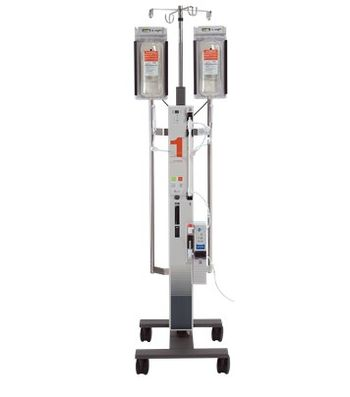
Smiths Medical Level 1 H-1200 Fast Flow
 Smiths Medical · Model Level 1 H-1200 Fast Flow
On/Off toggle switch used to pressurize chambers. Constant 300 mmHg pressure is applied and maintained. Accommodate standard blood and solution bags. Aluminum heat exchanger transfers heat 1000 times faster than plastic. Counter current 42°C circulating water bath for effective and stable heating. Detects the presence of air in blood and crystalloid. Automatically stops the flow of blood and crystalloid andalerts personnel with audible and visual alarms when air is detected. Allows quick removal of air and restoration of flow without disconnecting from the patient or changing Disposable Administration Sets.
Key tips
- ·Never skip temperature-accuracy verification to save time - it's the one check that directly prevents burns.
- ·Hose/blanket connector wear is the most common real fault and the easiest to miss on a quick visual check.
Typical Failure Modes
Compiled for this model from its own documentation and established engineering knowledge for this equipment class - not from a verified service record. Confirm against the manufacturer's service manual.
Fluid / blood not reaching target temperature
HighSymptoms: Output below target, low-temperature alarm, slow warm-up.
Root cause: Heater plate(s) or the heater-control circuit, or a temperature-sensor fault.
Over-temperature alarm / shutdown
HighSymptoms: The unit disables heating with an over-temperature condition (protects against haemolysis).
Root cause: Sensor or control fault driving the heater high, or an extreme flow-rate change.
Air-detector / bubble-trap alarm (rapid infusers)
MediumSymptoms: Air-in-line alarm, flow stops.
Root cause: Air in the set, an improperly primed set, or an air-detector fault.
Disposable-set detection / fitting fault
MediumSymptoms: Set not detected, will not clamp / seat, leaks at the warming chamber.
Root cause: Worn set-detection switch or chamber fitting.
Flow / pressure fault (rapid infusers)
MediumSymptoms: Cannot reach set flow, pressure alarm.
Root cause: Pump / roller fault or an occlusion.
Serviceable Parts & Consumables
Serviceable items for this model, compiled from its documentation and engineering knowledge for this equipment class. Service class and relative cost are estimates, not manufacturer figures; no part numbers are given. Confirm intervals and pricing against the manufacturer.
Heater plate(s) / heater-control assembly
Class Periodic replacementRel. cost $$$R&R Moderate
Temperature sensor
Class Major service partRel. cost $$R&R Moderate
Air-detector / bubble sensor
Class Major service partRel. cost $$R&R Moderate
Set-detection switch / chamber fitting
Class Periodic replacementRel. cost $$R&R Fairly easy
Disposable warming set
Class ConsumableRel. cost $R&R Easy
| Part | Service class | Relative cost | R&R difficulty |
|---|---|---|---|
| Heater plate(s) / heater-control assembly | Periodic replacement | $$$ | Moderate |
| Temperature sensor | Major service part | $$ | Moderate |
| Air-detector / bubble sensor | Major service part | $$ | Moderate |
| Set-detection switch / chamber fitting | Periodic replacement | $$ | Fairly easy |
| Disposable warming set | Consumable | $ | Easy |
Relative cost: $ lowest · $$$$ highest service-part cost for this equipment class. Not a price.
PM Checklist
Preventive-maintenance tasks typical of this equipment class. Perform to the manufacturer's procedure and your facility's policy - this is general reference, not a schedule for this specific unit.
- ·Hose / blanket connector inspection
- ·Temperature-accuracy verification
- ·Annual electrical safety test
Troubleshooting Approach
A starting sequence for this model, compiled from its documentation and engineering knowledge for this equipment class. Follow the manufacturer's service documentation for the actual procedure.
Symptom: Fluid / blood / blanket not reaching target temperature
- Confirm the correct programme / set for the fluid type and flow rate.
- Check both heater plates (or the water bath) warm evenly.
- Verify the output temperature against an independent reference at a representative flow.
- Replace the temperature sensor if it disagrees.
- Replace the heater plate / control assembly if output is still low.
Symptom: Over-temperature alarm / shutdown
- Let the unit cool and restart.
- Compare the displayed temperature to an independent reference.
- Check for an extreme flow-rate change during use (fluid warmers).
- Replace the temperature sensor / control board as isolated.
- Confirm stable control across the range before returning to service.
Symptom: Low airflow / blower fault (forced-air) or low water flow (water blanket)
- Replace the intake / HEPA filter (forced-air) or top up and de-air the reservoir (water).
- Check the hose for kinks or splits and confirm the correct blanket type.
- Inspect the blower / circulation pump and impeller.
- Replace the blower / pump if flow is still low.
- Confirm delivered air / water temperature and flow after repair.
Typical Location
Where this class of equipment is typically deployed - general reference, not this unit's own placement record.
- Operating Room
- PACU
- Emergency Department
- Labor & Delivery
- NICU
Documents & Manuals
Safety & Recalls
Synced live from the FDA openFDA API.
- RECALL
Specific lots of Medex High Pressure Adaptors, Rotators, Manifolds, Stopcocks and Tubing and Medex LogiCal Kits may have been manufactured with insufficient or incomplete welds. These are components for various cardiac kits including pressure monitoring devices and interventional imaging devices.
- RECALL
Certain lots of Medex" High Pressure Stopcocks were manufactured with an inner body defect that may result in a leak. Model Number - Lot Number MX4301L - 3538569 MX4331L - 3562377 & 3546826 MX4331R - 3546924
- RECALL
HOTLINE Blood and Fluid Warmers included Greek and Danish language labeling instead of the required Finnish labeling.
- RECALL
Disconnected/ loose Luer connectors at the patient end of the triple lumen tubing of the HOTLlNE Disposable Administration Sets and Level 1 D/DI-60HL Normothermic IV Administration Sets
- RECALL
Incorrect Oxygen Level: Device may not provide expected oxygen concentration or the expected flow rate due to incorrectly molded part. Patient will not receive proper amounts of air/oxygen when in need.
- RECALL
IV Fluid Administration Set may have a blockage of the recirculating warming fluid channel within the disposable administration set, causing an alarm condition of over-temperature during priming.
Troubleshoot this device with Bio
Describe a symptom or error code. Bio answers from this device's own documented error codes, failure modes, parts, and guides.
Ask Bio