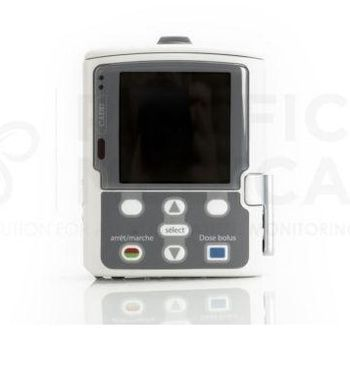
Smiths Medical CADD-Solis
 Smiths Medical · Model CADD-Solis
Small and lightweight pump that promotes clinician convenience. Programmed Intermittent Bolus - PIB delivery improves patient satisfaction, decreases drug use and reduces unplanned clinician interventions by reducing failed blocks and motor block. Innovative therapies and task based menus - Therapy based protocol library reduce the risk of adverse drug events and promote best practices. CADD®-Solis is the only pump to combine PIB and PCA. The intuitive task based software and therapy-based drug protocol library is familiar to users, promoting usability and safety. Scalable platform - Designed to satisfy hospital’s current and future clinical requirements and health information technology initiatives. Unique architecture provides flexibility to sustain your vision for future IT infrastructure to support best practices and enable continuous quality improvements. User-friendly interface - Simple, intuitive programming and confirmations screens enables quick training. Large color-coded screen displays infusion settings at all times. Visual indicators and alarms are differentiated by color and sound making it easier to identify alarms and interpret therapy trends and patient activity. Graphical Reports - On-screen graphs and trend reports provide delivery history for quick assessment to promote immediate patient care management. Safety Software - Administrator reduces the risk of medication delivery errors, improves patient safety, and increase clinician confidence and productivity. The Administrator software allows pharmacists to enter and store custom therapy-based protocols, drug names, concentrations and dosing limits for standardized programming downloads to CADD®-Solis pumps. The software is designed to safely and effectively program and collect data from the CADD®-Solis Ambulatory Infusion pump. CADD® Medication Cassette Reservoirs and CADD® Administration Sets - Contain or connect to medication, fit securely on the pump, keep drugs safe and provide free-flow protection.
Key tips
- ·Free-flow protection must be verified on every PM - a failed anti-free-flow clamp is a direct overdose risk.
- ·Test occlusion alarms in both directions - failing to alarm when it should is more dangerous than a false alarm.
- ·Battery run-time complaints are the most common real-world nuisance call - a full charge/discharge cycle test catches most of them.
Typical Failure Modes
Compiled for this model from its own documentation and established engineering knowledge for this equipment class - not from a verified service record. Confirm against the manufacturer's service manual.
Failure / error message
HighSymptoms: The pump alarms and displays an error message / code and stops delivery.
Root cause: A subsystem fault indexed in the service manual - motor / drive, a sensor, set-detection, or a board.
Occlusion alarm / pressure fault
MediumSymptoms: Repeated occlusion alarms, delivery stops, or an occlusion is missed.
Root cause: Kinked or clamped line, a closed roller clamp, a positional patient IV, a pressure-sensor drift, or an improperly loaded set.
Air-in-line alarm
MediumSymptoms: Frequent air-in-line alarms, delivery stops.
Root cause: Air in the set, an improperly loaded set, or an ultrasonic air-detector fault.
Flow-rate accuracy drift
MediumSymptoms: Delivered volume outside tolerance on the annual test, especially at low rates.
Root cause: Worn pumping mechanism / plunger drive, or (syringe pumps) a worn plunger grip / drive train.
Battery will not hold charge
MediumSymptoms: Short run time, low-battery early.
Root cause: Aged battery pack.
Serviceable Parts & Consumables
Serviceable items for this model, compiled from its documentation and engineering knowledge for this equipment class. Service class and relative cost are estimates, not manufacturer figures; no part numbers are given. Confirm intervals and pricing against the manufacturer.
Battery pack
Class Periodic replacementRel. cost $$R&R Fairly easy
Pumping mechanism / door assembly
Class Major service partRel. cost $$$R&R Difficult
Pressure / air-detector sensor assembly
Class Major service partRel. cost $$R&R Moderate
Drive train / motor
Class Major service partRel. cost $$$R&R Difficult
Administration / syringe set
Class ConsumableRel. cost $R&R Easy
| Part | Service class | Relative cost | R&R difficulty |
|---|---|---|---|
| Battery pack | Periodic replacement | $$ | Fairly easy |
| Pumping mechanism / door assembly | Major service part | $$$ | Difficult |
| Pressure / air-detector sensor assembly | Major service part | $$ | Moderate |
| Drive train / motor | Major service part | $$$ | Difficult |
| Administration / syringe set | Consumable | $ | Easy |
Relative cost: $ lowest · $$$$ highest service-part cost for this equipment class. Not a price.
PM Checklist
Preventive-maintenance tasks typical of this equipment class. Perform to the manufacturer's procedure and your facility's policy - this is general reference, not a schedule for this specific unit.
- ·Occlusion pressure and flow-rate accuracy verification
- ·Battery conditioning cycle
- ·Door latch and air-in-line sensor inspection
- ·Post-drop functional check before return to service
- ·Annual PM per manufacturer schedule
Troubleshooting Approach
A starting sequence for this model, compiled from its documentation and engineering knowledge for this equipment class. Follow the manufacturer's service documentation for the actual procedure.
Symptom: Error message / code
- Note the exact error message / code.
- Look it up in the pump's technical service manual troubleshooting section.
- Use the biomed diagnostics / utilities to test the affected subsystem.
- Follow the manual's parts-replacement procedure.
- Run the scheduled-maintenance test set (including flow accuracy) after any repair.
Symptom: Occlusion / air-in-line alarm
- Check the line for kinks, clamps and a closed roller clamp; check the patient IV site.
- Reload the set correctly, clearing all air.
- Confirm an approved set for this pump.
- Run the pressure / air-detector test in diagnostics.
- Replace the set; refer the pump if a sensor fault is indicated.
Technical Specs
- Height
- 5 in
- Length
- 4 in
- Weight
- 1.31 lbs
- Flow Accuracy
- 6 %
- Infusion Pump Type
- Ambulatory
- Width
- 1.6 in
Typical Location
Where this class of equipment is typically deployed - general reference, not this unit's own placement record.
- Patient care floors
- ICU
- OR
- Oncology / infusion centers
- Home health (portable pumps)
Documents & Manuals
Safety & Recalls
Synced live from the FDA openFDA API.
- RECALL
Pumps may experience Wireless Connection Modules intermittent connection alarms, which will interrupt an active infusion. Interruption or delay of therapy can lead to serious patient injury or death.
- RECALL
Affected pumps may trigger an erroneous (false) Upstream Occlusion Alarm under certain conditions, which will interrupt an active infusion. Interruption or delay of therapy can lead to serious patient injury or death.
- RECALL
There is a potential for thermal damage in CADD-Solis and CADD- Solis VIP infusion pumps.
- RECALL
Damage to the battery pack may have caused a short to a capacitor within the battery pack. While the battery encasement is designed to be flame retardant, a short to the capacitor could lead to melting of the battery pack case. If this issue occurs, the battery pack charging circuit may become inoperable.
- RECALL
The adapter input plug can become damaged or broken. If the input plug is damaged, the metal contacts to the body of the AC adapter may be exposed or one or more of the AC mains prongs may separate from the input plug.
- RECALL
CADD-Solis Ambulatory Infusion Pumps, with software versions before v4.3, may have the following issues:1. Upstream Occlusion, 2. Stop and Power Keys Unresponsive, 3. Manual Mode Air Detector, 4. Single Bubble Air Detection, 5. Error Codes Not Displayed at Power Up, 6. Audible Alarm, 7. Low Sensitivity Air in Line Detection Threshold, 8. PharmGuard Server Password. Smiths Medical corrected many of the issues included in this notification in previous software updates and the corrections were carried forward into all subsequent software releases. Please ensure you have the most recent CADD software (v4.3 - 2023) installed on your pumps.
- RECALL
Specific Pumps may exhibit intermittent performance in the AILD (Air in Line Detector) function. If an AILD does not sufficiently discern fluid from air in line, an air in line event may not be recognized by the pump and may not alarm to notify the clinician.
- RECALL
20 Pumps sold to the Finnish market contain a message in which one word in the message is mistranslated. When the user follows a specific set of key presses the pump will display the incorrect message. The message indicates that a Patient Controlled Analgesia (PCA) dose is unavailable because the pump is running. It should indicate that the PCA dose is not available because the pump is stopped. The function of the pump is unchanged and no patient injury can occur since no drug is being delivered.
- RECALL
Smiths Medical has become aware of an issue with an intermittent occurrence of binding of the locking assembly on some CADD-Solis pumps. Binding of the Cassette/ Keypad Lock can occur after latching the CADD-Solis Medication Cassette Reservoir or Administration Set disposable to the pump. When binding occurs, it can prevent the key from fully rotating the Cassette/ Keypad Lock to the locked (e
- RECALL
Reports of non-delivery/ significant under-delivery of fluids when the CADD Medication Cassette Reservoir is not correctly latched to the pump. EXPANDED: On 7/14/11, Smith Medical expanded this recall to include all consignees with affected pumps.
- RECALL
Reports of the Cassette Lock mechanism on certain CADD-Solis Pumps becoming stuck in the locked position, making it nearly impossible to remove the medication cassette reservoirs (or administration set). The purpose of the Cassette Lock is to secure the medication cassette reservoir (or administration set) to the pump.
- RECALL
Potential for the power cord's prongs to crack and fail at/or inside the plug. Other medical device manufacturers have reported incidents of sparking, charring, and fires from the affected power cords used with their devices. Smiths Medical has received no reports of incidents regarding the use of the affected Electri-Cord power cords with their devices.
Related calculators
From BioLab, for work done with this kind of equipment.
Troubleshoot this device with Bio
Describe a symptom or error code. Bio answers from this device's own documented error codes, failure modes, parts, and guides.
Ask Bio