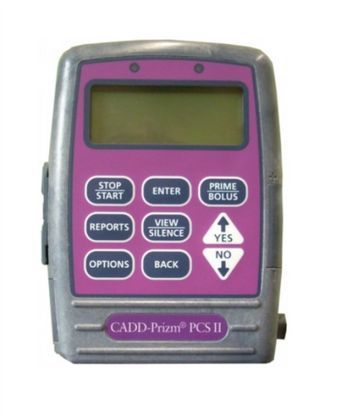
Smiths Medical CADD Prism PCS II
 Smiths Medical · Model CADD Prism PCS II
Enhance patient satisfaction and clinical outcomes for your epidural, PCEA, nerve block and I.V. PCA patients. With the pain scale integrated into the pump, the patient's current pain level can at any time be easily entered, either by the patient or the clinician. The pump stores the input in a special report. When desired, the entire pain process can be directly called up and displayed on the pump, and the pain therapy, if necessary, can immediately be changed to adapt to the patient's changing pain conditions. With a titration spectrum fixed (+/- 1 - 300%), the accurate adaptation of the therapy can be accomplished quickly and more easily.
Key tips
- ·Free-flow protection must be verified on every PM - a failed anti-free-flow clamp is a direct overdose risk.
- ·Test occlusion alarms in both directions - failing to alarm when it should is more dangerous than a false alarm.
- ·Battery run-time complaints are the most common real-world nuisance call - a full charge/discharge cycle test catches most of them.
Typical Failure Modes
Compiled for this model from its own documentation and established engineering knowledge for this equipment class - not from a verified service record. Confirm against the manufacturer's service manual.
Failure / error message stops delivery
HighSymptoms: The pump alarms and displays an error message / code and stops.
Root cause: A subsystem fault indexed in the service manual - motor / drive, a sensor, set-detection, or a board.
Occlusion alarm / pressure fault
MediumSymptoms: Repeated occlusion alarms, delivery stops, or an occlusion is missed.
Root cause: Kinked or clamped line, a closed roller clamp, a positional patient tube, pressure-sensor drift, or an improperly loaded set.
Air-in-line alarm
MediumSymptoms: Frequent air-in-line alarms, delivery stops.
Root cause: Air in the set, an improperly loaded set, or an ultrasonic air-detector fault.
Flow-rate accuracy drift
MediumSymptoms: Delivered volume outside tolerance on the annual test, especially at low rates.
Root cause: Worn pumping mechanism / plunger drive.
Battery will not hold charge
MediumSymptoms: Short run time, low-battery early after a full charge.
Root cause: Aged battery pack.
Door / plunger / sensor mechanical wear
LowSymptoms: Set will not load, door will not latch, plunger grip poor.
Root cause: Worn door latch, plunger jaws, or anti-free-flow mechanism.
Serviceable Parts & Consumables
Serviceable items for this model, compiled from its documentation and engineering knowledge for this equipment class. Service class and relative cost are estimates, not manufacturer figures; no part numbers are given. Confirm intervals and pricing against the manufacturer.
Battery pack
Class Periodic replacementRel. cost $$R&R Fairly easy
Pumping mechanism / rotor / plunger drive
Class Major service partRel. cost $$$R&R Difficult
Pressure / air-detector sensor assembly
Class Major service partRel. cost $$R&R Moderate
Door / latch / anti-free-flow assembly
Class Major service partRel. cost $$R&R Moderate
Drive motor / gearbox
Class Major service partRel. cost $$$R&R Difficult
| Part | Service class | Relative cost | R&R difficulty |
|---|---|---|---|
| Battery pack | Periodic replacement | $$ | Fairly easy |
| Pumping mechanism / rotor / plunger drive | Major service part | $$$ | Difficult |
| Pressure / air-detector sensor assembly | Major service part | $$ | Moderate |
| Door / latch / anti-free-flow assembly | Major service part | $$ | Moderate |
| Drive motor / gearbox | Major service part | $$$ | Difficult |
Relative cost: $ lowest · $$$$ highest service-part cost for this equipment class. Not a price.
PM Checklist
Preventive-maintenance tasks typical of this equipment class. Perform to the manufacturer's procedure and your facility's policy - this is general reference, not a schedule for this specific unit.
- ·Occlusion pressure and flow-rate accuracy verification
- ·Battery conditioning cycle
- ·Door latch and air-in-line sensor inspection
- ·Post-drop functional check before return to service
- ·Annual PM per manufacturer schedule
Troubleshooting Approach
A starting sequence for this model, compiled from its documentation and engineering knowledge for this equipment class. Follow the manufacturer's service documentation for the actual procedure.
Symptom: Alarm with an error message / code, delivery stopped
- Note the exact error message or code from the display.
- Look it up in the pump's technical service manual troubleshooting section.
- Run the biomed diagnostics / service utilities to exercise the named subsystem (motor / drive, a sensor, set-detection, a board).
- Follow the manual's parts-replacement procedure for that fault.
- Run the full scheduled-maintenance test set, including a flow-accuracy check, after any repair.
Symptom: Occlusion alarm / pressure fault (or a missed occlusion)
- Check the line for kinks, closed clamps and a closed roller clamp; check the patient site and cannula.
- Reload the administration set correctly, clearing all air.
- Confirm the set is an approved type for this pump.
- Run the pressure-sensor / force-sensor test in the service menu.
- Replace the set; refer the pump if the pressure sensor or pumping mechanism is indicated.
Symptom: Air-in-line alarm / free-flow or feed not delivering
- Prime the set fully and reload it; tap out micro-bubbles at the drip chamber.
- Confirm the set seats correctly against the air-in-line detector / rotor.
- Clean the ultrasonic air-detector window.
- Run the air-detector (or rotor / cassette) test in diagnostics.
- Replace a worn pumping mechanism / anti-free-flow assembly if flow accuracy or detection is out.
Symptom: Battery will not hold charge / short run time
- Fully charge, then run a battery run-down / capacity test in the service menu.
- Check the charging circuit and contacts.
- Replace the battery pack when capacity is below the service limit.
- Recalibrate the battery gauge if the pump supports it.
- Confirm run time meets spec after replacement.
Typical Location
Where this class of equipment is typically deployed - general reference, not this unit's own placement record.
- Patient care floors
- ICU
- OR
- Oncology / infusion centers
- Home health (portable pumps)
Documents & Manuals
Safety & Recalls
Synced live from the FDA openFDA API.
- RECALL
Certain CADD Medication Cassette Reservoirs may exhibit a weakened weld joint between the medication bag and tubing due to a production equipment malfunction. This could result in a medication leakage.
- RECALL
There are two potential issues with CADD Infusion System Infusion Sets: (1) Lack of Delivery or Underdelivery related to Tubing Occlusion and (2) False "No Disposable Attached (NDA)" Alarms
- RECALL
Product may have been manufactured with an air filter assembled in an incorrect orientation.
- RECALL
The medication cassette reservoir, part number 21-7002-24, with lot number 16X659, may have been manufactured with the incorrect pressure plate and the tubing used on the cassette may have been routed incorrectly.
- RECALL
Smiths Medical has become aware that the drawing on the Instructions for Use (IFU) on certain yellow striped CADD Administration Sets (part number 21-7339-24), incorrectly represent the actual filter size of the product. Although the text description on the IFU correctly identifies the product to include a 0.2 micron filter, the illustration on the IFU identifies the filter size as 2.0 microns.
- RECALL
The label of the CADD Blue-Striped Administrative Set is missing the expiration date, which is considered a regulatory compliance issue for Canada.
- RECALL
Smiths Medical determined that a single custom Tracheostomy device had been shipped to the customer without required sterilization.
- RECALL
Smiths Medical became aware that under delivery of medication may occur on CADD Administration Sets with Flow Stop.
- RECALL
Smiths Medical has become aware of an issue with specific lots of 50mL CADD" Medication Cassette Reservoirs (Cassette). Some Cassettes may leak at the sealing area of the pump tube and medication bag. Smiths Medical has received no reports of serious injury or death related to this issue.
- RECALL
Smith Medical has become aware of a small number of customer reports regarding occlusions/high pressure alarms with the use of one lot of CADD High Volume Administration Sets. EXPANDED: Smiths Medical became aware that an additional Product Reorder No. 21-738-01 and Lot No. 21X221 are also being recalled for receiving reports regarding occlusion/high pressure alarms with the use of these set
- RECALL
Smiths Medical discovered an issue with a motor component in specific serial numbers of the CADD-MS 3 Ambulatory Infusion Pump. This issue affects motor operation and may cause an over-delivery of medication which could result in injury to the user.
- RECALL
Smiths Medical has received reports that the device powers down without an alarm. Investigation concluded that if the battery cap is not fully tightened, the pump may power down and a brief "chirp" will sound. This may occur if the user has not sufficiently tightened the battery cap or if the battery cap is damaged. If a patient is asleep or does not regularly check their Pump, there is a potentia
- RECALL
Leakage associated with the CADD Medication Cassette Reservoirs for use with the CADD Ambulatory Infusion Pumps
- RECALL
Incorrect dosage possible: A software anomaly in the CADD-Sentry Pro Administrator software (version B) where the values of a weight based protocol go to zero or round up to the next higher hundredths place, even if Administrator displayed the values correctly at data entry.
- RECALL
The year of manufacture had been incorrectly entered as 1980 into the pumps software during the manufacture process. As a result the pump may go into an immediate 'Clock battery is Low/Service Immediately' or 'Clock Battery needs service soon' alarm message indicating that the pump requires servicing.
Related calculators
From BioLab, for work done with this kind of equipment.
Troubleshoot this device with Bio
Describe a symptom or error code. Bio answers from this device's own documented error codes, failure modes, parts, and guides.
Ask Bio