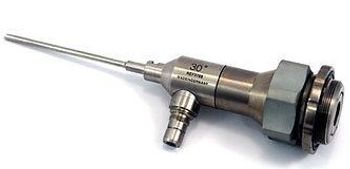
Smith and Nephew Non-Autoclavable Arthroscope
Smith and Nephew · Model Non-Autoclavable Arthroscope
Stainless steel construction to withstand chemical sterilization modalities (EtO and SterradTM). Wide angle of view. Ergonomically designed to directly attach to the camera head for ease of use and reduce the number of interface where fogging could occur. Insertion needle is fully rotatable without the need to reposition the camera head. Compatible with Smith & Nephew Non-Autoclavable Camera Heads (C-Mount).
Key tips
- ·A failed leak test means the scope does not get reprocessed or used - send it for repair, full stop.
- ·A shortened reprocessing cycle is a real infection-control failure, not a minor deviation - follow AAMI ST91 exactly.
- ·Track light-source lamp-hours against the manufacturer's limit rather than running to failure.
Typical Failure Modes
Compiled for this model from its own documentation and established engineering knowledge for this equipment class - not from a verified service record. Confirm against the manufacturer's service manual.
Poor or dark image
HighSymptoms: Dim, yellow, hazy or halved image; reduced field of view.
Root cause: Broken rod-lens elements, broken light-post fibres, or moisture / debris between the lenses (seal failure).
Fluid ingress / autoclave-seal failure
HighSymptoms: Fogging inside the scope, fluid droplets in the view, fails a vacuum-leak test.
Root cause: Failed hermetic seals - the scope is no longer watertight.
Bent / dented shaft
MediumSymptoms: Distorted image, will not pass a trocar, visible bend.
Root cause: Mechanical damage from a drop or crush.
Light-post / cable-fitting fault
MediumSymptoms: Very dim illumination, loose light-cable fitting.
Root cause: Broken light-post fibres or a worn light-post thread / adapter.
Distal / objective lens damage
MediumSymptoms: Scratch or chip in the image, persistent spot.
Root cause: Objective-lens surface damage.
Serviceable Parts & Consumables
Serviceable items for this model, compiled from its documentation and engineering knowledge for this equipment class. Service class and relative cost are estimates, not manufacturer figures; no part numbers are given. Confirm intervals and pricing against the manufacturer.
Rod-lens system repair (OEM / 3rd-party)
Rod-lens and seal work is a workshop repair, not a field fix.
Class Periodic replacementRel. cost $$$$R&R Expert-level
Light-post fibre bundle
Class Periodic replacementRel. cost $$$R&R Difficult
Hermetic seals
Class Periodic replacementRel. cost $$$R&R Difficult
Objective / eyepiece lens
Class Periodic replacementRel. cost $$$R&R Difficult
| Part | Service class | Relative cost | R&R difficulty |
|---|---|---|---|
| Rod-lens system repair (OEM / 3rd-party) Rod-lens and seal work is a workshop repair, not a field fix. | Periodic replacement | $$$$ | Expert-level |
| Light-post fibre bundle | Periodic replacement | $$$ | Difficult |
| Hermetic seals | Periodic replacement | $$$ | Difficult |
| Objective / eyepiece lens | Periodic replacement | $$$ | Difficult |
Relative cost: $ lowest · $$$$ highest service-part cost for this equipment class. Not a price.
PM Checklist
Preventive-maintenance tasks typical of this equipment class. Perform to the manufacturer's procedure and your facility's policy - this is general reference, not a schedule for this specific unit.
- ·Leak testing before each reprocessing cycle
- ·Scope reprocessing per AAMI ST91
- ·Light source lamp-hour tracking
- ·Annual full PM
Troubleshooting Approach
A starting sequence for this model, compiled from its documentation and engineering knowledge for this equipment class. Follow the manufacturer's service documentation for the actual procedure.
Symptom: Poor or dark image
- Confirm the light source, cable and camera with a known-good scope.
- Hold the scope to a light and look through it - assess brightness, colour and clarity.
- Check the light post fibres against a bright light for dark patches.
- Look for internal fogging / droplets (seal failure).
- Send for a rod-lens / seal / light-post repair - quarantine a scope that fails a leak test.
Symptom: Fails a leak / vacuum test
- Repeat the leak test to confirm.
- Do not reprocess or soak a leaking rigid scope.
- Tag and quarantine it.
- Send for seal replacement and pressure testing.
- Re-test and re-inspect the image after repair.
Typical Location
Where this class of equipment is typically deployed - general reference, not this unit's own placement record.
- Endoscopy suite / GI lab
- Operating Room
- Bronchoscopy suite
Documents & Manuals
No documents available for this device yet.
Safety & Recalls
Synced live from the FDA openFDA API.
- RECALL
Sterile barrier breach due to inadequate packaging design that could not hold the geometry of the device.
- RECALL
The product was mispackaged (swapped). The devices within the inner tray matches the inner tray but does not match the outer box label and the chart sticks.
- RECALL
The 4.5MM PeriLoc Targeter right hand part was anodized green and was marked as a left-hand part.
- RECALL
Devices, incorrectly labeled as a VLP MINI-MOD 2.0MM STRAIGHT PLATE 8 HOLE, contained a VLP MINI-MOD 2.0MM STOUT PLATE 8 HOLE and vice versa
- RECALL
One lot of EVOS 2.4MM Flex Plate 6 Hole packaging contained templates.
- RECALL
Two lots of Genesis II Non Porous C/R Femoral Size 6 right packaged were distributed containing Genesis II C/R Femoral Size 4 left.
- RECALL
The Cardan joint of the Polarstem Cardan could potentially fracture or functionally fail after multiple procedures.
- RECALL
This lot of left plates were laser etched and packaged as right plates.
- RECALL
The firm received complaints of cracks in the weld on the head of the mallet. In the reported cases, some of the lead beads and particles escaped from the mallet into the surgical wound.
- RECALL
All lots of modular neck hip prostheses are being recalled due to a higher than anticipated complaint and adverse event trend.
- RECALL
Swapped product. Non-porous tibial base size 5 L was mis-packaged as size 6 R and vice versa.
- RECALL
The products were produced using the wrong color material, resulting in the devices being red (used for deep dished inserts) instead of blue (used for cruciate retaining inserts).
- RECALL
HD1200 camera heads may cause image issues
- RECALL
Shaft tip (casting) does not meet the SNE 416 specification, which could result in rusting of the Tendon Strippers
- RECALL
Smith & Nephew, Inc., St. Petersburg, FL is recalling multiple lot numbers of the following products: REMOVE Universal Adhesive Remover Wipes, UNI-SOLVE Adhesive Remover Wipes, SKIN-PREP Protective Wipes, PERI-PREP Protective Wipes, and NO-STING SKIN-PREP Protective Wipes. These products were manufactured by H&P Industries dba The Triad Group who has initiated a recall of products manufactured i
- RECALL
During the manufacturing process for several batches of R3 Ceramic Liners, the titanium rings were pressed onto the ceramic component with a higher force than allowed by manufacturing specifications. This has the potential to result in lower than expected strength for the liners.
- RECALL
Markings for the drill guides are on the incorrect side: left is printed on right side and right is printed on the left side
- RECALL
Problems with transducer may result in a reduced ultrasound output.
- RECALL
The product was breaking during use.
- RECALL
Drill does not contain laser etched depth marks to assure proper depth of inserted device
- RECALL
Endocouplers assembled with screws that cannot be effectively sterilized
Troubleshoot this device with Bio
Describe a symptom or error code. Bio answers from this device's own documented error codes, failure modes, parts, and guides.
Ask Bio