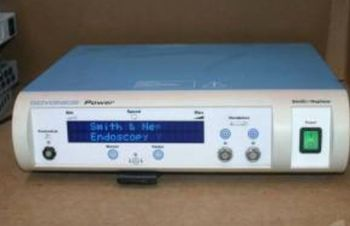
Smith and Nephew Dyonics Power Instrument Control Unit
Smith and Nephew · Model Dyonics Power Instrument Control Unit
Lighter cord than our standard MDU for better balance. Same power and torque compared to our standard MDU. Runs blades and burrs between 100 and 5000 rpm's. The DYONICS POWER UltraLight MDU will power all DYONICS POWER straight blades, burrs and Ultra Series curved blades. The UltraLight handpiece will not operate standard DYONICS POWER curved blades.
Key tips
- ·Never defeat or bypass a return-electrode monitoring (REM) alarm to finish a case - it's a direct burn risk.
- ·Verify OR table battery backup - a table that loses power mid-procedure is a real, documented incident type.
- ·Track surgical light lamp-hours rather than waiting for failure - a sudden failure mid-case is avoidable.
Typical Failure Modes
Compiled for this model from its own documentation and established engineering knowledge for this equipment class - not from a verified service record. Confirm against the manufacturer's service manual.
Will not power on or unexpected shutdown
HighSymptoms: The surgical & or is dead, reboots, or shuts down mid-use.
Root cause: Mains lead / fuse, an aged battery, or a power-supply board fault.
Battery will not hold charge
MediumSymptoms: Short run time on battery; low-battery alarm soon after a full charge.
Root cause: Aged rechargeable battery pack or a charger fault.
Display / control-panel fault
MediumSymptoms: Blank, dim or distorted display; unresponsive keys or touchscreen.
Root cause: Display, backlight, or control-board fault.
Fails self-test or calibration
MediumSymptoms: Power-on self-test or the scheduled performance check fails or is out of tolerance.
Root cause: Sensor drift or an internal board fault; recalibration or repair needed.
Serviceable Parts & Consumables
Serviceable items for this model, compiled from its documentation and engineering knowledge for this equipment class. Service class and relative cost are estimates, not manufacturer figures; no part numbers are given. Confirm intervals and pricing against the manufacturer.
Rechargeable battery pack
Class Periodic replacementRel. cost $$R&R Fairly easy
Power supply / mains board
Class Major service partRel. cost $$$R&R Difficult
Display / control-panel assembly
Class Major service partRel. cost $$$R&R Moderate
Cooling fan
Class Major service partRel. cost $R&R Moderate
| Part | Service class | Relative cost | R&R difficulty |
|---|---|---|---|
| Rechargeable battery pack | Periodic replacement | $$ | Fairly easy |
| Power supply / mains board | Major service part | $$$ | Difficult |
| Display / control-panel assembly | Major service part | $$$ | Moderate |
| Cooling fan | Major service part | $ | Moderate |
Relative cost: $ lowest · $$$$ highest service-part cost for this equipment class. Not a price.
PM Checklist
Preventive-maintenance tasks typical of this equipment class. Perform to the manufacturer's procedure and your facility's policy - this is general reference, not a schedule for this specific unit.
- ·Pre-case functional check
- ·Electrosurgical return-electrode cable inspection
- ·Table hydraulic / mechanical inspection
- ·Annual electrical safety test and full PM
Troubleshooting Approach
A starting sequence for this model, compiled from its documentation and engineering knowledge for this equipment class. Follow the manufacturer's service documentation for the actual procedure.
Symptom: Will not power on
- Confirm the outlet, mains lead and fuse.
- Try on battery, then on mains only, to isolate the supply.
- Look for a power indicator or POST code.
- Replace the fuse / battery / power supply as isolated.
- Run the self-test after any repair.
Symptom: Fails self-test or calibration
- Note the exact failure message / code.
- Power-cycle and repeat the self-test.
- Verify against a reference / simulator where one applies.
- Recalibrate per the service manual.
- Refer the affected board for service if it will not hold calibration.
Typical Location
Where this class of equipment is typically deployed - general reference, not this unit's own placement record.
- Operating rooms
- Procedure rooms
- Interventional suites
Documents & Manuals
Safety & Recalls
Synced live from the FDA openFDA API.
- RECALL
Potential for the NAVIO Soft Tissue Protector to become stuck or bound to the bone pin intraoperatively when inserting the NAVIO bone pins.
- RECALL
The spike rail was manufactured with an oversized thru-hole which could potentially cause the dowel pin to fall out and the device to disassemble.
- RECALL
There is a a potential failure mode associated with the use of the mallet, wherein the poly tip of the mallet may become loose and/or come off during use. If the potential failure mode occurs, particles generated in the poly thread potentially could enter the surgical field or a delay in surgery could occur if the tip disengages during the use of the mallet.
- RECALL
Higher than anticipated occurrence of bone fracture during the use of the XR Tibia Posterior Punch
- RECALL
One lot of the Legion AP femoral cutting block, size 6, was manufactured with an oversized spring.
- RECALL
The Cardan joint of the Polarstem Cardan could potentially fracture or functionally fail after multiple procedures.
- RECALL
Blade exhibiting fracture during hip arthroscopy procedures
- RECALL
Driver does not meet specification, oversized. Driver may not be able to be fully inserted into the screw, or screw may become stuck on the driver.
- RECALL
May experience intermittent loss of video due to a defective board component
- RECALL
Shaft tip (casting) does not meet the SNE 416 specification, which could result in rusting of the Tendon Strippers
- RECALL
Hip Arthroscopy Repair Instrument Tray shipped with an incorrect Instructions For Use (IFU)
- RECALL
Markings for the drill guides are on the incorrect side: left is printed on right side and right is printed on the left side
- RECALL
The product was breaking during use.
- RECALL
External battery chargers used with the Version 29 VISTA Negative Pressure Wound Therapy pumps are failing to properly charge the pump's battery.
- RECALL
Integrity of the remote control bag may not be sufficient to prevent tearing or opening of the bag during use.
- RECALL
Surgical camera control units were not designed and manufactured to pass the IEC 60101 testing for electrical fast transients (EFT)
- RECALL
Hardware of the camera coupler may rust and result in an ineffective sterilization/cleaning process.
- RECALL
Product may not meet the established stability specification before the end of labeled expiry date.
Troubleshoot this device with Bio
Describe a symptom or error code. Bio answers from this device's own documented error codes, failure modes, parts, and guides.
Ask Bio