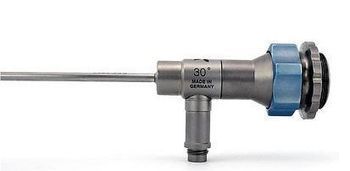
Smith and Nephew Dyonics Autoclavable Video Arthroscope
Smith and Nephew · Model Dyonics Autoclavable Video Arthroscope
Wide-angle lens design for a larger field-of-view. Unparalleled brightness. Sharp images throughout the entire field-of-view. Lightweight construction. Sapphire lenses for improved scratch resistance compared to conventional glass. Compatible with Smith & Nephew autoclavable and non-autoclavable Camera Heads. Validated for both steam and chemical (EtO and SterradTM) sterilization modalities.
Key tips
- ·A failed leak test means the scope does not get reprocessed or used - send it for repair, full stop.
- ·A shortened reprocessing cycle is a real infection-control failure, not a minor deviation - follow AAMI ST91 exactly.
- ·Track light-source lamp-hours against the manufacturer's limit rather than running to failure.
Typical Failure Modes
Compiled for this model from its own documentation and established engineering knowledge for this equipment class - not from a verified service record. Confirm against the manufacturer's service manual.
Poor or dark image
HighSymptoms: Dim, yellow, hazy or halved image; reduced field of view.
Root cause: Broken rod-lens elements, broken light-post fibres, or moisture / debris between the lenses (seal failure).
Fluid ingress / autoclave-seal failure
HighSymptoms: Fogging inside the scope, fluid droplets in the view, fails a vacuum-leak test.
Root cause: Failed hermetic seals - the scope is no longer watertight.
Bent / dented shaft
MediumSymptoms: Distorted image, will not pass a trocar, visible bend.
Root cause: Mechanical damage from a drop or crush.
Light-post / cable-fitting fault
MediumSymptoms: Very dim illumination, loose light-cable fitting.
Root cause: Broken light-post fibres or a worn light-post thread / adapter.
Distal / objective lens damage
MediumSymptoms: Scratch or chip in the image, persistent spot.
Root cause: Objective-lens surface damage.
Serviceable Parts & Consumables
Serviceable items for this model, compiled from its documentation and engineering knowledge for this equipment class. Service class and relative cost are estimates, not manufacturer figures; no part numbers are given. Confirm intervals and pricing against the manufacturer.
Rod-lens system repair (OEM / 3rd-party)
Rod-lens and seal work is a workshop repair, not a field fix.
Class Periodic replacementRel. cost $$$$R&R Expert-level
Light-post fibre bundle
Class Periodic replacementRel. cost $$$R&R Difficult
Hermetic seals
Class Periodic replacementRel. cost $$$R&R Difficult
Objective / eyepiece lens
Class Periodic replacementRel. cost $$$R&R Difficult
| Part | Service class | Relative cost | R&R difficulty |
|---|---|---|---|
| Rod-lens system repair (OEM / 3rd-party) Rod-lens and seal work is a workshop repair, not a field fix. | Periodic replacement | $$$$ | Expert-level |
| Light-post fibre bundle | Periodic replacement | $$$ | Difficult |
| Hermetic seals | Periodic replacement | $$$ | Difficult |
| Objective / eyepiece lens | Periodic replacement | $$$ | Difficult |
Relative cost: $ lowest · $$$$ highest service-part cost for this equipment class. Not a price.
PM Checklist
Preventive-maintenance tasks typical of this equipment class. Perform to the manufacturer's procedure and your facility's policy - this is general reference, not a schedule for this specific unit.
- ·Leak testing before each reprocessing cycle
- ·Scope reprocessing per AAMI ST91
- ·Light source lamp-hour tracking
- ·Annual full PM
Troubleshooting Approach
A starting sequence for this model, compiled from its documentation and engineering knowledge for this equipment class. Follow the manufacturer's service documentation for the actual procedure.
Symptom: Poor or dark image
- Confirm the light source, cable and camera with a known-good scope.
- Hold the scope to a light and look through it - assess brightness, colour and clarity.
- Check the light post fibres against a bright light for dark patches.
- Look for internal fogging / droplets (seal failure).
- Send for a rod-lens / seal / light-post repair - quarantine a scope that fails a leak test.
Symptom: Fails a leak / vacuum test
- Repeat the leak test to confirm.
- Do not reprocess or soak a leaking rigid scope.
- Tag and quarantine it.
- Send for seal replacement and pressure testing.
- Re-test and re-inspect the image after repair.
Typical Location
Where this class of equipment is typically deployed - general reference, not this unit's own placement record.
- Endoscopy suite / GI lab
- Operating Room
- Bronchoscopy suite
Documents & Manuals
No documents available for this device yet.
Safety & Recalls
Synced live from the FDA openFDA API.
- RECALL
The single use devices are provided sterile and do not have an expiration date on the label.
- RECALL
Devices labeled with an expiry period of 48 months instead of 36 months; an additional 12 months for which product and package reliability has not been validated.
- RECALL
May experience intermittent loss of video due to a defective board component
- RECALL
Manufacturing issue: The distal tip of the outer sheath (return electrode) may detach and become loose in the joint during use.
- RECALL
HD1200 camera heads may cause image issues
- RECALL
The sterility of the device cannot be assured
- RECALL
Sterility seal of the package tray may have gaps/voids compromising the sterility of the device.
- RECALL
Endocouplers assembled with screws that cannot be effectively sterilized
Troubleshoot this device with Bio
Describe a symptom or error code. Bio answers from this device's own documented error codes, failure modes, parts, and guides.
Ask Bio