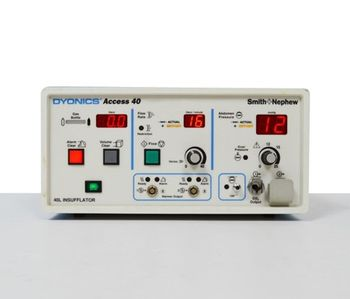
Smith and Nephew Dyonics Access 40
Smith and Nephew · Model Dyonics Access 40
Fast, reliable insufflation. For fast, reliable insufflation, choose the Dyonics Access 40L Insufflator which offers a unique method"using the MP* line, to monitor intra-abdominalpressure. With T AP*, Access 40 continuously calculatesand measuresabdominal pressurern4rilethe system is pumping, so you can rely on a faster responsein the event of leaking during surgery. Access 40's other high performance features include two CO2 outputs that each pump 20 liters per minute, saving insufflation time. The systemcanbeusedwith or without heatfor flexibility in settingoptimalconditionsfor thepatient; heatreducesrecovery time by lowering the risk of hypothermia during laparoscopy. An optional, reusablein-line gaswarmer and disposabletubing make Access40 more cost-effectivethan other systems.
Key tips
- ·A failed leak test means the scope does not get reprocessed or used - send it for repair, full stop.
- ·A shortened reprocessing cycle is a real infection-control failure, not a minor deviation - follow AAMI ST91 exactly.
- ·Track light-source lamp-hours against the manufacturer's limit rather than running to failure.
Typical Failure Modes
Compiled for this model from its own documentation and established engineering knowledge for this equipment class - not from a verified service record. Confirm against the manufacturer's service manual.
Will not reach or hold set intra-abdominal pressure
HighSymptoms: Pressure alarm, insufflation stops, cannot maintain pneumoperitoneum, high-flow alarm.
Root cause: CO2 supply low, a leak in the tubing / trocar, a solenoid / valve fault, or a pressure-sensor fault.
Poor video image
HighSymptoms: Noisy, dark, discoloured or out-of-focus image, dropouts, no image.
Root cause: Camera head / coupler fault, a camera-cable fault, or a CCU / video-processor fault.
White-balance / colour fault
MediumSymptoms: Cannot white-balance, persistent colour cast.
Root cause: Camera head sensor drift, a dirty coupler, or the light source colour temperature.
Gas heater fault (if fitted)
LowSymptoms: Gas delivered cold, heater alarm.
Root cause: Heating element or its sensor in the heated tubing / unit.
Output / connector fault
LowSymptoms: Signal only on one output, connector damage, HD/SDI dropout.
Root cause: Worn video output connector or an output board fault.
Serviceable Parts & Consumables
Serviceable items for this model, compiled from its documentation and engineering knowledge for this equipment class. Service class and relative cost are estimates, not manufacturer figures; no part numbers are given. Confirm intervals and pricing against the manufacturer.
Insufflator solenoid / valve block
Class Major service partRel. cost $$$R&R Difficult
Camera head / coupler
Class Periodic replacementRel. cost $$$R&R Moderate
Camera cable
Class Periodic replacementRel. cost $$R&R Fairly easy
Pressure-sensor / regulator assembly
Class Major service partRel. cost $$R&R Moderate
CCU / video-processor board
Class Major service partRel. cost $$$R&R Difficult
| Part | Service class | Relative cost | R&R difficulty |
|---|---|---|---|
| Insufflator solenoid / valve block | Major service part | $$$ | Difficult |
| Camera head / coupler | Periodic replacement | $$$ | Moderate |
| Camera cable | Periodic replacement | $$ | Fairly easy |
| Pressure-sensor / regulator assembly | Major service part | $$ | Moderate |
| CCU / video-processor board | Major service part | $$$ | Difficult |
Relative cost: $ lowest · $$$$ highest service-part cost for this equipment class. Not a price.
PM Checklist
Preventive-maintenance tasks typical of this equipment class. Perform to the manufacturer's procedure and your facility's policy - this is general reference, not a schedule for this specific unit.
- ·Leak testing before each reprocessing cycle
- ·Scope reprocessing per AAMI ST91
- ·Light source lamp-hour tracking
- ·Annual full PM
Troubleshooting Approach
A starting sequence for this model, compiled from its documentation and engineering knowledge for this equipment class. Follow the manufacturer's service documentation for the actual procedure.
Symptom: Will not hold set pressure
- Confirm the CO2 cylinder / supply is not empty and is at pressure.
- Leak-test the tubing set and all trocar / stopcock connections.
- Run the insufflator's self-test / calibration.
- Check the solenoid and pressure sensor per the service manual.
- Replace the tubing set; refer the valve block or sensor if the fault persists.
Symptom: Poor video image
- Clean and re-white-balance; inspect the scope lens / coupler.
- Swap the camera head and cable to isolate head vs CCU.
- Check the light cable and lamp hours.
- Try a second monitor / output cable.
- Replace the camera head or refer the CCU as isolated.
Typical Location
Where this class of equipment is typically deployed - general reference, not this unit's own placement record.
- Endoscopy suite / GI lab
- Operating Room
- Bronchoscopy suite
Documents & Manuals
Safety & Recalls
Synced live from the FDA openFDA API.
- RECALL
Products were shipped to the Global Distribution Center instead of the sterilizer and therefore product did not undergo the sterilization process
- RECALL
The J Lock feature on the cannula body was manufactured incorrectly, preventing the cannula from locking into an irrigation extender or arthroscope in the correct orientation.
Troubleshoot this device with Bio
Describe a symptom or error code. Bio answers from this device's own documented error codes, failure modes, parts, and guides.
Ask Bio