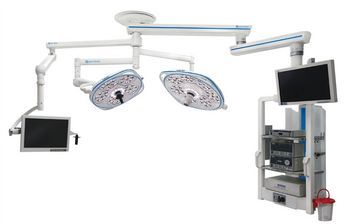
Skytron Ergon 3
 Skytron · Model Ergon 3
Exclusive Central Tandem Mount allows the positioning of the equipment carrier, flat-screen displays or lights anywhere around the patient Extensive arm reach provides greater equipment access Button-free, friction braking system reduces expensive maintenance requirements Center-aligned carriers minimize rotational footprint by 50%.
Key tips
- ·When no category-specific guidance fits, default to the manufacturer's own service manual and the general troubleshooting method in the Engineer's Guide.
- ·Run an incoming and annual electrical safety test regardless of how niche the device is.
Typical Failure Modes
Compiled for this model from its own documentation and established engineering knowledge for this equipment class - not from a verified service record. Confirm against the manufacturer's service manual.
Friction Brake Slippage Under Load
HighSymptoms: Boom arm descends or rotates unexpectedly when locked; equipment carrier shifts position during procedure
Root cause: Friction pad wear or contamination reducing clamping torque; brake adjustment out of specification
Central Tandem Mount Position Drift
MediumSymptoms: Equipment carrier not centered on boom axis; asymmetric reach or rotation resistance; displays/lights offset from patient
Root cause: Mounting bracket wear or misalignment; carrier rotation mechanism gear backlash; locking pin engagement issues
Arm Range Limitation Due to Friction Brake Engagement
MediumSymptoms: Boom arm movement restricted or stiff; cannot achieve full extension arc; audible dragging during rotation
Root cause: Friction brake system overly tight or pads contaminated with medical-grade lubricant residue; brake adjustment screw out of range
Central Carrier Rotational Footprint Exceeds Specification
LowSymptoms: Boom occupies more floor space than documented; carrier rotation interferes with adjacent equipment or walls
Root cause: Carrier not properly aligned on central axis; mounting hardware loosened; rotational stop mechanism damaged
Serviceable Parts & Consumables
Serviceable items for this model, compiled from its documentation and engineering knowledge for this equipment class. Service class and relative cost are estimates, not manufacturer figures; no part numbers are given. Confirm intervals and pricing against the manufacturer.
Friction Brake Assembly (pad set and adjustment mechanism)
Serviceable via pad replacement and torque adjustment; no full assembly replacement typically required
Class Periodic replacementRel. cost $$R&R Moderate
Central Tandem Mount Bracket and Locking Pins
Precision-machined brackets; alignment critical during reinstallation; carry spare pin set for field service
Class Major service partRel. cost $$$R&R Difficult
Arm Friction Adjustment Knob and Cable Assembly
User-adjustable friction tension; common adjustment point for brake slippage complaints
Class Periodic replacementRel. cost $R&R Fairly easy
Carrier Rotation Gear Set and Bearing
Internal gear set; failure manifests as binding or excessive play; requires OEM-level disassembly and alignment
Class Major service partRel. cost $$$R&R Expert-level
| Part | Service class | Relative cost | R&R difficulty |
|---|---|---|---|
| Friction Brake Assembly (pad set and adjustment mechanism) Serviceable via pad replacement and torque adjustment; no full assembly replacement typically required | Periodic replacement | $$ | Moderate |
| Central Tandem Mount Bracket and Locking Pins Precision-machined brackets; alignment critical during reinstallation; carry spare pin set for field service | Major service part | $$$ | Difficult |
| Arm Friction Adjustment Knob and Cable Assembly User-adjustable friction tension; common adjustment point for brake slippage complaints | Periodic replacement | $ | Fairly easy |
| Carrier Rotation Gear Set and Bearing Internal gear set; failure manifests as binding or excessive play; requires OEM-level disassembly and alignment | Major service part | $$$ | Expert-level |
Relative cost: $ lowest · $$$$ highest service-part cost for this equipment class. Not a price.
PM Checklist
Preventive-maintenance tasks typical of this equipment class. Perform to the manufacturer's procedure and your facility's policy - this is general reference, not a schedule for this specific unit.
- ·Follow the manufacturer's PM schedule
- ·Perform incoming and annual electrical safety testing per facility biomedical program
Troubleshooting Approach
A starting sequence for this model, compiled from its documentation and engineering knowledge for this equipment class. Follow the manufacturer's service documentation for the actual procedure.
Symptom: Boom arm descends or rotates when friction brake is engaged
- Release all carrier locks and verify brake adjustment knob is fully seated and not rotating freely
- Inspect friction pads for contamination, glazing, or residue; clean with approved medical degreaser if contaminated
- Adjust brake torque using manufacturer-specified procedure; verify pad contact pressure meets specification before returning to service
Symptom: Equipment carrier offset from center axis; asymmetric reach
- Visually inspect central tandem mount bracket alignment against boom axis; check for bent or worn mounting surfaces
- Verify locking pin engagement and carrier seat engagement on central axis; replace pins if worn or deformed
- Measure carrier rotation resistance; if uneven, inspect gear backlash and bearing condition; realign bracket per service manual tolerance
Typical Location
Where this class of equipment is typically deployed - general reference, not this unit's own placement record.
- Varies by device - check the unit's own manual for facility placement guidance
Documents & Manuals
- Ergon Mounting Pre-Installation Guide.pdfUser Manual · External
- Ergon 3 Brochure.pdfBrochure · External
- Ergon 3 100 Series Datasheet.pdfDocument · External
- Ergon 3 110 Series Datasheet.pdfDocument · External
- Ergon 3 120 Series Datasheet.pdfDocument · External
- Ergon 3 200 Series Datasheet.pdfDocument · External
- Ergon 3 300 Series Datasheet.pdfDocument · External
- Ergon 3 310 Series Datasheet.pdfDocument · External
- Ergon 3 320 Series Datasheet.pdfDocument · External
- Ergon 3 330 Series Datasheet.pdfDocument · External
Troubleshoot this device with Bio
Describe a symptom or error code. Bio answers from this device's own documented error codes, failure modes, parts, and guides.
Ask Bio