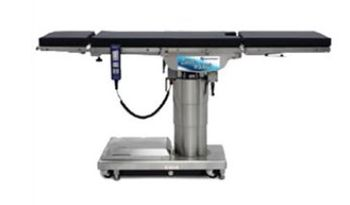
Skytron 6302 Elite
 Skytron · Model 6302 Elite
210° top rotation Removable leg section simplifies accessory set-up Table height adjustable from 25” to 39-7/8” Low table height allows surgical team to comfortably operate at waist-height on bariatric patients Slim-profile base will not conflict with imaging equipmen.
Key tips
- ·Never defeat or bypass a return-electrode monitoring (REM) alarm to finish a case - it's a direct burn risk.
- ·Verify OR table battery backup - a table that loses power mid-procedure is a real, documented incident type.
- ·Track surgical light lamp-hours rather than waiting for failure - a sudden failure mid-case is avoidable.
Typical Failure Modes
Compiled for this model from its own documentation and established engineering knowledge for this equipment class - not from a verified service record. Confirm against the manufacturer's service manual.
A powered function will not run
HighSymptoms: Height, tilt, Trendelenburg, back or leg section does not respond to the hand control / pendant.
Root cause: Hand control fault, an electro-hydraulic actuator, a control-board fault, or a low battery (mobile column).
Section drifts or will not hold
MediumSymptoms: Table settles under load after positioning.
Root cause: Hydraulic valve internal leak or an actuator backdrive.
Battery will not hold charge (mobile column)
MediumSymptoms: Short run time, table dies mid-procedure, battery alarm.
Root cause: Aged battery pack or a charger fault.
Hand control / pendant / cable fault
MediumSymptoms: Intermittent or dead hand control.
Root cause: Worn hand control or a damaged cable.
Table-top segment / rail / pad fault
LowSymptoms: Segments loose, accessory rails will not clamp, pads torn, radiolucent top damaged.
Root cause: Worn segment latches, rail clamps, or upholstery.
Serviceable Parts & Consumables
Serviceable items for this model, compiled from its documentation and engineering knowledge for this equipment class. Service class and relative cost are estimates, not manufacturer figures; no part numbers are given. Confirm intervals and pricing against the manufacturer.
Electro-hydraulic actuator
Class Major service partRel. cost $$$R&R Difficult
Hydraulic control valve block
Class Major service partRel. cost $$$R&R Difficult
Battery pack (mobile column)
Class Periodic replacementRel. cost $$R&R Fairly easy
Hand control / pendant
Class Periodic replacementRel. cost $$R&R Fairly easy
Table-top segment pads / rail clamps
Class Major service partRel. cost $$R&R Fairly easy
| Part | Service class | Relative cost | R&R difficulty |
|---|---|---|---|
| Electro-hydraulic actuator | Major service part | $$$ | Difficult |
| Hydraulic control valve block | Major service part | $$$ | Difficult |
| Battery pack (mobile column) | Periodic replacement | $$ | Fairly easy |
| Hand control / pendant | Periodic replacement | $$ | Fairly easy |
| Table-top segment pads / rail clamps | Major service part | $$ | Fairly easy |
Relative cost: $ lowest · $$$$ highest service-part cost for this equipment class. Not a price.
PM Checklist
Preventive-maintenance tasks typical of this equipment class. Perform to the manufacturer's procedure and your facility's policy - this is general reference, not a schedule for this specific unit.
- ·Pre-case functional check
- ·Electrosurgical return-electrode cable inspection
- ·Table hydraulic / mechanical inspection
- ·Annual electrical safety test and full PM
Troubleshooting Approach
A starting sequence for this model, compiled from its documentation and engineering knowledge for this equipment class. Follow the manufacturer's service documentation for the actual procedure.
Symptom: A powered function is dead
- Confirm the battery is charged or the table is on mains, and any lock-out is off.
- Operate the function and listen for the actuator / pump.
- Substitute a known-good hand control.
- Check the control cable for damage.
- Replace the actuator, valve or control board as isolated, then load-test.
Symptom: Section drifts down
- Note how fast it settles and under what load.
- Check the hydraulic valve for internal leakage and the actuator for backdrive.
- Bleed / top up the hydraulic system per the manual.
- Rebuild or replace the leaking valve / actuator.
- Confirm it holds at several positions under load.
Technical Specs
- Lateral Tilt
- 30 degrees
- Patient Weight Capacity
- 1000 lift and 600 lbs articulation
Typical Location
Where this class of equipment is typically deployed - general reference, not this unit's own placement record.
- Operating rooms
- Procedure rooms
- Interventional suites
Documents & Manuals
Troubleshoot this device with Bio
Describe a symptom or error code. Bio answers from this device's own documented error codes, failure modes, parts, and guides.
Ask Bio