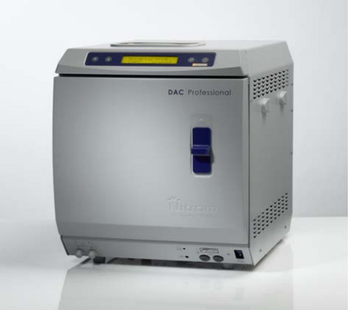
Sirona DAC Autoclave
 Sirona · Model DAC Autoclave
DAC Professional – Take advantage of the many convenient features Compact solution with integrated fresh water and waste water tank Easy handling minimizes operator errors Robust, compact, reliable Documentation with printer, CF card or directly on the PC without additional documentation software is possible Complies with all relevant norms for legal certainty Sterilization (quick program S) is possible in just 15 minutes (without drying) Process control You can document all program cycles either with the NitraPrint log printer or digitally with the NitraFlash CF card. DAC Professional / DAC Professional Plus not only gives you perfectly prepared instruments, it also gives you legal certainty.
Key tips
- ·Biological-indicator verification applies to dental sterilizers exactly the same as hospital CSSD - no exception for smaller units.
- ·"Sounds different" is often the first real report of handpiece bearing wear, not an outright failure - investigate early rather than waiting.
Typical Failure Modes
Compiled for this model from its own documentation and established engineering knowledge for this equipment class - not from a verified service record. Confirm against the manufacturer's service manual.
Cycle fault / will not reach sterilization parameters
HighSymptoms: Cycle aborts, temperature or pressure not reached / held, failed BI or chemical indicator.
Root cause: Heater / element fault, a door-gasket leak, a steam-generation or water-fill fault, a blocked chamber drain / strainer, or a temperature / pressure-sensor fault.
Door / gasket seal fault
MediumSymptoms: Steam leak at the door, door will not seal, lock or unlock, pressure will not build.
Root cause: Worn door gasket or a door-lock / interlock fault.
Poor drying / wet packs
MediumSymptoms: Instruments / packs come out wet.
Root cause: Drying-phase vacuum / heater fault, an overloaded chamber, or a clogged drain.
Water / reservoir / feedwater fault
MediumSymptoms: Low-water alarm, mineral scale, cloudy chamber, poor steam quality.
Root cause: Empty or scaled reservoir, a fill-valve / pump fault, or use of non-distilled water.
Steam-trap / air-removal / vacuum fault
MediumSymptoms: Failed Bowie-Dick / air-removal test, slow come-up, air pockets.
Root cause: Blocked steam trap, a vacuum-pump / ejector fault, or a check-valve fault.
Printer / recorder fault
LowSymptoms: No or faint cycle printout.
Root cause: Thermal print head or paper.
Serviceable Parts & Consumables
Serviceable items for this model, compiled from its documentation and engineering knowledge for this equipment class. Service class and relative cost are estimates, not manufacturer figures; no part numbers are given. Confirm intervals and pricing against the manufacturer.
Door gasket
Class Periodic replacementRel. cost $$R&R Fairly easy
Heating element / steam-generator element
Class Major service partRel. cost $$$R&R Difficult
Chamber / feedwater strainer & fill valve
Class Periodic replacementRel. cost $$R&R Moderate
Temperature / pressure sensor
Class Major service partRel. cost $$R&R Moderate
Steam trap / solenoid & check valves
Class Periodic replacementRel. cost $$R&R Moderate
Thermal print head / paper
Class Periodic replacementRel. cost $R&R Fairly easy
| Part | Service class | Relative cost | R&R difficulty |
|---|---|---|---|
| Door gasket | Periodic replacement | $$ | Fairly easy |
| Heating element / steam-generator element | Major service part | $$$ | Difficult |
| Chamber / feedwater strainer & fill valve | Periodic replacement | $$ | Moderate |
| Temperature / pressure sensor | Major service part | $$ | Moderate |
| Steam trap / solenoid & check valves | Periodic replacement | $$ | Moderate |
| Thermal print head / paper | Periodic replacement | $ | Fairly easy |
Relative cost: $ lowest · $$$$ highest service-part cost for this equipment class. Not a price.
PM Checklist
Preventive-maintenance tasks typical of this equipment class. Perform to the manufacturer's procedure and your facility's policy - this is general reference, not a schedule for this specific unit.
- ·Daily handpiece lubrication and autoclave cycle verification
- ·Compressor moisture-trap draining
- ·Annual full PM
Error Codes
Extracted directly from this unit's own service manual.
Fault 14The amount of water supplied by the feed-water dosing unit 33-00 is not enough; test as follows:
Place the end of the feed-water hose 41-00-A (behind the flow monitor) into a measuring beaker. Switch on “A5: Pump/SV feed pump” (AC OUT 5) in the digital outputs of the Diagnosis Program. Check the feed rate for the water: it must be 1 … 1.5 l/min. If necessary, replace the defective feed-water pump including the solenoid valve 33-00.
Fault 21 PreheatingThe monitoring time limit Uet11-Uet16 from switching on the preheating until reaching the necessary temperature has been exceeded
Mains electricity voltag
Troubleshooting Approach
A starting sequence for this model, compiled from its documentation and engineering knowledge for this equipment class. Follow the manufacturer's service documentation for the actual procedure.
Symptom: Handpieces weak / no drive air / no coolant spray
- Confirm the compressor runs and the supply air pressure is at spec.
- Inspect and clean the in-line air and water filters.
- Test the foot control and its valves.
- Check the handpiece tubing and O-rings for leaks or blockage.
- Confirm drive air and coolant at the handpiece connector against spec.
Symptom: Weak or no suction (HVE / saliva ejector)
- Confirm the central vacuum / pump is operating.
- Empty and clean the solids collector and any operatory filter.
- Inspect the HVE / SE valves for wear.
- Leak-test the suction lines and connections.
- Replace worn valves or the collector filter.
Symptom: Chair will not raise / lower / recline / preset
- Confirm mains power and that no lock-out is set.
- Try the foot control and the touchpad to isolate the control.
- Listen for the hydraulic pump or the actuator.
- Check the control cable and the control board.
- Replace the hydraulic pump / actuator or the control board as isolated.
Symptom: Water-line / bottle-system fault / operatory light fault
- Check the self-contained bottle pressurises and the check valve holds.
- Flush / shock the water lines per the biofilm protocol.
- For the light, replace the bulb / LED module and check the switch and power supply.
- Confirm water at every instrument and full light output.
- Replace the bottle-system regulator / check valve as isolated.
Typical Location
Where this class of equipment is typically deployed - general reference, not this unit's own placement record.
- Dental operatory
- Oral surgery suite
- CSSD (dental sterilizers)
Documents & Manuals
Troubleshoot this device with Bio
Describe a symptom or error code. Bio answers from this device's own documented error codes, failure modes, parts, and guides.
Ask Bio