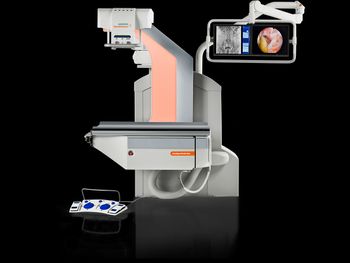
Siemens Healthineers Uroskop Omnia Max
 Siemens Healthineers · Model Uroskop Omnia Max
Sharper images with CARE – with the lowest possible dose Smart workflows – from patient access to system positioning Smart integration – for more efficiency and safety.
Key tips
- ·When no category-specific guidance fits, default to the manufacturer's own service manual and the general troubleshooting method in the Engineer's Guide.
- ·Run an incoming and annual electrical safety test regardless of how niche the device is.
Typical Failure Modes
Compiled for this model from its own documentation and established engineering knowledge for this equipment class - not from a verified service record. Confirm against the manufacturer's service manual.
Image quality degradation
HighSymptoms: Noisy, low-contrast or artefacted fluoro / radiographic images, poor detail.
Root cause: X-ray tube aging, image-intensifier / flat-panel detector degradation, or a collimator / filter fault.
Table / C-arm positioning fault
HighSymptoms: Uro-table tilt, height, longitudinal or the C-arm / tube-column will not move or gives a position / collision error.
Root cause: Drive motor, encoder, brake, or a collision / limit-sensor fault.
X-ray generator / exposure fault
HighSymptoms: Exposure inhibited, kV / mA error, tube-overload or thermal interlock.
Root cause: Generator fault, tube thermal limit, or the cooling system.
Drainage / patient-support or footrest fault
MediumSymptoms: Integrated drainage tray, footrest or leg supports loose or will not adjust.
Root cause: Worn mechanical hardware.
Workstation / PACS-send fault
MediumSymptoms: Images will not display, annotate or send to PACS.
Root cause: Workstation PC or the DICOM configuration.
Serviceable Parts & Consumables
Serviceable items for this model, compiled from its documentation and engineering knowledge for this equipment class. Service class and relative cost are estimates, not manufacturer figures; no part numbers are given. Confirm intervals and pricing against the manufacturer.
X-ray tube assembly
Class Major service partRel. cost $$$$R&R Expert-level
Image intensifier / flat-panel detector
Class Major service partRel. cost $$$$R&R Expert-level
Table / C-arm drive motor & encoder
Class Major service partRel. cost $$$$R&R Expert-level
Generator components
Class Major service partRel. cost $$$R&R Difficult
Workstation PC
Class Major service partRel. cost $$$R&R Moderate
| Part | Service class | Relative cost | R&R difficulty |
|---|---|---|---|
| X-ray tube assembly | Major service part | $$$$ | Expert-level |
| Image intensifier / flat-panel detector | Major service part | $$$$ | Expert-level |
| Table / C-arm drive motor & encoder | Major service part | $$$$ | Expert-level |
| Generator components | Major service part | $$$ | Difficult |
| Workstation PC | Major service part | $$$ | Moderate |
Relative cost: $ lowest · $$$$ highest service-part cost for this equipment class. Not a price.
PM Checklist
Preventive-maintenance tasks typical of this equipment class. Perform to the manufacturer's procedure and your facility's policy - this is general reference, not a schedule for this specific unit.
- ·Follow the manufacturer's PM schedule
- ·Perform incoming and annual electrical safety testing per facility biomedical program
Troubleshooting Approach
A starting sequence for this model, compiled from its documentation and engineering knowledge for this equipment class. Follow the manufacturer's service documentation for the actual procedure.
Symptom: Poor image quality
- This is an OEM-service imaging system - the BMET role is triage and coordination with Siemens Healthineers.
- Run the image-quality / detector calibration test.
- Check the tube hour / exposure counters and the cooling-system status.
- Review recent QA / dose trends.
- Escalate a confirmed tube or detector degradation to Siemens.
Symptom: Positioning or exposure interlock
- Note the exact fault code from the console.
- Check for collision-sensor activation or a physical obstruction and clear it.
- Verify the table and stand emergency stops are reset.
- Check the generator / tube thermal status.
- Escalate a drive, generator or tube fault to Siemens.
Typical Location
Where this class of equipment is typically deployed - general reference, not this unit's own placement record.
- Varies by device - check the unit's own manual for facility placement guidance
Documents & Manuals
No documents available for this device yet.
Troubleshoot this device with Bio
Describe a symptom or error code. Bio answers from this device's own documented error codes, failure modes, parts, and guides.
Ask Bio