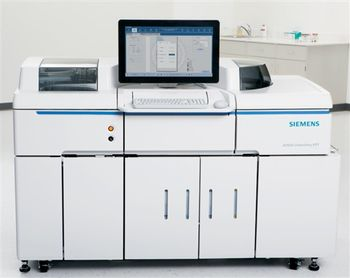
Siemens ADVIA XPT
 Siemens Healthineers · Model ADVIA XPT
Intuitive, icon-driven user interface for simplified training and operation. ISE module designed for high throughput without the need for routine maintenance. Concentrated reagents provide a high number of tests onboard for long walkaway times. Status light displays system alerts visible from anywhere in the laboratory. Designed for automation; requires no additional robotics. Point-in-space technology enables direct-from-track sampling. Onboard aliquotting allows sample to be immediately released to the next workstation, driving productivity and improving laboratory turnaround time (TAT). Comprehensive menu of 116 assays (June 2014); supports up to 2400 tests per hour (1800 photometric plus 600 ISE) to provide consistent and predictable TAT. Micro-volume technology reduces blood-draw requirements by using a single 30 µL sample for up to 15 tests. Quick release of sample tubes allows parallel tube processing and rapid, predictable TAT. Aliquot retention allows automated, preprogrammable dilution, reflex, and rerun testing without calling back the sample.
Key tips
- ·Run QC controls before trusting any repair - an analyzer that passes self-test can still report clinically wrong results.
- ·Rule out a reagent lot change before opening the instrument - it can look exactly like a hardware fault.
- ·Centrifuge rotors have a hard retirement age/cycle limit regardless of visible condition - don't eyeball it.
Typical Failure Modes
Compiled for this model from its own documentation and established engineering knowledge for this equipment class - not from a verified service record. Confirm against the manufacturer's service manual.
Assay / QC failure across a channel or the whole system
HighSymptoms: Controls out of range, calibration fails, flagged results, drift over a shift.
Root cause: Reagent or cuvette issue, lamp ageing, a probe / mixer / wash-station fault, or ISE-module problems.
Sample / reagent probe clog or crash
MediumSymptoms: Short aspiration, no dispense, clot detection, probe-position error.
Root cause: Clogged or bent probe, or a clot in the sample.
Cuvette / reaction-rotor fault
MediumSymptoms: High cuvette blanks, non-uniform results by position, rotor-drive error.
Root cause: Worn / scratched cuvettes or a wash fault, or a rotor-drive fault.
ISE module fault (Na / K / Cl)
MediumSymptoms: Electrolyte results biased or noisy, ISE calibration fails.
Root cause: Aged ISE electrodes / reference, or a pinch-valve / tubing fault.
Water / vacuum / pressure system fault
MediumSymptoms: Multiple station alarms, priming failures, poor wash.
Root cause: Water / DI supply quality, a pump, or a vacuum / pressure regulator.
Serviceable Parts & Consumables
Serviceable items for this model, compiled from its documentation and engineering knowledge for this equipment class. Service class and relative cost are estimates, not manufacturer figures; no part numbers are given. Confirm intervals and pricing against the manufacturer.
Sample / reagent probes
Class Periodic replacementRel. cost $$R&R Moderate
Photometer lamp
Class Frequent wear itemRel. cost $$R&R Moderate
Reaction cuvettes / segment
Class Frequent wear itemRel. cost $$R&R Easy
ISE electrodes (Na / K / Cl) & reference
Class Frequent wear itemRel. cost $$R&R Fairly easy
Peristaltic / pinch-valve tubing
Class Frequent wear itemRel. cost $R&R Moderate
| Part | Service class | Relative cost | R&R difficulty |
|---|---|---|---|
| Sample / reagent probes | Periodic replacement | $$ | Moderate |
| Photometer lamp | Frequent wear item | $$ | Moderate |
| Reaction cuvettes / segment | Frequent wear item | $$ | Easy |
| ISE electrodes (Na / K / Cl) & reference | Frequent wear item | $$ | Fairly easy |
| Peristaltic / pinch-valve tubing | Frequent wear item | $ | Moderate |
Relative cost: $ lowest · $$$$ highest service-part cost for this equipment class. Not a price.
PM Checklist
Preventive-maintenance tasks typical of this equipment class. Perform to the manufacturer's procedure and your facility's policy - this is general reference, not a schedule for this specific unit.
- ·Daily QC controls run and reviewed
- ·Calibration verification per assay
- ·Routine cleaning and decontamination
- ·Scheduled reagent-path and pump-tubing maintenance
Troubleshooting Approach
A starting sequence for this model, compiled from its documentation and engineering knowledge for this equipment class. Follow the manufacturer's service documentation for the actual procedure.
Symptom: Assay or QC failure
- Run fresh controls at all levels.
- Confirm reagents are in date, correctly loaded and mixed.
- Run the photometer check and replace the lamp if energy is low.
- Clean the probes, mixers and wash stations.
- Recalibrate the affected assay / ISE module and re-run QC.
Symptom: Probe clog or crash
- Inspect the probe for a bend or blockage and clear it.
- Run the fluidics prime / wash cycle.
- Check for a clot in the sample.
- Verify liquid-level sensing and probe positioning.
- Replace the probe if aspiration is still short.
Technical Specs
- Height
- 135 in w/out monitor; 149
- Sample Capacity
- 84
- Length
- 99 in
- Weight
- 725 kg
- Light Source
- 12V, 50W halogen lamp
- Sample Types
- Serum, plasma, urine, whole blood, and CSF, assay-dependent
- Width
- 177 in
Typical Location
Where this class of equipment is typically deployed - general reference, not this unit's own placement record.
- Central / core laboratory
- Point-of-care testing stations
- Blood bank
- Microbiology lab
Documents & Manuals
No documents available for this device yet.
Related calculators
From BioLab, for work done with this kind of equipment.
Troubleshoot this device with Bio
Describe a symptom or error code. Bio answers from this device's own documented error codes, failure modes, parts, and guides.
Ask Bio