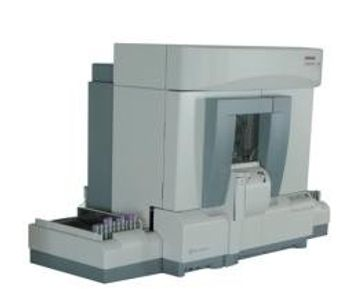
Siemens ADVIA 2120
 Siemens Healthineers · Model ADVIA 2120
ADVIA 2120 and ADVIA 2120i technology utilize Peroxidase stain, the gold standard for WBC differentials, therefore, delivering better agreement with your technologists’ manual results- providing higher confidence, better efficiency. True RBC morphology advances cell separation to a new level that allows for the differentiation of various disease states, including those associated with anemia. Maximize the effectiveness of costly platelet transfusions with accurate results the first time, every time - even at very low platelet levels. Two dimensional optical platelets analyze both extra-cellular and intracellular properties, ensuring that large platelets are included in your counts, and known interferences are not. Rack-based capacity for 150 samples delivers all the benefits of "walkaway" convenience. Fixed throughput of CBC/Diff at 120 samples per hour, even on leukopenic samples, provides fast results reporting to enhance the service to clinicians. Proven technology, reference methods and onboard delta checks reduce manual slide reviews. Increased linearities minimize costly, timeconsuming dilutions and repeat. Differentiates microcytic anemias with advanced RBC and reticulocyte technology. Automates hematology workflow without the need for large track-based systems, expensive stains, or reflexive testing. Delivers gold standard flow cytometry peroxidase methodology for optimum results. Simplifies maintenance through reduced fluidics, eliminated pinch valves, and automated daily cleaning using Unifluidics™ Technology.
Key tips
- ·Run QC controls before trusting any repair - an analyzer that passes self-test can still report clinically wrong results.
- ·Rule out a reagent lot change before opening the instrument - it can look exactly like a hardware fault.
- ·Centrifuge rotors have a hard retirement age/cycle limit regardless of visible condition - don't eyeball it.
Typical Failure Modes
Compiled for this model from its own documentation and established engineering knowledge for this equipment class - not from a verified service record. Confirm against the manufacturer's service manual.
Aperture / flow-cell blockage or partial obstruction
HighSymptoms: Flagged or implausible CBC counts, voteouts, clog alarms, poor precision.
Root cause: Debris or a clot partially blocking a counting aperture or the flow cell.
Sample probe / piercer / valve wear
MediumSymptoms: Short samples, aspiration errors, cap-piercing failures, carryover.
Root cause: Worn or bent sample probe / closed-vial piercer, or a worn shear / segment valve.
Reagent / lyse delivery fault
MediumSymptoms: WBC, HGB or diff results shifted, high background, reagent alarms.
Root cause: Reagent depleted or wrong lot, or a pinch-valve / tubing fault.
Optics / laser fault (diff)
MediumSymptoms: Diff scattergrams abnormal, missing populations, flow-cell or laser alarm.
Root cause: Contaminated or aged flow cell, or the laser / optics.
Vacuum / pressure out of range
MediumSymptoms: Multiple parameter errors, priming failures.
Root cause: Pump or regulator drift.
Serviceable Parts & Consumables
Serviceable items for this model, compiled from its documentation and engineering knowledge for this equipment class. Service class and relative cost are estimates, not manufacturer figures; no part numbers are given. Confirm intervals and pricing against the manufacturer.
Sample probe / closed-vial piercer
Class Periodic replacementRel. cost $$R&R Moderate
Shear / segment valve
Class Periodic replacementRel. cost $$$R&R Difficult
Pinch-valve / peristaltic tubing
Class Frequent wear itemRel. cost $R&R Moderate
Flow cell
Class Periodic replacementRel. cost $$$R&R Difficult
System reagents / controls
Class ConsumableRel. cost $$R&R Easy
| Part | Service class | Relative cost | R&R difficulty |
|---|---|---|---|
| Sample probe / closed-vial piercer | Periodic replacement | $$ | Moderate |
| Shear / segment valve | Periodic replacement | $$$ | Difficult |
| Pinch-valve / peristaltic tubing | Frequent wear item | $ | Moderate |
| Flow cell | Periodic replacement | $$$ | Difficult |
| System reagents / controls | Consumable | $$ | Easy |
Relative cost: $ lowest · $$$$ highest service-part cost for this equipment class. Not a price.
PM Checklist
Preventive-maintenance tasks typical of this equipment class. Perform to the manufacturer's procedure and your facility's policy - this is general reference, not a schedule for this specific unit.
- ·Daily QC controls run and reviewed
- ·Calibration verification per assay
- ·Routine cleaning and decontamination
- ·Scheduled reagent-path and pump-tubing maintenance
Error Codes
Extracted directly from this unit's own service manual.
ASL - Communications errorCommunication lost between Analytical Module and Autoslide.
Check serial I/O cable between instrument and autoslide, and cycle autoslide power, perform a mechanical initialization.
ASL - Dispenser errorMechanical problem on dispenser.
Inspect dispenser area. Look for stuck or broken slide. Ensure sufficient slides are loaded to cover both slide sensors, proceed to Tip # 2
ASL - EEPROM errorEEPROM read or write error during initialization.
Call Siemens.
ASL - EEPROM IO errorAn error occurred when reading or updating the EEPROM.
Perform Mechanical Initialization to reset autoslide, Cycle power to Autoslide if problem persists, and call Siemens.
ASL - Emergency stop cycleCover may have been opened while autoslide was busy.
Close cover, and reset autoslide. See Tips # 2 & 3.
ASL - Hardware errorA hardware error has occurred.
Check message log for other errors, correct problem, reset autoslide - see Tip # 2. Call Siemens.
ASL - Impossible to rinseUnable to rinse sample or deposit deposit lines; Other command is processing.
Perform a mechanical initialization; If problem persists, call Siemens.
ASL - Internal software errorSoftware initialization problem or incorrect data entered.
Enter correct information; Run a mechanical initialization cycle. Call your Siemens Representative if not resolved.
ASL - Internal synchronization errorAutoslide internal synchronization error.
Perform a mechanical initialization. If problem persists, call Siemens.
ASL - Needle plate errorStaining needle positioning problem.
Open the covers and identify the problem. Close covers. Refer to Tips 2 & 3. If needles hitting slides, call Siemens.
ASL - Printer errorPrinter ribbon not advancing or jammed.
Open front panel, inspect printer ribbon - clear jam or replace ribbon as needed. Ensure that there are no glass particles in the printer area. Run a Mechanical Initialization cycle. Cycle autoslide power if necessary.
ASL - Rack Handling errorHardware failure in rack handler track.
Check for jammed racks or debris. Run a reset smearer. (See Tips above)
ASL - Slide Carrier errorSlide did not make it to the carrier in time, or loaded incorrectly.
Clear slide and inspect area for glass particles or debris then refer to Troubleshooting Tip # 2.
ASL - SmearSmear
Troubleshooting Approach
A starting sequence for this model, compiled from its documentation and engineering knowledge for this equipment class. Follow the manufacturer's service documentation for the actual procedure.
Symptom: Clog / aperture / flow-cell alarm or flagged CBC counts
- Run the instrument's aperture / flow-cell clear (burn / back-flush) and flush cycles.
- Run a background count and confirm it is within limits.
- Run controls at all levels.
- Clean or replace the aperture bath / flow cell if clogs recur.
- Confirm precision on a replicate sample before releasing results.
Symptom: Short samples / aspiration errors / carryover
- Inspect the sample probe / closed-vial piercer for wear or a bend.
- Check the shear / segment valve and the tubing for leaks or wear.
- Verify vacuum and pressure against the service spec.
- Replace the probe / piercer, valve or tubing as found.
- Re-run controls and a carryover check.
Symptom: WBC / HGB / diff shifted / high background
- Confirm reagents and lyse are in date, primed and the correct lot.
- Check the pinch valves and tubing for wear or air.
- Run the fluidics prime and a background count.
- Recalibrate if the shift is confirmed against controls.
- Escalate an optics / laser fault if scattergrams are abnormal.
Symptom: Autoloader / transport jam
- Clear the jammed tube / rack and note where it hangs up.
- Inspect the autoloader belt, gripper and mixing station.
- Check the rack sensors.
- Cycle several racks.
- Replace the belt / gripper as found.
Technical Specs
- Height
- 33.8 in Analytical Module with Autosampler
- Length
- 26.8 in Analytical Module with Autosampler
- Weight
- 425 lbs Analytical Module with Autosampler
- Width
- 55.5 in Analytical Module with Autosampler
Typical Location
Where this class of equipment is typically deployed - general reference, not this unit's own placement record.
- Central / core laboratory
- Point-of-care testing stations
- Blood bank
- Microbiology lab
Documents & Manuals
- ADVIA 2120/2120i Operators GuideUser Manual · External
- 3 in 1 TEST point Hematology ControlsDocument · External
- ADVIA 120 /ADVIA 2120 Hematology Systems, Communication Links Between the Data Manager and a HostDocument · External
- ADVIA 2120 /2120i Hematology Systems, Communication Links Between the Data Manager and a Host CompDocument · External
- OPTIpoint Hematology_SystemsDocument · External
- SETpoint_Calibrator Hematology_SystemsDocument · External
- TESTpoint_CSF_ControlsDocument · External
- TESTpoint_Hematology_ControlsDocument · External
- TESTpoint_Reticulocyte_ControlsDocument · External
- Turning the ADVIA 2120 and ADVIA 2120i Systems On and Off, Rev BDocument · External
Related calculators
From BioLab, for work done with this kind of equipment.
Troubleshoot this device with Bio
Describe a symptom or error code. Bio answers from this device's own documented error codes, failure modes, parts, and guides.
Ask Bio