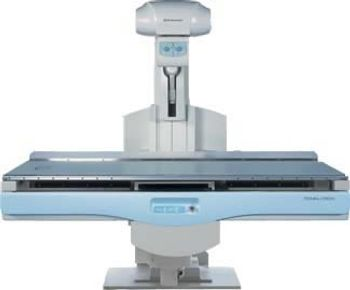
Shimadzu Sonialvision Versa 100IR
 Shimadzu · Model Sonialvision Versa 100IR
Wide Application Coverage Safe and easy procedures are achieved by its head-to-toe coverage by the full longitudinal sliding range of imaging unit at any tilting angle, no need to move the patient. (Especially at Endoscopic procedures, no more worry about sudden patient movement by mis-operation)The sliding speed of the imaging unit is user-adjustable (max. 15CM/sec); slow speed is recommended for ERCP, PTCD, biopsy examinations, etc., and fast speed is good enough for peripheral bolus chase and upper GI. Wider fluoroscopic and radiographic image field to both ends of the tabletop without spot film device allows efficient examinations with normal positioning and without patient anxiety. One-million-pixel CCD Camera Produces High Image Quality Extremely valuable for gastrointestinal examinations, the newly developed one-million-pixel CCD camera produces 12-bit high-definition, high-contrast 1024 x 1024 matrix images. Also, to ensure no detail is missed during esophageal imaging, the latest digital technology is used to capture images at up to 15 frames per second. Designed for the comfort of patient and operator alike The perfectly flat tabletop simplifies patient movement and provides the optimal examination environment. The tabletop can be set at the appropriate operator’s working height or, to reduce the load on care staff when moving the patient. When the I.I. retracting function is used, the table can be lowered to just 63 cm.*.
Key tips
- ·Never bypass a radiation interlock to "just get the image" - this is one of the few true zero-tolerance rules in BMET work.
- ·Trend image-quality phantom results over time - drift shows up before an outright failure does.
- ·Portable/mobile units take real physical abuse from transport - check wheel locks and cable strain reliefs more often than fixed units.
Typical Failure Modes
Compiled for this model from its own documentation and established engineering knowledge for this equipment class - not from a verified service record. Confirm against the manufacturer's service manual.
Fluoro dose-rate / image-brightness fault
HighSymptoms: Fluoro image too dark or bright, dose creep, ABC / ADRC not tracking.
Root cause: Image-intensifier or flat-panel degradation, or the dose-control loop.
No or inconsistent exposure / generator error
HighSymptoms: Exposure inhibited, generator error code, spot images under/over-exposed.
Root cause: HV generator / tank, tube, filament supply, or an interlock.
Table motion / tilt / spot-film device fault
MediumSymptoms: Table will not tilt or move, the spot-film / carriage will not position.
Root cause: Table drive, tilt motor, or the spot-film device drive.
Tube overload / cooling fault
MediumSymptoms: Exposures inhibited after a series, tube-heat alarm.
Root cause: Tube heat limit reached or a heat-exchanger / cooling fault.
Console / image-chain / PACS fault
MediumSymptoms: Console unresponsive, image freeze, images will not archive.
Root cause: Console PC, the image-processing chain, or the network.
Serviceable Parts & Consumables
Serviceable items for this model, compiled from its documentation and engineering knowledge for this equipment class. Service class and relative cost are estimates, not manufacturer figures; no part numbers are given. Confirm intervals and pricing against the manufacturer.
X-ray tube assembly
Class Major service partRel. cost $$$$R&R Expert-level
Image intensifier / flat-panel detector
Class Major service partRel. cost $$$$R&R Expert-level
HV generator / tank components
Class Major service partRel. cost $$$$R&R Expert-level
Table / tilt drive components
Class Major service partRel. cost $$$R&R Difficult
Heat exchanger / cooling components
Class Major service partRel. cost $$$R&R Difficult
| Part | Service class | Relative cost | R&R difficulty |
|---|---|---|---|
| X-ray tube assembly | Major service part | $$$$ | Expert-level |
| Image intensifier / flat-panel detector | Major service part | $$$$ | Expert-level |
| HV generator / tank components | Major service part | $$$$ | Expert-level |
| Table / tilt drive components | Major service part | $$$ | Difficult |
| Heat exchanger / cooling components | Major service part | $$$ | Difficult |
Relative cost: $ lowest · $$$$ highest service-part cost for this equipment class. Not a price.
PM Checklist
Preventive-maintenance tasks typical of this equipment class. Perform to the manufacturer's procedure and your facility's policy - this is general reference, not a schedule for this specific unit.
- ·Daily QC per modality: image-quality phantom test
- ·Tube and detector inspection
- ·Annual state-required radiation safety survey
- ·Vendor-scheduled preventive maintenance
Troubleshooting Approach
A starting sequence for this model, compiled from its documentation and engineering knowledge for this equipment class. Follow the manufacturer's service documentation for the actual procedure.
Symptom: Image artefacts / poor fluoro or CT image / failed calibration
- Run the daily air / water (fast) calibration; if it fails, run the full calibration set.
- Scan / image a uniform phantom and review uniformity and noise against baseline.
- Check the X-ray tube warm-up and heat-unit / arc status.
- Check the detector / image-intensifier / flat-panel performance via service diagnostics.
- Escalate a confirmed detector-channel, DAS or tube fault to the OEM; re-verify with the phantom after any correction.
Symptom: Exposure aborts / tube-arc errors / kV-mAs fault
- Record the exact error codes and the phase (warm-up vs scan / fluoro vs cine).
- Run extended tube conditioning / seasoning.
- Review the arc-count and heat-unit trend.
- Confirm the chiller / heat-exchanger operates and coolant is at level.
- Plan a tube replacement when arc counts climb or output drifts; verify output after any HV work.
Symptom: Gantry rotation / slip-ring / positioner fault
- Note the axis and any collision-sensor indication.
- Clear obstructions and check the body-contour / collision sensors.
- Inspect the slip-ring brushes (dust, wear) and the drive belt / bearings.
- Run the motion self-test / calibration.
- Replace the brush set / drive component or refer as isolated.
Symptom: Table / cradle drifts, will not index or reach position
- Note the position / geometry error.
- Check for a mechanical obstruction on the table.
- Run the table drive self-test / calibration.
- Inspect the drive, brake and encoder.
- Replace the drive component or refer as isolated.
Symptom: Reconstruction / console / PACS fault
- Note the console / recon error.
- Restart the recon hardware / console per the OEM procedure.
- Check free storage and the database.
- Confirm the network link to PACS.
- Escalate a recon-hardware or host fault to the OEM.
Technical Specs
- Maximum Focal Spot
- 59.1 in
- Height
- 83.5 in
- Length
- 92.5 in
- X-ray Generator Power Rating
- 80 Kw
- Motorized Tilting/Pivot Rotation
- 90
- Width
- 72.8 in
Typical Location
Where this class of equipment is typically deployed - general reference, not this unit's own placement record.
- Radiology / Imaging department
- Emergency Department (portable units)
- Operating Room (C-arms)
- Cath lab
- Bedside ICU (portable X-ray)
Documents & Manuals
Safety & Recalls
Synced live from the FDA openFDA API.
- RECALL
X-ray R/F system software with certain versions of the control board may occasionally fail to display images when switching from Fluoroscopy mode to Radiography mode, which may lead to the possibility of delay or cancellation of the examination.
- RECALL
Shimadzu Medical Systems is recalling Shimadzu X-ray TV System SONIALVISION due to possibility of oil leaking from the x-ray tube housing under certain conditions.
- RECALL
Shimadzu Medical Systems is recalling the Shimadzu X-ray High Voltage Generator due to the possibility of oil leaking from the x-ray tube housing under certain conditions.
Troubleshoot this device with Bio
Describe a symptom or error code. Bio answers from this device's own documented error codes, failure modes, parts, and guides.
Ask Bio