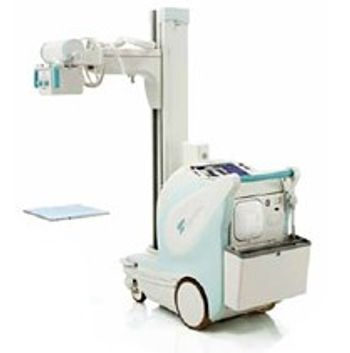
Shimadzu MobileDaRt Evolution Wireless Type
 Shimadzu · Model MobileDaRt Evolution Wireless Type
Wireless FPD makes handling easier. The wireless FPD makes it easy to maintain the system asepsis in the operating room or infectious diseases ward. The system offers excellent positioning, with no concerns about cables. Supports display of X-ray exposure dose [Option]. Two kinds of dose management tools are available according to the needs of facilities. A Dose Area Product (DAP) meter can be mounted to the front of the collimator to display dose measurements on the display panel. If a dose calculation function is incorporated in the system, the estimated skin dose is displayed on the main unit display panel prior to taking exposures. Dose data measured with a dose area product meter or calculated skin dose can also be output in DICOM format. Supports display of X-ray exposure dose [Option] State-of-the-art control software. Two types of digital system are selectable. The optimized workflow reduces steps and supports multiple study acquisition. High power minimizes effect by patient motion. With radiography of children and emergency cases where it is difficult to maintain a stable posture, there is a tendency for images to be blurred due to patient movement. With MobileDaRt Evolution, a maximum output of 32 kw allows for shorter exposure times, eliminating blurring issues. User firendly design ensures quick positioning and smooth resposive mobility Light-touch, natural maneuvering. A light pressure applied to the drive handle moves the mobile system in a natural manner as if it were an extension of one's hand, allowing the MobileDaRt Evolution to be controlled easily and effortlessly. "Inch-mover". The MobileDaRt Evolution can be moved forward or backward by using the bedside drive controls located on the front of the collimator. Safety is a major consideration and any sudden force applied to the handle during "Inch-mover" operation stops the MobileDaRt Evolution automatically. In addition, X-ray irradiation is also automatically disabled during any movement of the MobileDaRt Evolution. Keyless Entry(*). Setting a password for each user enables keyless use of the system. The Key-less Entry enables to turn on the system by 4 digits key command input without any actual key, which is useful to share the units by several staffs. Wireless Networking (*). Standard MobileDaRt Evolution features include support of DICOM print and storage. Output data in DICOM format to a laser printer, image server, or viewer using the provided LAN connection. Optional wireless network connection is available that provides even greater freedom for communication to RIS or PACS while moving the unit.
Key tips
- ·Never bypass a radiation interlock to "just get the image" - this is one of the few true zero-tolerance rules in BMET work.
- ·Trend image-quality phantom results over time - drift shows up before an outright failure does.
- ·Portable/mobile units take real physical abuse from transport - check wheel locks and cable strain reliefs more often than fixed units.
Typical Failure Modes
Compiled for this model from its own documentation and established engineering knowledge for this equipment class - not from a verified service record. Confirm against the manufacturer's service manual.
No or inconsistent exposure
HighSymptoms: Exposure inhibited, kV / mAs error, images under- or over-exposed.
Root cause: HV generator / capacitor fault, exposure-switch fault, tube fault, or a thermal interlock.
Drive / propulsion fault (motor-driven units)
MediumSymptoms: Unit will not drive, drives weakly, or a drive fault code.
Root cause: Drive battery, drive motor / controller, or the throttle handle.
Battery pack will not hold charge
HighSymptoms: Few exposures per charge, will not reach full charge, unit dies mid-round.
Root cause: Aged exposure / drive battery bank or a charger fault.
Column / arm / brake fault
MediumSymptoms: Tube arm drifts, will not extend / rotate, or a brake will not hold.
Root cause: Worn arm bearings, counterbalance, or brakes.
Detector / console fault (DR units)
MediumSymptoms: Panel not detected, images not received, console errors.
Root cause: Wireless detector, its battery, or the acquisition PC.
Serviceable Parts & Consumables
Serviceable items for this model, compiled from its documentation and engineering knowledge for this equipment class. Service class and relative cost are estimates, not manufacturer figures; no part numbers are given. Confirm intervals and pricing against the manufacturer.
Battery bank (exposure / drive)
Class Periodic replacementRel. cost $$$R&R Moderate
HV generator / capacitor module
Class Major service partRel. cost $$$$R&R Expert-level
Drive motor / controller
Class Major service partRel. cost $$$R&R Difficult
Column arm brake / bearing kit
Class Major service partRel. cost $$R&R Moderate
Wireless detector / battery (DR)
Class Periodic replacementRel. cost $$$$R&R Fairly easy
| Part | Service class | Relative cost | R&R difficulty |
|---|---|---|---|
| Battery bank (exposure / drive) | Periodic replacement | $$$ | Moderate |
| HV generator / capacitor module | Major service part | $$$$ | Expert-level |
| Drive motor / controller | Major service part | $$$ | Difficult |
| Column arm brake / bearing kit | Major service part | $$ | Moderate |
| Wireless detector / battery (DR) | Periodic replacement | $$$$ | Fairly easy |
Relative cost: $ lowest · $$$$ highest service-part cost for this equipment class. Not a price.
PM Checklist
Preventive-maintenance tasks typical of this equipment class. Perform to the manufacturer's procedure and your facility's policy - this is general reference, not a schedule for this specific unit.
- ·Daily QC per modality: image-quality phantom test
- ·Tube and detector inspection
- ·Annual state-required radiation safety survey
- ·Vendor-scheduled preventive maintenance
Troubleshooting Approach
A starting sequence for this model, compiled from its documentation and engineering knowledge for this equipment class. Follow the manufacturer's service documentation for the actual procedure.
Symptom: No or inconsistent exposure
- Note the exact error code.
- Confirm the battery bank is fully charged (exposure energy depends on it).
- Check the exposure switch and cable.
- Confirm the tube is not in a thermal lockout.
- Escalate a confirmed generator / capacitor / tube fault; verify output with an analyser after repair.
Symptom: Will not drive or short battery life
- Check the charge level and that the charger reaches full charge overnight.
- Load-test or check the battery bank voltages against spec.
- For no-drive, check the drive fuse, motor controller and throttle.
- Replace the battery bank when capacity is low.
- Confirm exposure count per charge returns to spec.
Typical Location
Where this class of equipment is typically deployed - general reference, not this unit's own placement record.
- Radiology / Imaging department
- Emergency Department (portable units)
- Operating Room (C-arms)
- Cath lab
- Bedside ICU (portable X-ray)
Documents & Manuals
Safety & Recalls
Synced live from the FDA openFDA API.
- RECALL
There is a potential that the adjustable handle option on the X-Ray system may have been installed with improper bolts. This could result in improper driving operation which could lead to harm of individuals around the device.
- RECALL
In these units, the brake is usually released by gripping the drive handle and applied by letting go of the handle. However, for systems within a specified manufacture period, we have identified that even when letting go of the handle, the systems brakes are not applied. In this event, if the Operator releases the handle when the device is moving, the unit will continue to coast.
- RECALL
Cracks may occur over time on the tube holding shaft near the base of the tube mounting flange.
- RECALL
The firm is recalling the Shimadzu Mobile X-ray system because an image may not transfer to image server properly.
Troubleshoot this device with Bio
Describe a symptom or error code. Bio answers from this device's own documented error codes, failure modes, parts, and guides.
Ask Bio