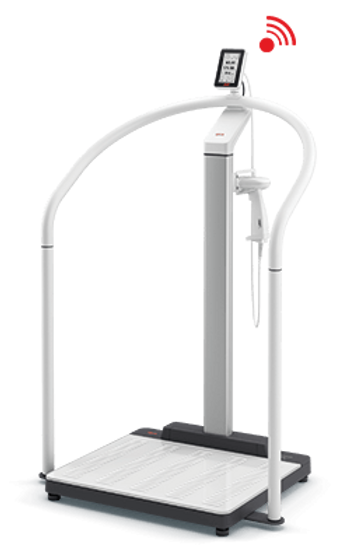
Seca Scale-Up Line
 Seca · Model Scale-Up Line
Display shows user and patient names or IDs for increased patient safety Data transmission controlled by touchscreen Safe weighing with a stable handraily Lightweight, sophisticated design and extremely robust thanks to steel handrail that is directly attached to the cast iron pedestal Large platform made of tested seca Bearclaw Glass® for absolute breakage resistance and perfect hygiene Convenient transport with extremely robust rubber wheels Optional panda bear facilitates measuring and weighing of children EMR-validated: transmit measured data directly to an electronic medical record system or printer.
Key tips
- ·Mounting and securement hardware takes real fatigue from vibration and road shock - inspect it as carefully as the device itself.
- ·Post-call battery and function checks catch transport-induced faults that a scheduled PM would miss for months.
Typical Failure Modes
Compiled for this model from its own documentation and established engineering knowledge for this equipment class - not from a verified service record. Confirm against the manufacturer's service manual.
Inaccurate weight / will not calibrate
HighSymptoms: Reading disagrees with certified test weights, drifts, or fails calibration.
Root cause: Load-cell drift or damage, a binding platform / linkage, or a calibration fault.
Will not zero / unstable reading
MediumSymptoms: Reading will not settle or return to zero, jumps around.
Root cause: Something fouling the platform, a damaged load cell, or electrical noise / a loose connector.
Display / keypad fault
MediumSymptoms: Missing segments, unresponsive keys, error code on power-up.
Root cause: Display or keypad membrane fault, or a main-board fault.
Battery / power fault
MediumSymptoms: Will not power on, short battery life, only works on mains.
Root cause: Aged battery or a power / adapter fault.
Mechanical / handrail / seat fault (chair & bed scales)
LowSymptoms: Wobble, worn castors, loose seat or handrail, folding mechanism stiff.
Root cause: Worn castors, hardware, or the folding mechanism.
Serviceable Parts & Consumables
Serviceable items for this model, compiled from its documentation and engineering knowledge for this equipment class. Service class and relative cost are estimates, not manufacturer figures; no part numbers are given. Confirm intervals and pricing against the manufacturer.
Load cell(s)
Recalibrate with certified weights after replacement.
Class Major service partRel. cost $$R&R Moderate
Display / main board
Class Major service partRel. cost $$R&R Moderate
Keypad membrane
Class Periodic replacementRel. cost $R&R Fairly easy
Battery / power adapter
Class Periodic replacementRel. cost $R&R Easy
Castors / seat / handrail hardware
Class Periodic replacementRel. cost $R&R Fairly easy
| Part | Service class | Relative cost | R&R difficulty |
|---|---|---|---|
| Load cell(s) Recalibrate with certified weights after replacement. | Major service part | $$ | Moderate |
| Display / main board | Major service part | $$ | Moderate |
| Keypad membrane | Periodic replacement | $ | Fairly easy |
| Battery / power adapter | Periodic replacement | $ | Easy |
| Castors / seat / handrail hardware | Periodic replacement | $ | Fairly easy |
Relative cost: $ lowest · $$$$ highest service-part cost for this equipment class. Not a price.
PM Checklist
Preventive-maintenance tasks typical of this equipment class. Perform to the manufacturer's procedure and your facility's policy - this is general reference, not a schedule for this specific unit.
- ·Post-call function and battery check
- ·Mounting / securement inspection
- ·Annual full PM and vibration-tolerance check
Troubleshooting Approach
A starting sequence for this model, compiled from its documentation and engineering knowledge for this equipment class. Follow the manufacturer's service documentation for the actual procedure.
Symptom: Inaccurate or will not calibrate
- Confirm the scale is on a firm, level surface with nothing touching the platform.
- Check with certified test weights across the range.
- Inspect the load-cell mounts and linkage for binding or debris.
- Run the calibration procedure per the manual.
- Replace the load cell(s) if it will not hold calibration.
Symptom: Will not zero / unstable
- Clear anything fouling or bridging the platform.
- Reseat the load-cell connector at the indicator.
- Move away from strong RF / vibration sources.
- Re-zero / tare.
- Replace a damaged load cell.
Typical Location
Where this class of equipment is typically deployed - general reference, not this unit's own placement record.
- Ambulance / transport vehicles
- Emergency Department
- Inter-facility transport teams
Documents & Manuals
No documents available for this device yet.
Safety & Recalls
Synced live from the FDA openFDA API.
- RECALL
It has been determined that the wheels on the baby scale cart can unexpectedly loosen and in the worst case, detach from the cart completely. If this occurs the cart can become unstable and tip over, potentially leading to the scale falling from the cart. If a baby is left unattended in a cart, the baby could fall off the scale and be subjected to several serious injuries.
Troubleshoot this device with Bio
Describe a symptom or error code. Bio answers from this device's own documented error codes, failure modes, parts, and guides.
Ask Bio