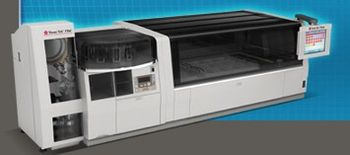
Sakura Tissue-Tek Prisma/Film
 Sakura · Model Tissue-Tek Prisma/Film
Continuous loading of up to 60 slides per run (up to 500 slides an hour) Combination of three separate work stations for routine H&E stains, special stain methods, and coverslipping Capacity for simultaneous runs of H&E and special stains Ability to set multiple loading and unloading stations based on slide volume Program up to 3 stations for continuous loading Program up to 5 stations for efficient unloading 2 drying stations to reduce potential bottlenecks 2 optional heating stations for special stains like PAS, Giemsa stain, and mucicarmine stain Compatible with histology and cytology protocols, including PAP and non-gyn Touch-sensitive color menu screens on the Tissue-Tek® Prisma® Adhesive-backed polymer with Tissue-Tek® Film® Automated Coverslipper Automatic transfer of stained slides from the Tissue-Tek® Prisma® to the Tissue-Tek® Film® xylene drawer through robotic link Audible alarm when film supply is low Permits integrated operation as a system or use as stand-alone instruments.
Key tips
- ·Run QC controls before trusting any repair - an analyzer that passes self-test can still report clinically wrong results.
- ·Rule out a reagent lot change before opening the instrument - it can look exactly like a hardware fault.
- ·Centrifuge rotors have a hard retirement age/cycle limit regardless of visible condition - don't eyeball it.
Typical Failure Modes
Compiled for this model from its own documentation and established engineering knowledge for this equipment class - not from a verified service record. Confirm against the manufacturer's service manual.
Reagent / paraffin transfer or handling fault
HighSymptoms: Stations not filling or draining, retort not filling (processor), transport arm mis-places baskets, error alarm halts the run.
Root cause: Worn pump / valve, a blocked line, a level-sensor fault, or a transport-drive / gripper fault.
Retort / chamber pressure or vacuum fault (processor)
MediumSymptoms: Pressure / vacuum not achieved, poor infiltration, seal alarm.
Root cause: Worn retort door seal, a vacuum / pressure-pump fault, or a valve.
Poor or inconsistent staining
MediumSymptoms: Slides over- / under-stained, uneven, station-time drift.
Root cause: Exhausted reagents, wrong programme, incorrect agitation, or a timing / arm fault.
Heater / paraffin-bath / oven fault
MediumSymptoms: Paraffin not molten or too hot, oven not at temperature, bath alarm.
Root cause: Heater or temperature-sensor fault.
Fume-extraction / carbon-filter fault
LowSymptoms: Reagent fumes in the room, filter-change overdue.
Root cause: Saturated carbon filter or a fan fault.
Serviceable Parts & Consumables
Serviceable items for this model, compiled from its documentation and engineering knowledge for this equipment class. Service class and relative cost are estimates, not manufacturer figures; no part numbers are given. Confirm intervals and pricing against the manufacturer.
Reagent / paraffin pump & valves
Class Periodic replacementRel. cost $$$R&R Difficult
Retort / reagent-vessel seals
Class Periodic replacementRel. cost $$R&R Fairly easy
Transport-arm drive / gripper (stainer)
Class Periodic replacementRel. cost $$$R&R Difficult
Bath / oven heater & temperature sensor
Class Major service partRel. cost $$R&R Moderate
Activated-carbon fume filter
Class Frequent wear itemRel. cost $R&R Easy
| Part | Service class | Relative cost | R&R difficulty |
|---|---|---|---|
| Reagent / paraffin pump & valves | Periodic replacement | $$$ | Difficult |
| Retort / reagent-vessel seals | Periodic replacement | $$ | Fairly easy |
| Transport-arm drive / gripper (stainer) | Periodic replacement | $$$ | Difficult |
| Bath / oven heater & temperature sensor | Major service part | $$ | Moderate |
| Activated-carbon fume filter | Frequent wear item | $ | Easy |
Relative cost: $ lowest · $$$$ highest service-part cost for this equipment class. Not a price.
PM Checklist
Preventive-maintenance tasks typical of this equipment class. Perform to the manufacturer's procedure and your facility's policy - this is general reference, not a schedule for this specific unit.
- ·Daily QC controls run and reviewed
- ·Calibration verification per assay
- ·Routine cleaning and decontamination
- ·Scheduled reagent-path and pump-tubing maintenance
Troubleshooting Approach
A starting sequence for this model, compiled from its documentation and engineering knowledge for this equipment class. Follow the manufacturer's service documentation for the actual procedure.
Symptom: QC / calibration failure across a channel or the whole system
- Run fresh controls at all levels and note which analytes fail.
- Confirm reagents are in date, correctly loaded, mixed and not bubbled.
- Run the photometer / lamp-energy check and replace the lamp if energy is low.
- Clean the sample and reagent probes, the mixers and the wash / cuvette-wash stations.
- Recalibrate the affected assay / ISE module and re-run QC.
Symptom: Sample or reagent probe clog / crash / short aspiration
- Inspect the probe for a bend or blockage and clear it (wire / sonicate per the manual).
- Run the fluidics prime and the probe-wash cycle.
- Check for a clot or fibrin in the sample and the liquid-level sensing.
- Verify probe positioning / alignment.
- Replace the probe if aspiration is still short.
Symptom: ISE electrolyte results biased or noisy / ISE calibration fails
- Run the ISE calibration and check the slope / drift against spec.
- Replace an ISE electrode or the reference that is at end of life.
- Check the ISE pinch valves and tubing for wear or air.
- Confirm the ISE standard packs are in date.
- Re-run ISE QC before releasing electrolyte results.
Symptom: High cuvette blanks / position-dependent results
- Run the cuvette blank / photometric check.
- Clean or replace worn / scratched cuvettes or the reaction segment.
- Check the cuvette-wash station nozzles and drying.
- Confirm the water / DI supply quality.
- Recalibrate and re-run QC.
Technical Specs
- Height
- 24.8 in
- Length
- 28 in
- Weight
- 330 lbs
- Width
- 49.2 in
Typical Location
Where this class of equipment is typically deployed - general reference, not this unit's own placement record.
- Central / core laboratory
- Point-of-care testing stations
- Blood bank
- Microbiology lab
Documents & Manuals
Troubleshoot this device with Bio
Describe a symptom or error code. Bio answers from this device's own documented error codes, failure modes, parts, and guides.
Ask Bio