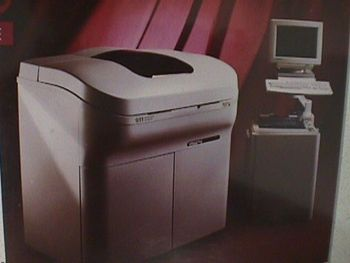
Roche Hitachi 911
 Roche · Model Hitachi 911
A computerized chemistry analyzer. Hitachi 911 (now the Roche Hitachi 911) uses plasma, serum, urine, and CSF sample types to execute in qualitative and vitro quantitative determination on a broad range of analysts. A fully automated, discrete analyzer comprising two units: control unit and analytical unit. Control unit is composed of a keyboard, a monitor (CRT), and a printer. The analytical unit involves a photometric measuring system, an ISE System and a CPU.Roche Hitachi 911 is a complete system with probes, manuals and waste outlet. It is capable of performing both potentiometric and photometric assays. For photometric assays, it has a throughput capacity of 360 tests per hour. Its ISE module, with a throughput of 760 tests per hour, allows the automatic calibration of sodium, potassium and chloride levels.
Key tips
- ·Run QC controls before trusting any repair - an analyzer that passes self-test can still report clinically wrong results.
- ·Rule out a reagent lot change before opening the instrument - it can look exactly like a hardware fault.
- ·Centrifuge rotors have a hard retirement age/cycle limit regardless of visible condition - don't eyeball it.
Typical Failure Modes
Compiled for this model from its own documentation and established engineering knowledge for this equipment class - not from a verified service record. Confirm against the manufacturer's service manual.
Assay / QC failure across a channel or the whole system
HighSymptoms: Controls out of range, calibration fails, flagged results, drift over a shift.
Root cause: Reagent or cuvette issue, lamp ageing, a probe / mixer / wash-station fault, or ISE-module problems.
Sample / reagent probe clog or crash
MediumSymptoms: Short aspiration, no dispense, clot detection, probe-position error.
Root cause: Clogged or bent probe, or a clot in the sample.
Cuvette / reaction-rotor fault
MediumSymptoms: High cuvette blanks, non-uniform results by position, rotor-drive error.
Root cause: Worn / scratched cuvettes or a wash fault, or a rotor-drive fault.
ISE module fault (Na / K / Cl)
MediumSymptoms: Electrolyte results biased or noisy, ISE calibration fails.
Root cause: Aged ISE electrodes / reference, or a pinch-valve / tubing fault.
Water / vacuum / pressure system fault
MediumSymptoms: Multiple station alarms, priming failures, poor wash.
Root cause: Water / DI supply quality, a pump, or a vacuum / pressure regulator.
Serviceable Parts & Consumables
Serviceable items for this model, compiled from its documentation and engineering knowledge for this equipment class. Service class and relative cost are estimates, not manufacturer figures; no part numbers are given. Confirm intervals and pricing against the manufacturer.
Sample / reagent probes
Class Periodic replacementRel. cost $$R&R Moderate
Photometer lamp
Class Frequent wear itemRel. cost $$R&R Moderate
Reaction cuvettes / segment
Class Frequent wear itemRel. cost $$R&R Easy
ISE electrodes (Na / K / Cl) & reference
Class Frequent wear itemRel. cost $$R&R Fairly easy
Peristaltic / pinch-valve tubing
Class Frequent wear itemRel. cost $R&R Moderate
| Part | Service class | Relative cost | R&R difficulty |
|---|---|---|---|
| Sample / reagent probes | Periodic replacement | $$ | Moderate |
| Photometer lamp | Frequent wear item | $$ | Moderate |
| Reaction cuvettes / segment | Frequent wear item | $$ | Easy |
| ISE electrodes (Na / K / Cl) & reference | Frequent wear item | $$ | Fairly easy |
| Peristaltic / pinch-valve tubing | Frequent wear item | $ | Moderate |
Relative cost: $ lowest · $$$$ highest service-part cost for this equipment class. Not a price.
PM Checklist
Preventive-maintenance tasks typical of this equipment class. Perform to the manufacturer's procedure and your facility's policy - this is general reference, not a schedule for this specific unit.
- ·Daily QC controls run and reviewed
- ·Calibration verification per assay
- ·Routine cleaning and decontamination
- ·Scheduled reagent-path and pump-tubing maintenance
Troubleshooting Approach
A starting sequence for this model, compiled from its documentation and engineering knowledge for this equipment class. Follow the manufacturer's service documentation for the actual procedure.
Symptom: Assay or QC failure
- Run fresh controls at all levels.
- Confirm reagents are in date, correctly loaded and mixed.
- Run the photometer check and replace the lamp if energy is low.
- Clean the probes, mixers and wash stations.
- Recalibrate the affected assay / ISE module and re-run QC.
Symptom: Probe clog or crash
- Inspect the probe for a bend or blockage and clear it.
- Run the fluidics prime / wash cycle.
- Check for a clot in the sample.
- Verify liquid-level sensing and probe positioning.
- Replace the probe if aspiration is still short.
Typical Location
Where this class of equipment is typically deployed - general reference, not this unit's own placement record.
- Central / core laboratory
- Point-of-care testing stations
- Blood bank
- Microbiology lab
Documents & Manuals
No documents available for this device yet.
Safety & Recalls
Synced live from the FDA openFDA API.
- RECALL
Possible drug interference when using the Trinder reaction method on multiple Cobas Analyzers. Results of Trinder tests may be falsely decreased when the tests are run with urine samples (Creatinine plus and Uric Acid applications only) or blood samples collected before sufficient time has lapsed after the administration of the drugs Acetaminophen and N-acetylcysteine.
- RECALL
The current product labeling for Acetaminophen does not provide specific interference information for bilirubin, hemoglobin or lipemia. Additional testing has been performed to quantify the impact of these interferences at different concentrations and different levels of acetaminophen. Low serum concentrations of acetaminophen were included in the study.
- RECALL
A high recovery of the assay may be generated, which would lead to an underdosage of gentamicin being administered to the patient.
- RECALL
The bottle caps may be more difficult to remove than usual, and minor injuries may be caused by the application of the force required to open the bottles.
- RECALL
If a masked module is unmasked during the reagent registration process, the calibration parameters may be assigned to the wrong reagents, resulting in the reporting of incorrect control and sample results.
- RECALL
A software bug may result in pipetting from an incorrect reagent pack and/or assigning calibration curve parameters incorrectly.
- RECALL
Possible mismatch between patient and result.
- RECALL
Reported results may have a positive bias of up to 113% because inadequate cleaning instructions may result in carry-over of the following reagents: Online TDM carbamazepine, Online TDM gentamycin, Online TDM phenytoin, Online DAT cocaine II, Online DAT methadone II, Online DAT opiates II and Online DAT THC II.
- RECALL
Expired product (dated 2006.06) was shipped as replacement for recalled product.
- RECALL
A design change in the electrodes will result in incorrect potassium level results.
- RECALL
A contaminant will change the pH of the R2 bottle, causing deterioration of the enzyme, and resulting in incorrect or no results being reported.
- RECALL
Rotation of the instrument reagent compartment can cause a bubble to form in the neck of the reagent bottle causing premature liquid level detection and short sampling of the reagent, resulting in falsely low or zero patient results.
- RECALL
A software defect will allow the reporting out of believable, but clinically significant, erroneous results if the analyzer is in operation and a channel has been masked or not requested over a period of time.
- RECALL
May report falsely decreased patient results.
- RECALL
Patient samples with very high lactate values may falsely be reported as within the normal range without the instrument giving a warning flag to the technician.
- RECALL
Incorrect results, without a data flag, reported if one of the other reagent containers becomes depleted before the R1 reagent is depleted.
- RECALL
Test results may exhibit a positive bias when plasma samples are used for the assay.
Related calculators
From BioLab, for work done with this kind of equipment.
Troubleshoot this device with Bio
Describe a symptom or error code. Bio answers from this device's own documented error codes, failure modes, parts, and guides.
Ask Bio