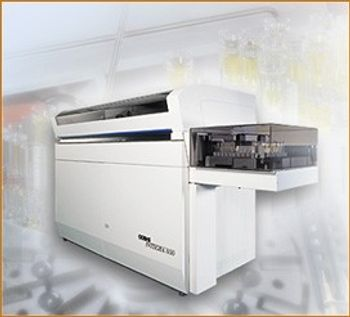
Roche Cobas Integra 800
 Roche · Model Cobas Integra 800
Real efficiency. More productivity. Quality of reagents. Quality of support.
Key tips
- ·Run QC controls before trusting any repair - an analyzer that passes self-test can still report clinically wrong results.
- ·Rule out a reagent lot change before opening the instrument - it can look exactly like a hardware fault.
- ·Centrifuge rotors have a hard retirement age/cycle limit regardless of visible condition - don't eyeball it.
Typical Failure Modes
Compiled for this model from its own documentation and established engineering knowledge for this equipment class - not from a verified service record. Confirm against the manufacturer's service manual.
Assay / QC failure across a channel or the whole system
HighSymptoms: Controls out of range, calibration fails, flagged results, drift over a shift.
Root cause: Reagent or cuvette issue, lamp ageing, a probe / mixer / wash-station fault, or ISE-module problems.
Sample / reagent probe clog or crash
MediumSymptoms: Short aspiration, no dispense, clot detection, probe-position error.
Root cause: Clogged or bent probe, or a clot in the sample.
Cuvette / reaction-rotor fault
MediumSymptoms: High cuvette blanks, non-uniform results by position, rotor-drive error.
Root cause: Worn / scratched cuvettes or a wash fault, or a rotor-drive fault.
ISE module fault (Na / K / Cl)
MediumSymptoms: Electrolyte results biased or noisy, ISE calibration fails.
Root cause: Aged ISE electrodes / reference, or a pinch-valve / tubing fault.
Water / vacuum / pressure system fault
MediumSymptoms: Multiple station alarms, priming failures, poor wash.
Root cause: Water / DI supply quality, a pump, or a vacuum / pressure regulator.
Serviceable Parts & Consumables
Serviceable items for this model, compiled from its documentation and engineering knowledge for this equipment class. Service class and relative cost are estimates, not manufacturer figures; no part numbers are given. Confirm intervals and pricing against the manufacturer.
Sample / reagent probes
Class Periodic replacementRel. cost $$R&R Moderate
Photometer lamp
Class Frequent wear itemRel. cost $$R&R Moderate
Reaction cuvettes / segment
Class Frequent wear itemRel. cost $$R&R Easy
ISE electrodes (Na / K / Cl) & reference
Class Frequent wear itemRel. cost $$R&R Fairly easy
Peristaltic / pinch-valve tubing
Class Frequent wear itemRel. cost $R&R Moderate
| Part | Service class | Relative cost | R&R difficulty |
|---|---|---|---|
| Sample / reagent probes | Periodic replacement | $$ | Moderate |
| Photometer lamp | Frequent wear item | $$ | Moderate |
| Reaction cuvettes / segment | Frequent wear item | $$ | Easy |
| ISE electrodes (Na / K / Cl) & reference | Frequent wear item | $$ | Fairly easy |
| Peristaltic / pinch-valve tubing | Frequent wear item | $ | Moderate |
Relative cost: $ lowest · $$$$ highest service-part cost for this equipment class. Not a price.
PM Checklist
Preventive-maintenance tasks typical of this equipment class. Perform to the manufacturer's procedure and your facility's policy - this is general reference, not a schedule for this specific unit.
- ·Daily QC controls run and reviewed
- ·Calibration verification per assay
- ·Routine cleaning and decontamination
- ·Scheduled reagent-path and pump-tubing maintenance
Troubleshooting Approach
A starting sequence for this model, compiled from its documentation and engineering knowledge for this equipment class. Follow the manufacturer's service documentation for the actual procedure.
Symptom: Assay or QC failure
- Run fresh controls at all levels.
- Confirm reagents are in date, correctly loaded and mixed.
- Run the photometer check and replace the lamp if energy is low.
- Clean the probes, mixers and wash stations.
- Recalibrate the affected assay / ISE module and re-run QC.
Symptom: Probe clog or crash
- Inspect the probe for a bend or blockage and clear it.
- Run the fluidics prime / wash cycle.
- Check for a clot in the sample.
- Verify liquid-level sensing and probe positioning.
- Replace the probe if aspiration is still short.
Technical Specs
- Height
- 120 cm
- Length
- 90 cm
- Weight
- 512 kg
- Width
- 190 cm
Typical Location
Where this class of equipment is typically deployed - general reference, not this unit's own placement record.
- Central / core laboratory
- Point-of-care testing stations
- Blood bank
- Microbiology lab
Documents & Manuals
No documents available for this device yet.
Safety & Recalls
Synced live from the FDA openFDA API.
- RECALL
Creatine Kinase (CK) Assay Abnormal calibrations on the cobas c 311/501/502 and COBAS INTEGRA 400 plus Analyzers may lead to erroneous results and misdiagnosis.
- RECALL
Roche received several complaints regarding increased control recovery and discrepant elevated results for the Iron Gen.2 (IRON2) assay on the cobas c311, 501, and 502 analyzers and on the COBAS Integra 400 plus analyzer.
- RECALL
Due to low Quality Control recovery and invalid Calibration.
- RECALL
COBAS INTEGRA 400 plus and cobas c 111 analyzers Additional Extra Wash Cycle Configurations and/or Batch Mode Needed for Specific Tests Due to Carry-over
- RECALL
The previous version of method sheets for the Acetaminophen assay on the COBAS INTEGRA 400 plus/800/800 CTS analyzers and the MODULAR ANALYTICS P module are missing the following statement in the Limitations-interference section: "In very rare cases, gammopathy, in particular type IgM (Waldenstrm s macroglobulinemia), may cause unreliable results."
- RECALL
.Roche Diagnostics has confirmed elevated QC and patient sample recovery for individual Tina-quant Hemoglobin A1c Gen.2 and Tina-quant Hemoglobin A1cDx Gen.2 cassettes/bottles. This issue occurred over multiple lots. Single cassettes/bottles of the reagents are affected. The issue can lead to erroneously high HbA1c results.
- RECALL
cobas c 111 analyzers (catalog numbers 04777433001 and 04528778001) with software versions up to and including 4.20 may encounter the following alarm: 7002: 108000572, A software error occurred. This alarm is generated due to a measurement timing error. Under very rare conditions, the instrument may process two tests in the same cuvette if the run restarts. If a used cuvette is used again result of the test(s) will be erroneous. These erroneous results may not be flagged. Falsely low or high patient results may lead to incorrect diagnostic measures and medical therapeutic decisions. The medical risk depends on the parameter.
- RECALL
Roche has received four reports of injury caused by the sharp edge of the center guide rail of an analyzers sample rack tray. The cleaning procedure for the sample rack tray has been revised to clarify the cleaning process.
- RECALL
Roche COBAS INTEGRA 800 system, Software Version 9864.C2 does not perform necessary ISE Service Actions. Whenever the ISE rack is removed, the ISE counters in the software are reset to zero and the corresponding Service Actions are not conducted automatically by the system. Additionally, certain maintenance activities that have to be performed manually by the operator are not requested on the sof
- RECALL
A software security issue with Oracles TNS-Listener component has been identified. TNS-Listener is supplied with the Roche COBAS INTEGRA 400/400 plus Analyzers. The Oracle TNS-Listener can be considered as an authentication and redirection component between the client and the database inside the Roche product. This means an attacker could register their own non-Roche database via remote access
- RECALL
The firm has recieved complaints of imprecision and erroneous patient results for calcium on the COBAS INTEGRA and COBAS c 501 system using reagent lots 62601901 and 63020401.
- RECALL
The cyclosporine sample pretreatment reagent lot was assigned an incorrect expiration date.
- RECALL
Some of the labels are glossy, resulting in the bar code being difficult to read by the bar code reader.
- RECALL
High Quality Control Recovery: Undetected high quality control recovery in bicarbonate assay.
- RECALL
The lower detection limit (LDL) may be a higher value than stated in the labeling. Note: To resolve this issue, the Digoxin LDL claim has been revised to 0.3 ng/mL for all reagent lots.
- RECALL
Falsely elevated IGGT results may be reported because the R2 reagent of the Tina-quant Gen.2 albumin assay has a carryover effect on the Immunoglobulin G (turbidimetric) assay on the COBAS INTEGRA 700 and 800 analyzers and the R1 reagent of the Tina-quant Hemoglobin A1c assay has a carryover effect on the Immunoglobulin G (turbidimetric) assay on the COBAS INTEGRA 800 analyzer.
- RECALL
The product is not uniform across the cassettes of some lots, which will result in an inconsistent bias of patient results.
- RECALL
After a cassette change, patient results and controls may be up to 40% too low or too high due to calibration factor variation.
Related calculators
From BioLab, for work done with this kind of equipment.
Troubleshoot this device with Bio
Describe a symptom or error code. Bio answers from this device's own documented error codes, failure modes, parts, and guides.
Ask Bio