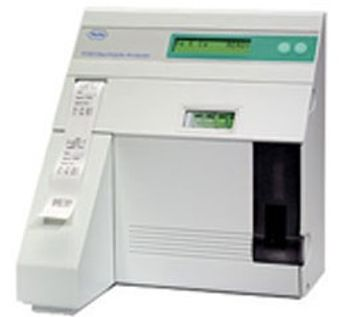
Roche 9180
 Roche · Model 9180
Stand-alone electrolyte analyzer. Measures 5 parameters, i.e., sodium, potassium, chloride, calcium and lithium. Low sample size. Sample type - whole blood, serum, plasma, urine dialysape, aqueous stds, qc. Sample application - syringe, sample cup, collection tubes, capillary. Fast analysis time. Fully automated callibration.
Key tips
- ·Run QC controls before trusting any repair - an analyzer that passes self-test can still report clinically wrong results.
- ·Rule out a reagent lot change before opening the instrument - it can look exactly like a hardware fault.
- ·Centrifuge rotors have a hard retirement age/cycle limit regardless of visible condition - don't eyeball it.
Typical Failure Modes
Compiled for this model from its own documentation and established engineering knowledge for this equipment class - not from a verified service record. Confirm against the manufacturer's service manual.
Sensor / electrode fault or drift
HighSymptoms: pH, pCO2, pO2, electrolyte, glucose / lactate or CO-oximetry results flagged, QC fails, stability / response errors.
Root cause: An electrode / membrane at end of life, an air bubble or protein in the measuring path, or a calibration fault.
Sample-path / inlet clog or clot
MediumSymptoms: Sample not aspirated, clot detected, inlet / preheater alarm.
Root cause: Clot in the inlet probe / preheater, or a worn inlet gasket.
Solution / cartridge / gas / waste fault
MediumSymptoms: Reagent-empty, gas-supply or waste-full alarm, calibration fails.
Root cause: Empty or expired solution pack / cartridge, an empty / expired gas cylinder, or a full waste container.
Pump / valve / pneumatic fault
MediumSymptoms: Poor sample transport, calibration or rinse failures, pressure alarms.
Root cause: Worn peristaltic pump tubing, a pinch-valve fault, or a pneumatic-pressure fault.
CO-oximetry / optical fault
MediumSymptoms: tHb, sO2 or dyshaemoglobin results implausible, optics / lamp error.
Root cause: Optics contamination, a lamp fault, or the haemolyser.
Serviceable Parts & Consumables
Serviceable items for this model, compiled from its documentation and engineering knowledge for this equipment class. Service class and relative cost are estimates, not manufacturer figures; no part numbers are given. Confirm intervals and pricing against the manufacturer.
Sensor cassette / individual electrodes & membranes
Class Frequent wear itemRel. cost $$$R&R Fairly easy
Solution pack / reagent cartridge
Class ConsumableRel. cost $$R&R Easy
Calibration gas cylinder
Class Frequent wear itemRel. cost $$R&R Easy
Peristaltic pump tubing / pinch valves
Class Frequent wear itemRel. cost $R&R Moderate
Inlet probe / preheater gasket
Class Frequent wear itemRel. cost $R&R Fairly easy
| Part | Service class | Relative cost | R&R difficulty |
|---|---|---|---|
| Sensor cassette / individual electrodes & membranes | Frequent wear item | $$$ | Fairly easy |
| Solution pack / reagent cartridge | Consumable | $$ | Easy |
| Calibration gas cylinder | Frequent wear item | $$ | Easy |
| Peristaltic pump tubing / pinch valves | Frequent wear item | $ | Moderate |
| Inlet probe / preheater gasket | Frequent wear item | $ | Fairly easy |
Relative cost: $ lowest · $$$$ highest service-part cost for this equipment class. Not a price.
PM Checklist
Preventive-maintenance tasks typical of this equipment class. Perform to the manufacturer's procedure and your facility's policy - this is general reference, not a schedule for this specific unit.
- ·Daily QC controls run and reviewed
- ·Calibration verification per assay
- ·Routine cleaning and decontamination
- ·Scheduled reagent-path and pump-tubing maintenance
Troubleshooting Approach
A starting sequence for this model, compiled from its documentation and engineering knowledge for this equipment class. Follow the manufacturer's service documentation for the actual procedure.
Symptom: Sensor flagged or QC fails
- Run the relevant calibration and check the sensor / electrode status screen.
- De-bubble / rinse the measuring path and check for protein deposits.
- Replace an electrode / membrane at end of life or that fails calibration.
- Confirm the solution pack and calibration gas are in date and not empty.
- Re-run QC at the relevant levels before releasing results.
Symptom: Sample not aspirated / clot
- Run the inlet / preheater clot-removal or rinse routine.
- Inspect the inlet probe and gasket.
- Replace the inlet gasket or probe.
- Confirm free sample aspiration with a QC sample.
- Replace worn pump tubing if transport is still poor.
Typical Location
Where this class of equipment is typically deployed - general reference, not this unit's own placement record.
- Central / core laboratory
- Point-of-care testing stations
- Blood bank
- Microbiology lab
Documents & Manuals
Safety & Recalls
Synced live from the FDA openFDA API.
- RECALL
May display Calcium results on the screen with wrong arrow direction which may lead to misinterpretation of results and incorrect medical decision. If the unit for iCa++ is set to mg/dL (configured as Service Code MGL) and a measured iCa++ value is lower than the normal range, an upward arrow is shown on the display instead of a downward arrow. The display is set per default to mmol/L; therefore, the arrow indicating an alarm reflects normal ranges of iCa++ in mmol/L. If mg/dL is chosen, the arrow warnings on screen still reflect the ranges from mmol/L, rather than mg/dL. The numeric result is displayed correctly.
Troubleshoot this device with Bio
Describe a symptom or error code. Bio answers from this device's own documented error codes, failure modes, parts, and guides.
Ask Bio