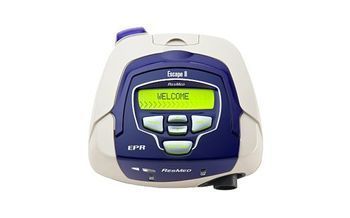
ResMed S8 Escape II CPAP
 ResMed · Model S8 Escape II CPAP
Whisper-quiet motor - Setting a new industry standard in quiet therapy and comfort, ResMed’s new sophisticated motor design delivers superior performance at a lower effort while cutting device noise significantly. By reducing noise, Easy-Breathe technology enables patients and their bed partners to sleep peacefully through the night. Easy-Breathe technology - Easy-Breathe technology combines new software, a quieter motor and improved EPR with Easy-Breathe for maximum comfort and a quiet night’s sleep. Pressure relief for more natural breathing - Featuring ResMed’s improved EPR with Easy-Breathe technology, the S8 Escape II offers pressure relief delivered in a smooth waveform that mimics patient breathing. With a choice of three different EPR comfort levels, the S8 Escape II with Easy-Breathe technology allows customized comfort for breathing that feels natural. Why prescribe EPR with Easy-Breathe? - Not all CPAP devices with pressure relief are the same. ResMed’s EPR with Easy-Breathe technology is supported by clinical studies, proving it as clinically effective as traditional fixed CPAP, but significantly more comfortable. EPR is preferred over traditional CPAP by 79% of patients.
Key tips
- ·Never disable a low-pressure/circuit-disconnect alarm while troubleshooting - silence it, don't disable it.
- ·Verify the O2 supply source and pressure before assuming an internal fault.
- ·Circuit type must match the patient population (adult/pediatric/neonatal) - a mismatched circuit invalidates delivered volumes.
Typical Failure Modes
Compiled for this model from its own documentation and established engineering knowledge for this equipment class - not from a verified service record. Confirm against the manufacturer's service manual.
Does not reach or hold set pressure
HighSymptoms: Therapy pressure low or unstable, cannot titrate, pressure-error alarm.
Root cause: Worn blower, an internal leak, a pressure-sensor fault, or a large mask / circuit leak.
Blower noisy / failing
MediumSymptoms: Loud or rattling blower, cannot meet flow demand, blower-error code.
Root cause: Worn blower bearings / motor.
Humidifier fault
MediumSymptoms: No or excessive humidity, water in the tubing, humidifier not heating, leak at the chamber.
Root cause: Humidifier heater plate, a chamber-seal fault, or a heated-tube fault.
Flow / pressure sensor drift
MediumSymptoms: Reported pressure or leak / AHI data implausible, fails verification.
Root cause: Sensor drift or a blocked sensing line.
Data / compliance download fault
LowSymptoms: SD card or modem data will not read, therapy data missing.
Root cause: SD card / slot fault or the wireless module.
Serviceable Parts & Consumables
Serviceable items for this model, compiled from its documentation and engineering knowledge for this equipment class. Service class and relative cost are estimates, not manufacturer figures; no part numbers are given. Confirm intervals and pricing against the manufacturer.
Blower / motor assembly
Class Periodic replacementRel. cost $$$R&R Difficult
Pressure / flow sensor
Class Major service partRel. cost $$R&R Moderate
Humidifier heater plate / chamber seal
Class Periodic replacementRel. cost $$R&R Fairly easy
Inlet air filter
Class ConsumableRel. cost $R&R Easy
SD card / wireless module
Class Periodic replacementRel. cost $R&R Fairly easy
| Part | Service class | Relative cost | R&R difficulty |
|---|---|---|---|
| Blower / motor assembly | Periodic replacement | $$$ | Difficult |
| Pressure / flow sensor | Major service part | $$ | Moderate |
| Humidifier heater plate / chamber seal | Periodic replacement | $$ | Fairly easy |
| Inlet air filter | Consumable | $ | Easy |
| SD card / wireless module | Periodic replacement | $ | Fairly easy |
Relative cost: $ lowest · $$$$ highest service-part cost for this equipment class. Not a price.
PM Checklist
Preventive-maintenance tasks typical of this equipment class. Perform to the manufacturer's procedure and your facility's policy - this is general reference, not a schedule for this specific unit.
- ·Daily pre-use check: self-test, circuit integrity, alarm function
- ·Scheduled circuit and inspiratory filter replacement per manufacturer interval
- ·Flow and pressure sensor calibration verification
- ·Battery load test and runtime check
- ·Annual full PM and electrical safety test
Troubleshooting Approach
A starting sequence for this model, compiled from its documentation and engineering knowledge for this equipment class. Follow the manufacturer's service documentation for the actual procedure.
Symptom: Will not hold set pressure
- Run the device's pressure-verification against a calibrated manometer with a test lung / cap.
- Check for internal leaks and a blocked sensing line.
- Confirm the mask / circuit is not the leak source.
- Replace the pressure sensor if it fails verification.
- Replace the blower if it cannot meet flow demand.
Symptom: Humidifier not working
- Confirm the heater plate warms and the chamber seats fully.
- Inspect the chamber seal and the heated-tube connector.
- Check the humidity setting and ambient conditions.
- Replace the chamber seal or heated tube.
- Replace the humidifier heater assembly if it will not heat.
Typical Location
Where this class of equipment is typically deployed - general reference, not this unit's own placement record.
- ICU / CCU
- Emergency Department
- Operating Room (anesthesia-adjacent)
- NICU
- Respiratory Therapy department
- Patient transport
Documents & Manuals
No documents available for this device yet.
Safety & Recalls
Synced live from the FDA openFDA API.
- RECALL
S8 devices manufactured between July 2004 and May 15, 2006 are susceptible to fatigue in the connection of the AC appliance inlet connector and the power supply (power cord) leading to possible failure (short circuit, electrical failure, sparks, smoke).
Troubleshoot this device with Bio
Describe a symptom or error code. Bio answers from this device's own documented error codes, failure modes, parts, and guides.
Ask Bio