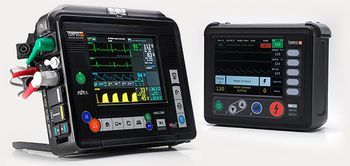
Remote Diagnostic Technologies Tempus ALS
 Remote Diagnostic Technologies · Model Tempus ALS
Fully ERC-compliant Large colour display (5.7″/14.5cm) Trusted Bi-phasic Truncated Exponential (BTE) waveform; 1 200J user-configurable energy levels; AED & manual modes; Synchronised cardioversion Pacer fixed, demand & overdrive Metronome & CPR feedback 3 lead ECG monitoring; 300 shocks at 200J 5 hours ECG monitoring Simple user interface Military grade robustness Fixed & rotary wing airworthiness IP66 ingress protection Automatic wired & wireless connectivity to the advanced monitor Large, colour touch screen display (6.5″/16.51cm) 3, 5 & 12-Lead ECG; 12-Lead interpretation Arrhythmia monitoring & alarms ST elevation & QT duration measurement with alarms Impedance respiration Masimo® SET® SpO? & pulse Masimo® SET® Rainbow® parameters PVI®, PI, SpMet®, SpCO™, SpHb®, SpOC® Suntech NIBP Medtronic Microstream® Capnometry Temperature (up to 2 channels) Invasive pressure (up to 4 channels); Advanced graphical & tabular trending More than 10 hours continuous monitoring Military grade robustness; Fixed & rotary wing airworthiness; IP66 ingress protection.
Key tips
- ·Never skip the daily/shift ready-check - a defibrillator found dead during a code is a real, repeated root-cause finding.
- ·Pads and batteries have real expiration dates - check them on every PM, not just at annual service.
- ·Verify energy-delivery accuracy with a real defibrillator analyzer, not just a self-test pass.
Typical Failure Modes
Compiled for this model from its own documentation and established engineering knowledge for this equipment class - not from a verified service record. Confirm against the manufacturer's service manual.
Fails the delivered-energy / discharge test
HighSymptoms: Delivered energy outside tolerance on the analyser, will not charge, or charges slowly.
Root cause: HV capacitor / charging-circuit ageing, or an output-relay fault.
Battery will not hold charge / fails readiness
HighSymptoms: Short standby, readiness indicator shows service, unit fails the self-test on battery.
Root cause: Aged battery pack or a charging fault.
Therapy cable / pads or paddles fault
MediumSymptoms: "Check pads", "connect electrodes", no ECG through pads, poor paceing capture.
Root cause: Worn therapy cable, expired pads, or a paddle / connector fault.
ECG / SpO2 / NIBP / CO2 parameter fault (defib-monitors)
MediumSymptoms: A monitoring parameter drops or is implausible.
Root cause: Patient cable / sensor or the parameter module.
Recorder / data fault
LowSymptoms: No printout, event data will not transfer.
Root cause: Thermal recorder or the data / Wi-Fi interface.
Serviceable Parts & Consumables
Serviceable items for this model, compiled from its documentation and engineering knowledge for this equipment class. Service class and relative cost are estimates, not manufacturer figures; no part numbers are given. Confirm intervals and pricing against the manufacturer.
Battery pack
Class Periodic replacementRel. cost $$R&R Easy
Therapy / defib cable
Class Periodic replacementRel. cost $$R&R Fairly easy
Multifunction pads
Class Frequent wear itemRel. cost $R&R Easy
HV / charging board
Class Major service partRel. cost $$$$R&R Difficult
Thermal recorder / print head
Class Periodic replacementRel. cost $$R&R Fairly easy
| Part | Service class | Relative cost | R&R difficulty |
|---|---|---|---|
| Battery pack | Periodic replacement | $$ | Easy |
| Therapy / defib cable | Periodic replacement | $$ | Fairly easy |
| Multifunction pads | Frequent wear item | $ | Easy |
| HV / charging board | Major service part | $$$$ | Difficult |
| Thermal recorder / print head | Periodic replacement | $$ | Fairly easy |
Relative cost: $ lowest · $$$$ highest service-part cost for this equipment class. Not a price.
PM Checklist
Preventive-maintenance tasks typical of this equipment class. Perform to the manufacturer's procedure and your facility's policy - this is general reference, not a schedule for this specific unit.
- ·Daily/shift visual and self-test check (AAMI EQ56 daily-ready standard)
- ·Battery and pad expiration-date tracking
- ·Energy-delivery accuracy test against a defibrillator analyzer
- ·Paddle/cable continuity check
- ·Annual full PM
Troubleshooting Approach
A starting sequence for this model, compiled from its documentation and engineering knowledge for this equipment class. Follow the manufacturer's service documentation for the actual procedure.
Symptom: Fails the discharge / energy test
- Run the full delivered-energy test at several settings with a defib analyser.
- Test synchronised cardioversion and, if fitted, pacing.
- Check the therapy cable and paddles.
- If energy is out of tolerance or charge time is long, remove from service.
- Refer the HV / charging board to the OEM.
Symptom: Fails readiness or dies on battery
- Fit a fully charged battery and repeat the self-test.
- Run a battery capacity test / calibration.
- Confirm the charger and charging contacts.
- Replace the battery pack when capacity is low.
- Log the readiness self-test result before returning to service.
Typical Location
Where this class of equipment is typically deployed - general reference, not this unit's own placement record.
- Crash carts (every unit)
- Emergency Department
- ICU
- OR
- Code-blue response areas
Documents & Manuals
Safety & Recalls
Synced live from the FDA openFDA API.
- RECALL
Patient monitor measures Intracranial Pressure (ICP) and Bladder Pressure (BDR) but ICP and BDR measurements have not been tested or validated for accuracy. If healthcare providers base clinical judgment on unvalidated measurements, this could potentially lead to incorrect clinical decisions.
- RECALL
Kit USB flash drive contains outdated software, which could result in reverting patient monitor to outdated software and reintroducing the video laryngoscope issue (related to an August 2023 recall), which could lead to delay in diagnosis, delayed treatment, hypoxia due to unexpected loss of video laryngoscopy and all other monitor measurements during system restart.
- RECALL
software issue that causes an error screen on a portable vital signs monitor when attaching video Laryngoscope.
- RECALL
Patient Monitor software update to address issues:1)May freeze at startup with MPM Application error and Attention Restart Required messages,2)Monitor may freeze and reboot at start of 12-lead ECG or after, 3)May reboot after intermittent connection with Smart Mount, 4) 12-lead ECG measurements with Louvain algorithm and software before vx.36 could produce inaccurate rhythm/morphology statements.
- RECALL
Due to incorrect labels applied to devices during servicing. Labels contain the incorrect product name and CAT number.
- RECALL
Simultaneous ECG measurements with multiple devices, including a manual defibrillator, on the same patient may cause electrical noise or interference, which may lead to distortions of the ECG signal; distortions may lead to no or ineffective pacing, or no or inappropriate defibrillation pulse.
- RECALL
Full screen error message may occur on patient monitors with affected hardware version, either during or after laryngoscopes are unplugged from monitors, informing users a 60-100 second shutdown/restart are required. Error prevents: viewing graphical patient vital signs, sounding of pulse audio tone, visualization of patient airway used during intubation; may lead to treatment delay or hypoxia.
- RECALL
Defibrillator/pacemaker module (DPM) may encounter a problem causing communication from the Mainboard to the DPM to fail, leading to no or ineffective pacing with displayed error message "HW failure DPM".
- RECALL
During internal testing, Regulatory Compliance issues were identified regarding the Monitor and Power Supplies for fluid ingress and basic safety issues.
- RECALL
Distribution of Defibrillators that are not approved or cleared for distribution US Market.
- RECALL
The Tempus Pro (Trizeps 7 only) when used in combination with a specified laryngoscope device can cause two error types when subsequently unplugged.
- RECALL
A software error was detected within software version 1.3.4 for the Tempus LS device. When exiting pacer back into manual mode the pacer pulse wave may put the ECG calibration out of calibration. This software error may result in a delay in therapy, as the clinician is not provided an ECG waveform on which a shockable rhythm decision can be made. The device is still able to deliver a manual defibrillation shock.
- RECALL
It was discovered that when a 12 Lead ECG is recorded and monitoring is quickly restarted, the ECG can cease functioning.
Troubleshoot this device with Bio
Describe a symptom or error code. Bio answers from this device's own documented error codes, failure modes, parts, and guides.
Ask Bio