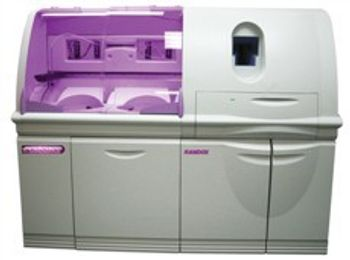
Randox Evidence
 Randox · Model Evidence
The Evidence has a 180 sample capacity and a throughput of up to 3960 tests per hour. A fully automated system, maximising walk-away time ensuring optimum laboratory productivity. The system is applicable to the analysis of multiple matrices, increasing the flexibility and utility of the Evidence. Multiplex testing delivers a fast and cost effective solution compared to traditional methods. Reduced sample volume of only 7uL is required, leaving more sample remaining for confirmatory testing.
Key tips
- ·Run QC controls before trusting any repair - an analyzer that passes self-test can still report clinically wrong results.
- ·Rule out a reagent lot change before opening the instrument - it can look exactly like a hardware fault.
- ·Centrifuge rotors have a hard retirement age/cycle limit regardless of visible condition - don't eyeball it.
Typical Failure Modes
Compiled for this model from its own documentation and established engineering knowledge for this equipment class - not from a verified service record. Confirm against the manufacturer's service manual.
QC / calibration failure on an assay
HighSymptoms: Controls out of range, calibration fails, flagged results on one or more assays.
Root cause: Reagent pack issue, a probe / dispense fault, incubation-temperature drift, or a detector / optics fault.
Sample / reagent probe or pipettor fault
MediumSymptoms: Short aspiration, no dispense, clot / level-sense errors, carryover.
Root cause: Clogged or bent probe, a syringe / pump fault, or a level-sense fault.
Wash / aspiration station fault
MediumSymptoms: High background / noise, poor precision, elevated blanks.
Root cause: Blocked wash-station nozzles or a wash-pump / vacuum fault.
Incubator temperature fault
MediumSymptoms: Assay drift or bias, incubation-temperature alarm.
Root cause: Incubator heater or temperature-sensor fault.
Detector / luminometer / photometer fault
MediumSymptoms: Low signal, high CV, detector-error message.
Root cause: PMT / detector ageing or an optics fault.
Serviceable Parts & Consumables
Serviceable items for this model, compiled from its documentation and engineering knowledge for this equipment class. Service class and relative cost are estimates, not manufacturer figures; no part numbers are given. Confirm intervals and pricing against the manufacturer.
Sample / reagent probe
Class Periodic replacementRel. cost $$R&R Moderate
Syringe / dispense pump
Class Periodic replacementRel. cost $$R&R Moderate
Wash-station nozzles / pump tubing
Class Frequent wear itemRel. cost $R&R Moderate
Incubator heater / temperature sensor
Class Major service partRel. cost $$R&R Moderate
Detector / PMT module
Class Major service partRel. cost $$$R&R Difficult
| Part | Service class | Relative cost | R&R difficulty |
|---|---|---|---|
| Sample / reagent probe | Periodic replacement | $$ | Moderate |
| Syringe / dispense pump | Periodic replacement | $$ | Moderate |
| Wash-station nozzles / pump tubing | Frequent wear item | $ | Moderate |
| Incubator heater / temperature sensor | Major service part | $$ | Moderate |
| Detector / PMT module | Major service part | $$$ | Difficult |
Relative cost: $ lowest · $$$$ highest service-part cost for this equipment class. Not a price.
PM Checklist
Preventive-maintenance tasks typical of this equipment class. Perform to the manufacturer's procedure and your facility's policy - this is general reference, not a schedule for this specific unit.
- ·Daily QC controls run and reviewed
- ·Calibration verification per assay
- ·Routine cleaning and decontamination
- ·Scheduled reagent-path and pump-tubing maintenance
Troubleshooting Approach
A starting sequence for this model, compiled from its documentation and engineering knowledge for this equipment class. Follow the manufacturer's service documentation for the actual procedure.
Symptom: QC or calibration failure
- Run fresh controls and recalibrate the affected assay.
- Confirm the reagent pack is in date, mixed and correctly loaded.
- Clean the probes and wash stations.
- Check the incubator temperature against a reference.
- Escalate a detector / optics fault to the OEM.
Symptom: Probe or pipettor fault
- Inspect the probe for a bend or clog and clear it.
- Run the fluidics prime.
- Check the syringe / pump and tubing for leaks or air.
- Verify level sensing and probe position.
- Replace the probe or syringe as found and re-run QC.
Typical Location
Where this class of equipment is typically deployed - general reference, not this unit's own placement record.
- Central / core laboratory
- Point-of-care testing stations
- Blood bank
- Microbiology lab
Documents & Manuals
Troubleshoot this device with Bio
Describe a symptom or error code. Bio answers from this device's own documented error codes, failure modes, parts, and guides.
Ask Bio