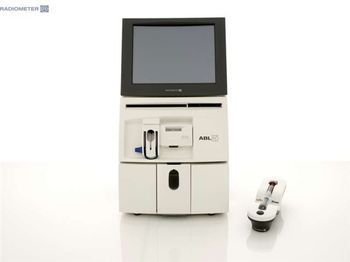
Radiometer ABL80 FLEX
 Radiometer · Model ABL80 FLEX
Fast TAT at the point of care. 100 seconds from result to result (140 seconds with CO-OX). Start-up time ~8 minutes after change of cassette (20 minutes with CO-OX). Sample volume of only 70 µL of whole blood (105 µL with CO-OX) Ease of use. Customizable user interface. Automated entry and logging of consumables enabled via smart chips. Simple and fast replacement of consumables. Fast and accurate data input with integrated barcode scanner Automatic quality control. Three levels (low, normal, high) of aqueous QC material spanning a broad portion of the reportable range. Continual system checks. Levey-Jennings plots for easy graphical overview Full flexibility. The small size fits anywhere. Carry or move it on a rolling stand. Several parameter panels and test volumes make it suitable for a variety of testing sites. Fully operational on batter Connectivity and seamless IT integration. Ethernet network connection ensures easy documentation. All common communication protocols, including POCT1-A*. Data backup with read/write CD drive and USB ports. The ABL80 FLEX is part of 1st automatic, the world’s first automatic blood gas analysis system.
Key tips
- ·Run QC controls before trusting any repair - an analyzer that passes self-test can still report clinically wrong results.
- ·Rule out a reagent lot change before opening the instrument - it can look exactly like a hardware fault.
- ·Centrifuge rotors have a hard retirement age/cycle limit regardless of visible condition - don't eyeball it.
Typical Failure Modes
Compiled for this model from its own documentation and established engineering knowledge for this equipment class - not from a verified service record. Confirm against the manufacturer's service manual.
Sensor / electrode fault or drift
HighSymptoms: pH, pCO2, pO2, electrolyte, glucose / lactate or CO-oximetry results flagged, QC fails, stability / response errors.
Root cause: An electrode / membrane at end of life, an air bubble or protein in the measuring path, or a calibration fault.
Sample-path / inlet clog or clot
MediumSymptoms: Sample not aspirated, clot detected, inlet / preheater alarm.
Root cause: Clot in the inlet probe / preheater, or a worn inlet gasket.
Solution / cartridge / gas / waste fault
MediumSymptoms: Reagent-empty, gas-supply or waste-full alarm, calibration fails.
Root cause: Empty or expired solution pack / cartridge, an empty / expired gas cylinder, or a full waste container.
Pump / valve / pneumatic fault
MediumSymptoms: Poor sample transport, calibration or rinse failures, pressure alarms.
Root cause: Worn peristaltic pump tubing, a pinch-valve fault, or a pneumatic-pressure fault.
CO-oximetry / optical fault
MediumSymptoms: tHb, sO2 or dyshaemoglobin results implausible, optics / lamp error.
Root cause: Optics contamination, a lamp fault, or the haemolyser.
Serviceable Parts & Consumables
Serviceable items for this model, compiled from its documentation and engineering knowledge for this equipment class. Service class and relative cost are estimates, not manufacturer figures; no part numbers are given. Confirm intervals and pricing against the manufacturer.
Sensor cassette / individual electrodes & membranes
Class Frequent wear itemRel. cost $$$R&R Fairly easy
Solution pack / reagent cartridge
Class ConsumableRel. cost $$R&R Easy
Calibration gas cylinder
Class Frequent wear itemRel. cost $$R&R Easy
Peristaltic pump tubing / pinch valves
Class Frequent wear itemRel. cost $R&R Moderate
Inlet probe / preheater gasket
Class Frequent wear itemRel. cost $R&R Fairly easy
| Part | Service class | Relative cost | R&R difficulty |
|---|---|---|---|
| Sensor cassette / individual electrodes & membranes | Frequent wear item | $$$ | Fairly easy |
| Solution pack / reagent cartridge | Consumable | $$ | Easy |
| Calibration gas cylinder | Frequent wear item | $$ | Easy |
| Peristaltic pump tubing / pinch valves | Frequent wear item | $ | Moderate |
| Inlet probe / preheater gasket | Frequent wear item | $ | Fairly easy |
Relative cost: $ lowest · $$$$ highest service-part cost for this equipment class. Not a price.
PM Checklist
Preventive-maintenance tasks typical of this equipment class. Perform to the manufacturer's procedure and your facility's policy - this is general reference, not a schedule for this specific unit.
- ·Daily QC controls run and reviewed
- ·Calibration verification per assay
- ·Routine cleaning and decontamination
- ·Scheduled reagent-path and pump-tubing maintenance
Error Codes
Extracted directly from this unit's own service manual.
1000The input field entry is not an acceptable value.
Enter an acceptable value in the input field.
1001The value entered (x) is not within the acceptable range (y-z) for this parameter.
Enter a value that falls within the acceptable input range.
1002Solution pack door latch is not fully connected.
Press on the solution pack door, near the top of the latch, until it snaps into place.
1004The system experienced a general read / write failure of the analyzer smart chip.
Contact your local Radiometer representative.
1005The system cannot read the analyzer's iButton.
Contact your local Radiometer representative.
1006Certain input fields have been configured for mandatory input and no information has been entered.
Enter information into all mandatory input fields.
1007The analyzer is unable to read and/or write to the analyzer's database.
Shutdown the analyzer then power it up again (re-boot). If the problem persists, contact your Radiometer representative.
1008Username has been configured for mandatory input.
Enter a valid username from the list of users on the Security screen.
1009Password has been configured for mandatory input.
Enter a valid password from the list of users on the Security screen.
1010A username has been entered that is not present in the list of users.
Enter a valid username from the list of users on the Security screen.
1011A password has been entered that is not present in the list of users. Note that the password field is case sensitive.
Enter a valid password from the user list, taking special note of the proper case for each letter.
1012The user password is expired.
Reset the user password in the Security screen.
1013The Administrator and Anonymous users cannot be deleted.
None
1014The user selected is a mandatory, default user. Editing is not allowed.
No action required
1015The query was unable to locate the requested information due to some type of system error.
Retry the query. If query fails, investigate the network communication status
1016No query results were received within the allowable time period.
Retry the query. If query fails, investigate the network communication status and speed
1017The network connection is not active.
Ensure the correct connection is selected on the Data Request tab of the Data Communications screen and it is active
1018The internal query was unable to find any matching information.
Verify the data upon which the query was based is accurate. Retry the query. If query fails, enter data manually
1019The query was unable to find any matching information.
Verify the data upon which the query was based is accurate. Retry the query. If query fails, enter data manually
1020The printer is unable to print successfully.
Verify the correct paper is being used and that the paper is properly loaded into the printer. If the printer error persists, contact your Radiometer representative
1021The charge state of the battery is not sufficient to complete the requested action.
Connect the analyzer to AC power.
1022At least one active parameter must be selected.
Select at least one active parameter in the custom parameter panel. (Only active parameters are available for selection.)
1023The system will not allow sensor cassette installation on battery power.
Connect the analyzer to AC power
1024The analyzer is currently on battery. The system requires AC power during an upgrade.
Connect the analyzer to AC power
1026The user is attempting to perform analysis while the analyzer has been manually locked.
Unlock the analyzer by proceeding to the Analyzer Lockout screen. (Menu > Settings > System > Analyzer Lockout)
1028The analyzer smart chip is not properly programmed.
Contact your Radiometer representative
1029The analyzer has experienced an unidentified error in reading or writing to the analyzer smart chip.
Contact your Radiometer representative
1030The Quick Key selection is not responding.
Use the main menu Menu button to select the desired function.
1031The analyzer has experienced an error accessing the CD drive.
Retry: if not successful contact your Radiometer representative
1032The analyzer is unable to locate the necessary files in the database to run video tutorials.
Contact your Radiometer representative
1033The system is unable to run the Video Tutorial feature.
Contact your Radiometer representative
Troubleshooting Approach
A starting sequence for this model, compiled from its documentation and engineering knowledge for this equipment class. Follow the manufacturer's service documentation for the actual procedure.
Symptom: Sensor / electrode fault or drift / QC failure
- Run the relevant calibration and check the sensor / electrode status screen.
- De-bubble / rinse the measuring path and check for protein deposits.
- Replace an electrode / membrane / sensor cassette at end of life or that fails calibration.
- Confirm the solution pack / reagent cartridge and calibration gas are in date and not empty.
- Re-run QC at the relevant levels before releasing results.
Symptom: Sample not aspirated / clot / inlet alarm
- Run the inlet / preheater clot-removal or rinse routine.
- Inspect the inlet probe and gasket.
- Replace the inlet gasket or probe.
- Confirm free sample aspiration with a QC sample.
- Replace worn peristaltic pump tubing if transport is still poor.
Symptom: Result flagged / questionable vs the clinical picture
- Repeat with a fresh sample / strip / cassette from correctly stored, in-date stock.
- Run the QC controls at each level.
- Confirm the meter / analyzer is coded / calibrated to the current lot.
- Clean the measurement chamber / strip port and the optics per the manual.
- Quarantine the lot if QC fails; refer the analyzer if QC passes but a result still looks wrong.
Symptom: Will not power on / short battery life / strip-port fault (handhelds)
- Fit fresh batteries or confirm the charger / dock.
- Clean the strip-port contacts / optics.
- Try several strips from a fresh vial.
- Replace the battery.
- Replace the meter if it will not read known-good strips.
Technical Specs
- Length
- 11 in
- Weight
- 19 lbs
- Width
- 9 in
Typical Location
Where this class of equipment is typically deployed - general reference, not this unit's own placement record.
- Central / core laboratory
- Point-of-care testing stations
- Blood bank
- Microbiology lab
Documents & Manuals
Safety & Recalls
Synced live from the FDA openFDA API.
- RECALL
ABL90 FLEX and ABL90 FLEX PLUS analyzers running with Radiometer Windows 10 versions RWIN10 1.0 and RWIN10 1.1 may unexpectedly freeze (the analyzer ceases to operate) during a sample measurement. The analyzer software includes a feature (watchdog) that detects a freeze and automatically restarts the software to continue operating the analyzer. However, even if a restart occurs, any sample being processed at that time will be lost, potential to lead to delay in test results.
- RECALL
Issue with analyzer when the pH of the calibration solution decreases during the in-use period potentially because of bacterial growth in the calibration solution bottles. This may result in a probability of reporting biased out-of-specification pH results on blood samples.
- RECALL
There is a potential for sporadic incidents of positive and negative biases for analyzer systems configured with cNa+, cCa+, and cK+.
- RECALL
Due to an issue with the internal clock of the analyzers with an e3800 PC unit installed.
- RECALL
Barcode readers on ALB900 and ABL800 analyzers used for measuring pH, blood gases, electrolytes, glucose, lactate, hematocrit and oximetry may misinterpret the contents of some barcode types not using a check digit for patient ID or accession number. Misinterpretation of a barcode, including e.g. patient ID or accession number, may result in patient mix up and/or delayed medical treatment.
- RECALL
Analyzer's barcode reader misinterprets the contents of barcode label used for entering patient ID or accession number. The issue is related to barcode types not using a check digit. This could result in patient mixup or loss of sample resulting in delayed medical treatment
- RECALL
Through internal investigation is has been determined that an incorrect component was used within the power supply. The incorrect component may cause a short circuit within the power supply resulting in a delay in treatment. The delay could result in a range of risk from cyanosis and low blood pressure to cardiac arrhythmias and severe impairment of cardiac function.
- RECALL
The firm received reports of occurrences where the barcode reader misinterpreted the contents of a locally printed barcode label used for entering patient ID or accession number into the analyzer in connection with a sample measurement. This could result is patient mixup and/or lost of sample, resulting in delayed medical treatment.
- RECALL
The analyzers fail on S7950 (Range +) QC measurements due to the hemolyzer cuvettes, a subcomponent of the optical system which measures ctHb and derivates. In a cuvette with light shunt, some of the received light has not been transmitted through the sample. This will lead to a perturbed and non-linear absorbance spectrum which results in measurement errors.
- RECALL
Software Security; The action is being initiated because of software security vulnerabilities with the firm's analyzer operating system, which may cause the device to shutdown or reboot resulting in delayed medical treatment.
- RECALL
From three incidents in Denmark and Sweden, comparison studies on patient blood samples carried out for quality assurance demonstrated that creatinine measurements as determined on analyzers could be underestimated with up to 28% as compared with measurements from COBAS. The underestimated creatinine occurs specifically, when measurements on Autocheck 6+ level 1 (also known as S7835 Autocheck module and abbreviated AC6+L1) are less than or equal to 230 micro-meter of a specified insert interval for AC6+L1 with insert limits 210 290 micro-meter. Ultimately, a lower read-out on patient samples is observed Customers are concerned about underestimation of creatinine results in patients, which are to undergo radiocontrast x-ray investigations. If these patients are not healthy, the exposure of radiocontrast agents may induce kidney insufficiency (contrast-induced nephropathy). Hazardous situ
- RECALL
The ABL90 FLEX can aspirate Cal 2 solution instead of rinse solution, when the following take place: The analyzer is in ready mode Operator lifts the inlet and then closes it again, thereby initiating a rinse Immediately after lifts the inlet and quickly closes it again
- RECALL
Reports that the sample type "cord blood" has been changed into the two sample types "cord blood arterial" and "cord blood venous.
- RECALL
The ABL90 analyzer does not always use the most recent calibration data to calculate patient results. This can in some cases lead to a biased patient result.
- RECALL
Negative drift on QC during in-use lifetime of CREA membranes can be observed.
- RECALL
RADIOMETER become aware that if the ABL90 FLEX is tilted, this may potentially cause a negative bias on sodium (Na+) results.
- RECALL
Following the receipt of two (2) reported customer complaints, the firm determined that the current operating software for their ABL 90 Analyzer does not prevent the further use of the sensor cassette when there is the possibility of iron rich plaque build-up in the reference electrode. If the device operator/user ignores the error message and continues to obtain biased measuring results using the
- RECALL
Due to a software error, a patient mix up can occur on the ABL90. If a sample is pre-registered and the sample "fails" the next result will inherit the patient data from the previous result.
- RECALL
Analysis of customer data, (for ABL 8X7 customers) has shown that the reference membranes are out of analytical specifications when replaced as specified in the device labeling. These errors in analytical specifications could lead to inadequate or clinical interventions (therapy) or misleading interpretation of patient status in clinical settings.
- RECALL
Tube may break. The firm discovered that the yellowish/white tubes used in their blood gas analyzers (ABL800 Flex Series) were manufactured incorrectly. These tubes have the potential to break off at the black plastic connectors. The breakage may occur during the installation of the tubes or after a short time in use.
- RECALL
In some situations pre-registered patient data is not reset when leaving the pre-registration mode in the software. This occurs when a Safe Pico blood sampler associated with a specific patient is pre-registered in the analyzer by scanning a barcode.
- RECALL
Incorrect FI02 values: programming issue can cause incorrect values to be transmitted to the LIS when : 1)- The FIO2 result is edited in the manual sample processing mode--2)- An existing result is opened and FI02 is then edited and sent.....In both cases RADIANCE will transmit the original FI02 value, not the value that was edited.
Troubleshoot this device with Bio
Describe a symptom or error code. Bio answers from this device's own documented error codes, failure modes, parts, and guides.
Ask Bio