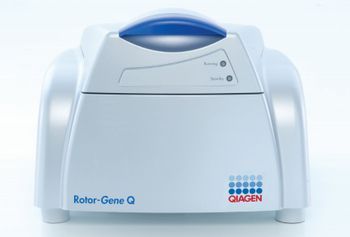
Qiagen Rotor-Gene Q
 Qiagen · Model Rotor-Gene Q
The Rotor-Gene Q uses a sophisticated heating and cooling design to achieve optimal reaction conditions. The unique rotary format ensures optimal thermal and optical uniformity between samples which is critical for precise and reliable analysis. Samples spin continually at 400 rpm during a run. Centrifugation prevents condensation and removes air bubbles, but does not pellet DNA. In addition, samples do not need to be spun down prior to a run. Samples are heated and cooled in a low-mass–air oven. Heating is achieved by a nickel-chrome element in the lid. The chamber is cooled by venting the air out through the top of the chamber while ambient air is blown up through the base.
Key tips
- ·Run QC controls before trusting any repair - an analyzer that passes self-test can still report clinically wrong results.
- ·Rule out a reagent lot change before opening the instrument - it can look exactly like a hardware fault.
- ·Centrifuge rotors have a hard retirement age/cycle limit regardless of visible condition - don't eyeball it.
Typical Failure Modes
Compiled for this model from its own documentation and established engineering knowledge for this equipment class - not from a verified service record. Confirm against the manufacturer's service manual.
Will not power on or unexpected shutdown
HighSymptoms: The laboratory & diagnostics is dead, reboots, or shuts down mid-use.
Root cause: Mains lead / fuse, an aged battery, or a power-supply board fault.
Battery will not hold charge
MediumSymptoms: Short run time on battery; low-battery alarm soon after a full charge.
Root cause: Aged rechargeable battery pack or a charger fault.
Display / control-panel fault
MediumSymptoms: Blank, dim or distorted display; unresponsive keys or touchscreen.
Root cause: Display, backlight, or control-board fault.
Fails self-test or calibration
MediumSymptoms: Power-on self-test or the scheduled performance check fails or is out of tolerance.
Root cause: Sensor drift or an internal board fault; recalibration or repair needed.
Serviceable Parts & Consumables
Serviceable items for this model, compiled from its documentation and engineering knowledge for this equipment class. Service class and relative cost are estimates, not manufacturer figures; no part numbers are given. Confirm intervals and pricing against the manufacturer.
Rechargeable battery pack
Class Periodic replacementRel. cost $$R&R Fairly easy
Power supply / mains board
Class Major service partRel. cost $$$R&R Difficult
Display / control-panel assembly
Class Major service partRel. cost $$$R&R Moderate
Cooling fan
Class Major service partRel. cost $R&R Moderate
| Part | Service class | Relative cost | R&R difficulty |
|---|---|---|---|
| Rechargeable battery pack | Periodic replacement | $$ | Fairly easy |
| Power supply / mains board | Major service part | $$$ | Difficult |
| Display / control-panel assembly | Major service part | $$$ | Moderate |
| Cooling fan | Major service part | $ | Moderate |
Relative cost: $ lowest · $$$$ highest service-part cost for this equipment class. Not a price.
PM Checklist
Preventive-maintenance tasks typical of this equipment class. Perform to the manufacturer's procedure and your facility's policy - this is general reference, not a schedule for this specific unit.
- ·Daily QC controls run and reviewed
- ·Calibration verification per assay
- ·Routine cleaning and decontamination
- ·Scheduled reagent-path and pump-tubing maintenance
Error Codes
Extracted directly from this unit's own service manual.
Chamber Lid OpenCould not continue run; the chamber lid was opened during a run.
Please reset the machine, and restart the software.
Communication CorruptedThis error occurs when the data received from the instrument does not conform to the expected pattern.
Communication Out SequenceInstrument has received data from the machine that is out of sequence.
Communication Protocol ErrorA communication protocol error occurred with this run.
Detector motor jam, stopped machineThis error can occur when the Rotor-Gene Q is started immediately after delivery in cold climates.
In this case, allow the instrument to acclimatize to room temperature for at least an hour before turning the instrument on. If the error persists, please contact your distributor or QIAGEN Technical Service.
Fatal Hardware MalfunctionThe instrument detected that there was a fatal hardware malfunction.
Do not attempt to re-use the machine until the machine has been serviced by your distributor.
Machine ErrorThis run was stopped as machine errors occurred that could not be recovered from.
Machine UnpluggedThe instrument is not responding and failed with the message <ERROR MESSAGE >.
This is an unrecoverable failure, please reset the instrument and restart the software.
Rotor Speed FailureTime out while setting the rotor speed.
Serial Port In UseThe serial port is currently being used by another application.
Close any applications such as communications or synchronization software and then retry.
Shutdown timeoutThe instrument has exceeded the expected time to shutdown.
Please reset the machine, and reset the software.
Temperature Protection ActivatedThe instrument detected that the chamber temperature increased above a safe level. It has therefore entered a self-protection mode.
Please turn off the instrument and contact your distributor if the problem persists.
Thermistor Is OpenThe instrument detected that the thermistor is open, and so to prevent damage to the machine, it has been turned off.
Please contact your distributor if this occurs again.
Unrecoverable errors occurredThis run was stopped as machine errors occurred that could not be recovered from.
Troubleshooting Approach
A starting sequence for this model, compiled from its documentation and engineering knowledge for this equipment class. Follow the manufacturer's service documentation for the actual procedure.
Symptom: QC / calibration failure across a channel or the whole system
- Run fresh controls at all levels and note which analytes fail.
- Confirm reagents are in date, correctly loaded, mixed and not bubbled.
- Run the photometer / lamp-energy check and replace the lamp if energy is low.
- Clean the sample and reagent probes, the mixers and the wash / cuvette-wash stations.
- Recalibrate the affected assay / ISE module and re-run QC.
Symptom: Sample or reagent probe clog / crash / short aspiration
- Inspect the probe for a bend or blockage and clear it (wire / sonicate per the manual).
- Run the fluidics prime and the probe-wash cycle.
- Check for a clot or fibrin in the sample and the liquid-level sensing.
- Verify probe positioning / alignment.
- Replace the probe if aspiration is still short.
Symptom: ISE electrolyte results biased or noisy / ISE calibration fails
- Run the ISE calibration and check the slope / drift against spec.
- Replace an ISE electrode or the reference that is at end of life.
- Check the ISE pinch valves and tubing for wear or air.
- Confirm the ISE standard packs are in date.
- Re-run ISE QC before releasing electrolyte results.
Symptom: High cuvette blanks / position-dependent results
- Run the cuvette blank / photometric check.
- Clean or replace worn / scratched cuvettes or the reaction segment.
- Check the cuvette-wash station nozzles and drying.
- Confirm the water / DI supply quality.
- Recalibrate and re-run QC.
Typical Location
Where this class of equipment is typically deployed - general reference, not this unit's own placement record.
- Central / core laboratory
- Point-of-care testing stations
- Blood bank
- Microbiology lab
Documents & Manuals
Safety & Recalls
Synced live from the FDA openFDA API.
- RECALL
Handbook Revision (Rev13) a dilution step is indicated as an Action when having the Flag SAMPLE_INT_CTRL_FAIL. A dilution of CRC tissue could lead to a false negative result. To remove ambiguity, an alteration must be made to the S the sample result with this flag should be interpreted as invalid
- RECALL
When using the Rotor-Gene Q with Software version 2.3.4 completing a LIMs export, the .csv file reports the calculated concentration result value as a logarithmic value, and could lead to a false negative result, which could lead to serious medical consequences such as the suspension or non-initiation of treatment
- RECALL
CMV RG PCR kits may contain a mixture of incorrect vials among the correct vials.
Related calculators
From BioLab, for work done with this kind of equipment.
Troubleshoot this device with Bio
Describe a symptom or error code. Bio answers from this device's own documented error codes, failure modes, parts, and guides.
Ask Bio