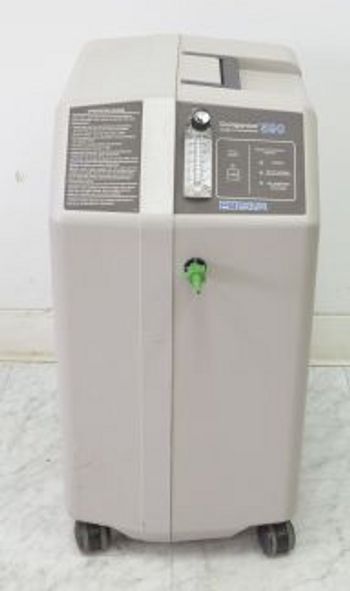
Puritan Bennett 590
 Puritan Bennett · Model 590
Puritan Bennett 590 Oxygen Concentrator The takes normal room air and, using a series of sieves, filters, and a compressor, removes the Nitrogen from the air, thereby increasing the oxygen content of the resulting air to up to 96%. They are used by patients with chronic respiratory ailments. The resulting concentrated oxygen is then delivered via an output tube from the unit to either an oxygen mask, tracheotomy mask or connector, or to a nasal cannula.
Key tips
- ·Don't extend filter/tubing replacement intervals to save cost - this is an infection-control issue, not just a performance one.
- ·Flow accuracy drift is often the earliest sign of a failing sensor, well before an outright alarm.
Typical Failure Modes
Compiled for this model from its own documentation and established engineering knowledge for this equipment class - not from a verified service record. Confirm against the manufacturer's service manual.
Low O2 concentration alarm
HighSymptoms: Oxygen-concentration alarm, delivered O2 below spec at flow.
Root cause: Aged sieve beds (molecular sieve), a compressor / valve fault, an air leak, or an inlet-filter blockage.
Compressor fault / will not build pressure
MediumSymptoms: Weak or no flow, compressor noisy or hot, thermal cut-out.
Root cause: Worn compressor / valve heads, or a cooling-fan fault.
Flow-control / flowmeter fault
MediumSymptoms: Flow will not adjust or does not match the setting.
Root cause: Worn flow-control valve or flowmeter.
Filter blockage
MediumSymptoms: Reduced performance, compressor working hard.
Root cause: Dirty gross-particle / cabinet / final bacteria filter.
Excessive noise / vibration
LowSymptoms: Loud operation, rattling.
Root cause: Worn compressor mounts or a loose panel.
Serviceable Parts & Consumables
Serviceable items for this model, compiled from its documentation and engineering knowledge for this equipment class. Service class and relative cost are estimates, not manufacturer figures; no part numbers are given. Confirm intervals and pricing against the manufacturer.
Molecular sieve beds
Class Periodic replacementRel. cost $$$R&R Difficult
Compressor / valve-head rebuild kit
Class Periodic replacementRel. cost $$$R&R Difficult
Inlet / cabinet / final filters
Class Frequent wear itemRel. cost $R&R Easy
Flow-control valve / flowmeter
Class Major service partRel. cost $$R&R Moderate
Cooling fan
Class Periodic replacementRel. cost $R&R Fairly easy
| Part | Service class | Relative cost | R&R difficulty |
|---|---|---|---|
| Molecular sieve beds | Periodic replacement | $$$ | Difficult |
| Compressor / valve-head rebuild kit | Periodic replacement | $$$ | Difficult |
| Inlet / cabinet / final filters | Frequent wear item | $ | Easy |
| Flow-control valve / flowmeter | Major service part | $$ | Moderate |
| Cooling fan | Periodic replacement | $ | Fairly easy |
Relative cost: $ lowest · $$$$ highest service-part cost for this equipment class. Not a price.
PM Checklist
Preventive-maintenance tasks typical of this equipment class. Perform to the manufacturer's procedure and your facility's policy - this is general reference, not a schedule for this specific unit.
- ·Filter and tubing replacement
- ·Flow accuracy check
- ·Annual full PM
Troubleshooting Approach
A starting sequence for this model, compiled from its documentation and engineering knowledge for this equipment class. Follow the manufacturer's service documentation for the actual procedure.
Symptom: Low O2 concentration alarm
- Verify O2 concentration with a calibrated analyser at the outlet at the rated flow.
- Replace / clean the inlet and cabinet filters.
- Check for air leaks in the pneumatic circuit and at the sieve-bed manifold.
- Replace worn sieve beds.
- Rebuild or replace the compressor / valves if concentration is still low with good sieve beds.
Symptom: Weak or no flow
- Confirm the flow-control valve operates and the flowmeter is not stuck.
- Check the filters.
- Feel whether the compressor builds pressure and is not overheating.
- Rebuild the compressor heads if worn.
- Verify flow and concentration after repair.
Technical Specs
- Height
- 25.4 in
- Length
- 16.5 in
- Weight
- 59 lbs
- Width
- 12.5 in
Typical Location
Where this class of equipment is typically deployed - general reference, not this unit's own placement record.
- Respiratory Therapy department
- Patient floors
- Emergency Department
- Home care (portable units)
Documents & Manuals
Troubleshoot this device with Bio
Describe a symptom or error code. Bio answers from this device's own documented error codes, failure modes, parts, and guides.
Ask Bio