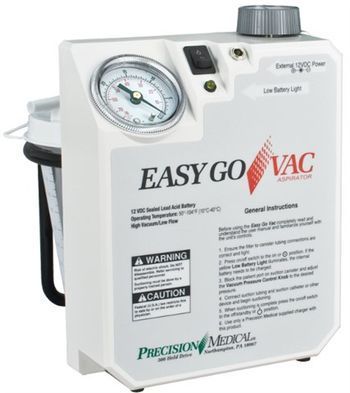
Precision Medical PM65
 Precision Medical · Model PM65
Delivers a vacuum range of 2-21 mmHg. Easy-to-read gauge allows the care giver to adjust the vacuum. The high performance battery allows 1.5 hours of run time. Uses any standard 800 cc canister and is visible in the carry bag while unit is in operation. The plastic cabinet is durable, attractive, easy-to-clean and infection control friendly. A float shut-off in the canister protects against overflow. An inline hydrophobic filter prevents back flow of fluid as well as airborne contaminants from entering the pump.
Key tips
- ·Always leak-test under load - a regulator that reads correctly at rest can still leak and fail in real use.
- ·Canister and tubing changes are an infection-control issue as much as a mechanical one.
Typical Failure Modes
Compiled for this model from its own documentation and established engineering knowledge for this equipment class - not from a verified service record. Confirm against the manufacturer's service manual.
Low or no suction
HighSymptoms: Weak or no vacuum at the patient port, slow to pull down, will not reach rated vacuum.
Root cause: Worn pump diaphragm / vanes, an air leak in the lid / tubing / overflow float, or a blocked filter.
Overflow / hydrophobic-filter blockage
MediumSymptoms: Suction drops suddenly, fluid near the pump, filter wet.
Root cause: Overflow shut-off triggered or a saturated / clogged bacteria filter.
Motor / pump fault
MediumSymptoms: Pump noisy, hot, runs slow, or trips its thermal cut-out.
Root cause: Worn motor bearings or pump head.
Battery will not hold charge (portable)
MediumSymptoms: Short run time, will not power on off mains.
Root cause: Aged battery.
Vacuum gauge / regulator fault
LowSymptoms: Gauge inaccurate or vacuum will not regulate.
Root cause: Gauge or regulator wear.
Serviceable Parts & Consumables
Serviceable items for this model, compiled from its documentation and engineering knowledge for this equipment class. Service class and relative cost are estimates, not manufacturer figures; no part numbers are given. Confirm intervals and pricing against the manufacturer.
Pump diaphragm / vane kit
Class Periodic replacementRel. cost $$R&R Moderate
Hydrophobic / bacteria filter
Class ConsumableRel. cost $R&R Easy
Collection-jar lid seals & float
Class Frequent wear itemRel. cost $R&R Easy
Motor / pump head
Class Major service partRel. cost $$$R&R Difficult
Battery (portable)
Class Periodic replacementRel. cost $$R&R Fairly easy
| Part | Service class | Relative cost | R&R difficulty |
|---|---|---|---|
| Pump diaphragm / vane kit | Periodic replacement | $$ | Moderate |
| Hydrophobic / bacteria filter | Consumable | $ | Easy |
| Collection-jar lid seals & float | Frequent wear item | $ | Easy |
| Motor / pump head | Major service part | $$$ | Difficult |
| Battery (portable) | Periodic replacement | $$ | Fairly easy |
Relative cost: $ lowest · $$$$ highest service-part cost for this equipment class. Not a price.
PM Checklist
Preventive-maintenance tasks typical of this equipment class. Perform to the manufacturer's procedure and your facility's policy - this is general reference, not a schedule for this specific unit.
- ·Regulator calibration and leak check
- ·Canister / tubing replacement
- ·Annual full PM
Troubleshooting Approach
A starting sequence for this model, compiled from its documentation and engineering knowledge for this equipment class. Follow the manufacturer's service documentation for the actual procedure.
Symptom: Low or no suction
- Fit a fresh bacteria filter and confirm the jar lid and seals are intact and seated.
- Cap the patient port and measure the vacuum the pump can pull against a gauge.
- Check the tubing and overflow float for leaks or a stuck shut-off.
- Rebuild the pump with the diaphragm / vane kit.
- Re-verify the rated vacuum and flow.
Symptom: Pump runs but poor performance / noisy
- Inspect the pump head and motor for wear.
- Check for a cracked jar or lid.
- Confirm the regulator and gauge.
- Rebuild or replace the pump head.
- Verify vacuum, flow and noise level after repair.
Technical Specs
- Height
- 8.875 in
- Length
- 6.687 in
- Weight
- 6.75 lbs
- Width
- 8.81 in
Typical Location
Where this class of equipment is typically deployed - general reference, not this unit's own placement record.
- Operating Room
- Emergency Department
- Patient floors (wall suction regulators)
- Central vacuum plant
Documents & Manuals
Troubleshoot this device with Bio
Describe a symptom or error code. Bio answers from this device's own documented error codes, failure modes, parts, and guides.
Ask Bio