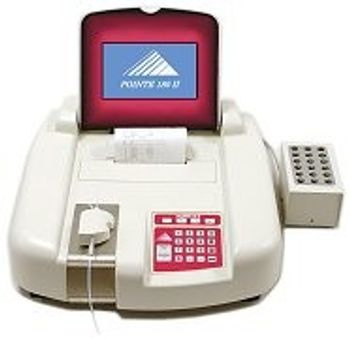
Pointe Scientific Pointe 180 II
 Pointe Scientific · Model Pointe 180 II
Bichromatic Photometer - Differential wavelengths to correct imperfections in test tubes or square cuvettes and to help remove interfering substances. Temperature controlled cuvette - Constant 37° C cuvette and cuvette well when optional tube or square cuvettes modes are used. Internal Temperature control - The analyzer monitors the incubator and cuvette temperatures. The temperatures are automatically corrected and the actual temperature in degrees (C) is displayed on the screen. Lamp Saver Feature - The instrument automatically shuts off the lamp if the instrument has not been used for 15 minutes. This feature can preserve the lamp for up to two years, depending on the actual usage. QC Tracking Feature - The instrument software can store control values and create Levy-Jennings plots. Work list and Patient reports - The instrument can create, stored and print work list and patient reports to on-board thermal printer to external printer and PC. Different Cuvette modes - The analyzer flowcell is removable to allow use of round 12 mm glass tube or 1 cm square cuvettes. Flip-up display - Large 240 x 128 pixel graphical display. Preprogrammed Chemistry Procedures - Optimized parameters for Pointe Scientific reagents are preprogrammed. 120 open channels. Kinetic Plots - Shows kinetic plots in real time. Maintenance Free - The analyzer does not require any scheduled maintenance procedures.
Key tips
- ·Run QC controls before trusting any repair - an analyzer that passes self-test can still report clinically wrong results.
- ·Rule out a reagent lot change before opening the instrument - it can look exactly like a hardware fault.
- ·Centrifuge rotors have a hard retirement age/cycle limit regardless of visible condition - don't eyeball it.
Typical Failure Modes
Compiled for this model from its own documentation and established engineering knowledge for this equipment class - not from a verified service record. Confirm against the manufacturer's service manual.
Assay / QC failure across a channel or the whole system
HighSymptoms: Controls out of range, calibration fails, flagged results, drift over a shift.
Root cause: Reagent or cuvette issue, lamp ageing, a probe / mixer / wash-station fault, or ISE-module problems.
Sample / reagent probe clog or crash
MediumSymptoms: Short aspiration, no dispense, clot detection, probe-position error.
Root cause: Clogged or bent probe, or a clot in the sample.
Cuvette / reaction-rotor fault
MediumSymptoms: High cuvette blanks, non-uniform results by position, rotor-drive error.
Root cause: Worn / scratched cuvettes or a wash fault, or a rotor-drive fault.
ISE module fault (Na / K / Cl)
MediumSymptoms: Electrolyte results biased or noisy, ISE calibration fails.
Root cause: Aged ISE electrodes / reference, or a pinch-valve / tubing fault.
Water / vacuum / pressure system fault
MediumSymptoms: Multiple station alarms, priming failures, poor wash.
Root cause: Water / DI supply quality, a pump, or a vacuum / pressure regulator.
Serviceable Parts & Consumables
Serviceable items for this model, compiled from its documentation and engineering knowledge for this equipment class. Service class and relative cost are estimates, not manufacturer figures; no part numbers are given. Confirm intervals and pricing against the manufacturer.
Sample / reagent probes
Class Periodic replacementRel. cost $$R&R Moderate
Photometer lamp
Class Frequent wear itemRel. cost $$R&R Moderate
Reaction cuvettes / segment
Class Frequent wear itemRel. cost $$R&R Easy
ISE electrodes (Na / K / Cl) & reference
Class Frequent wear itemRel. cost $$R&R Fairly easy
Peristaltic / pinch-valve tubing
Class Frequent wear itemRel. cost $R&R Moderate
| Part | Service class | Relative cost | R&R difficulty |
|---|---|---|---|
| Sample / reagent probes | Periodic replacement | $$ | Moderate |
| Photometer lamp | Frequent wear item | $$ | Moderate |
| Reaction cuvettes / segment | Frequent wear item | $$ | Easy |
| ISE electrodes (Na / K / Cl) & reference | Frequent wear item | $$ | Fairly easy |
| Peristaltic / pinch-valve tubing | Frequent wear item | $ | Moderate |
Relative cost: $ lowest · $$$$ highest service-part cost for this equipment class. Not a price.
PM Checklist
Preventive-maintenance tasks typical of this equipment class. Perform to the manufacturer's procedure and your facility's policy - this is general reference, not a schedule for this specific unit.
- ·Daily QC controls run and reviewed
- ·Calibration verification per assay
- ·Routine cleaning and decontamination
- ·Scheduled reagent-path and pump-tubing maintenance
Troubleshooting Approach
A starting sequence for this model, compiled from its documentation and engineering knowledge for this equipment class. Follow the manufacturer's service documentation for the actual procedure.
Symptom: Assay or QC failure
- Run fresh controls at all levels.
- Confirm reagents are in date, correctly loaded and mixed.
- Run the photometer check and replace the lamp if energy is low.
- Clean the probes, mixers and wash stations.
- Recalibrate the affected assay / ISE module and re-run QC.
Symptom: Probe clog or crash
- Inspect the probe for a bend or blockage and clear it.
- Run the fluidics prime / wash cycle.
- Check for a clot in the sample.
- Verify liquid-level sensing and probe positioning.
- Replace the probe if aspiration is still short.
Technical Specs
- Height
- 14 cm
- Wavelength Range
- 340 to 630 nm
- Length
- 40 cm
- Detector
- Gallium-Aresnide-Phoshide photoiode.
- Weight
- 6.4 kg
- Light Source
- Tungsten Halogen, 10 watt, with automatic lamp saver.
- Width
- 37 cm
Typical Location
Where this class of equipment is typically deployed - general reference, not this unit's own placement record.
- Central / core laboratory
- Point-of-care testing stations
- Blood bank
- Microbiology lab
Documents & Manuals
No documents available for this device yet.
Safety & Recalls
Synced live from the FDA openFDA API.
- RECALL
A reduction in the reconstituted stability has been identified. Clinicians may notice a drop in recovery of the control after reconstitution, which could result in an out of specification result prior to the current reconstitution claim of 7 days. For this reason we suggest discontinuing use of the control set.
- RECALL
Crystals may be observed in the R1 reagent. Crystals may be a result of the reagent being frozen during transport. The crystals do not impact product performance.
- RECALL
Creatinine kit C7539-150 contains Creatinine reagent R1 that is labeled as Creatinine reagent R2 (30ml) and reagent R2 vial is labeled as R1 (120ml). With manual procedure, no result will be reported as the control will be out of specifications.
- RECALL
A process deviation occurred during the production of the R1 component which may affect its performance.
- RECALL
An additional 10% picric acid was added to the R2 component during production.
- RECALL
Turbidity formation could occur, resulting in invalid test results being reported out.
- RECALL
The firm initiated the recall due to the presence of visible contamination of the product.
- RECALL
Non-compliance with the Good Manufacturing Practice regulations, as the manufacturing process for this product had not been validated.
- RECALL
There is a loss of linearity. The product fails to maintain linearity specification of 500 mg/dL.
- RECALL
R2 reagent component may fail because it may contain R1 reagent. The reagent was rendered inoperative and would not pass the required quality control (calibration and quality control testing) before beginning running the bilirubin assay.
- RECALL
The product performance fails due to precipitation of the R2 component.
- RECALL
The R1 reagent has microbial contamination.
- RECALL
The product is unable to maintain the specification for linearity through the shelf life of the product.
- RECALL
The inability of the product to maintain stated performance specifications through the stated shelf life.
- RECALL
The R1 component may be contaminated with Serratia liquefaciens, resulting decreased absorbances and failure of the reagent to produce test results.
- RECALL
May be contaminated with microorganisms.
- RECALL
Failure of the reagent to produce test results. The R1 reagent may be contaminated with microorganisms.
- RECALL
Unexpected changes in QC and proficiency results due to QC and proficiency material matrix.
- RECALL
The reagent may be contaminated with microorganisms.
- RECALL
Open vial stability-Potential microbial growth in the alcohol standard and possible unexpected QC changes in the ammonia portion of the control due to the lack of validation for long-term open vial stability.
- RECALL
Product does not meet performance specifications through its labeled expiration period.
Related calculators
From BioLab, for work done with this kind of equipment.
Troubleshoot this device with Bio
Describe a symptom or error code. Bio answers from this device's own documented error codes, failure modes, parts, and guides.
Ask Bio