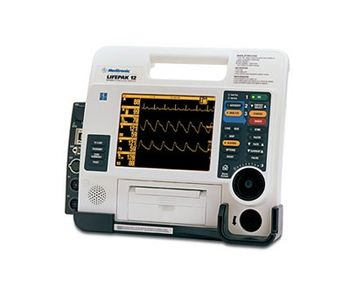
Physio-Control Lifepak 12
 Physio-Control · Model Lifepak 12
Compact and portable Paddle preference - your choice of standard paddles, pediatric paddles, and/or sterilizable internal and external paddles Compatible with QUIK-COMBO pacing/defibrillation/ECG electrodes Easy, simple, and affordable upgrades Guidance for compliance with HIPAA Security Standards for a Covered Entity available Advisory Mode (SAS) - Provides all features available except manual defibrillation, synchronous cardioversion and pacing Manual Mode - Provides normal operating capability for ALS users Setup Mode - Allows operator to customize the device Service Mode - Allows operator to execute device diagnostic tests and calibrations. Inservice Mode - Provides simulated waveforms for demonstration purposes.
Key tips
- ·Never skip the daily/shift ready-check - a defibrillator found dead during a code is a real, repeated root-cause finding.
- ·Pads and batteries have real expiration dates - check them on every PM, not just at annual service.
- ·Verify energy-delivery accuracy with a real defibrillator analyzer, not just a self-test pass.
Typical Failure Modes
Compiled for this model from its own documentation and established engineering knowledge for this equipment class - not from a verified service record. Confirm against the manufacturer's service manual.
Fails the daily / manual self-test or user test
HighSymptoms: Service wrench / "CALL SERVICE" indicator, failed self-test, will not arm therapy.
Root cause: Battery, internal electronics, or a therapy-circuit fault flagged by the self-test.
Defibrillation energy delivery fault
HighSymptoms: Will not charge, charges slowly, or delivered energy fails the analyser test.
Root cause: HV charging circuit, capacitor, or the paddle / therapy-cable path.
Battery will not hold charge / not recognised
HighSymptoms: Short run time, low-battery early, battery-fault indication.
Root cause: Aged FASTPAK / LiFePO4 battery, or a charging-system / BSS fault.
ECG / SpO2 / NIBP / EtCO2 parameter fault
MediumSymptoms: Noisy or absent ECG, SpO2 no signal, NIBP times out, EtCO2 will not zero.
Root cause: Worn patient cable / sensor, or a parameter-module fault.
Printer fault
LowSymptoms: No or faint strip, paper jam.
Root cause: Thermal print head or paper handling.
Serviceable Parts & Consumables
Serviceable items for this model, compiled from its documentation and engineering knowledge for this equipment class. Service class and relative cost are estimates, not manufacturer figures; no part numbers are given. Confirm intervals and pricing against the manufacturer.
Battery (FASTPAK / LiFePO4)
Class Periodic replacementRel. cost $$R&R Easy
Therapy / paddle cable
Class Periodic replacementRel. cost $$$R&R Easy
ECG patient cable / SpO2 sensor
Class Periodic replacementRel. cost $$R&R Easy
NIBP cuff and hose
Class Frequent wear itemRel. cost $R&R Easy
Thermal print head / paper
Class Periodic replacementRel. cost $R&R Fairly easy
| Part | Service class | Relative cost | R&R difficulty |
|---|---|---|---|
| Battery (FASTPAK / LiFePO4) | Periodic replacement | $$ | Easy |
| Therapy / paddle cable | Periodic replacement | $$$ | Easy |
| ECG patient cable / SpO2 sensor | Periodic replacement | $$ | Easy |
| NIBP cuff and hose | Frequent wear item | $ | Easy |
| Thermal print head / paper | Periodic replacement | $ | Fairly easy |
Relative cost: $ lowest · $$$$ highest service-part cost for this equipment class. Not a price.
PM Checklist
Preventive-maintenance tasks typical of this equipment class. Perform to the manufacturer's procedure and your facility's policy - this is general reference, not a schedule for this specific unit.
- ·Daily/shift visual and self-test check (AAMI EQ56 daily-ready standard)
- ·Battery and pad expiration-date tracking
- ·Energy-delivery accuracy test against a defibrillator analyzer
- ·Paddle/cable continuity check
- ·Annual full PM
Troubleshooting Approach
A starting sequence for this model, compiled from its documentation and engineering knowledge for this equipment class. Follow the manufacturer's service documentation for the actual procedure.
Symptom: Self-test fails / CALL SERVICE
- Run the manual user test with a fully charged, in-date battery.
- Note any fault code / message.
- Swap in a known-good battery.
- Verify defib energy delivery with a defibrillator analyser at several energy levels.
- If the self-test or energy test still fails, remove from service and refer to Physio-Control / Stryker.
Symptom: Battery / runtime problem
- Fully charge and check the battery status / capacity.
- Run the device on that battery and time it.
- Try a second known-good battery.
- Confirm the charger / BSS charges the battery to full.
- Retire batteries below the capacity threshold.
Technical Specs
- Height
- 12.5 in
- Length
- 9.1 in
- Weight
- 1.9 lbs
- Defibrillator Type
- External, Automated (AED)
- Width
- 15.6 in
Typical Location
Where this class of equipment is typically deployed - general reference, not this unit's own placement record.
- Crash carts (every unit)
- Emergency Department
- ICU
- OR
- Code-blue response areas
Documents & Manuals
- LifePak 12 Service ManualService Manual · External
- LifePak 12 Battery Support System 2 Operating InstructionsUser Manual · External
- LifePak 12 Operating InstructionsUser Manual · External
- LifePak 12 Operating Instructions # 2User Manual · External
- LifePak 12 Brochure and SpecsBrochure · External
- LifePak 12 AccessoriesDocument · External
- LifePak 12 Battery Support System 2 ChecklistDocument · External
- LifePak 12 ChecklistDocument · External
- LifePak 12 End of Life LetterDocument · External
- LifePak 12 Navigation HelpDocument · External
Troubleshoot this device with Bio
Describe a symptom or error code. Bio answers from this device's own documented error codes, failure modes, parts, and guides.
Ask Bio