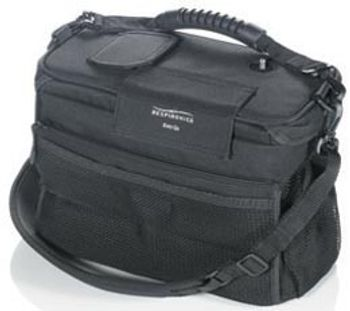
Philips EverGo Portable Oxygen Concentrator
 Philips Healthcare · Model EverGo Portable Oxygen Concentrator
8-Hour Battery Life, 1050 ml/minute Oxygen Capacity Mean More Freedom for Patients (based on 20 breaths / minute). Portable oxygen therapy solution that truly gives active patients the freedom they deserve. FAA - Approved for airline travel. Non-medical design looks like an ordinary carry-on bag or camcorder case. Lightweight. Easy-to-use touch screen interface controls all EverGo functions and clearly shows battery life and prescribed setting. Easy access to batteries makes them easy to change and charge – plus EverGo can be simultaneously charged and operated. Low maintenance just one easy-to-remove filter for patients to clean.
Key tips
- ·Don't extend filter/tubing replacement intervals to save cost - this is an infection-control issue, not just a performance one.
- ·Flow accuracy drift is often the earliest sign of a failing sensor, well before an outright alarm.
Typical Failure Modes
Compiled for this model from its own documentation and established engineering knowledge for this equipment class - not from a verified service record. Confirm against the manufacturer's service manual.
Low O2 concentration alarm
HighSymptoms: Oxygen-concentration alarm, delivered O2 below spec at flow.
Root cause: Aged sieve beds (molecular sieve), a compressor / valve fault, an air leak, or an inlet-filter blockage.
Compressor fault / will not build pressure
MediumSymptoms: Weak or no flow, compressor noisy or hot, thermal cut-out.
Root cause: Worn compressor / valve heads, or a cooling-fan fault.
Flow-control / flowmeter fault
MediumSymptoms: Flow will not adjust or does not match the setting.
Root cause: Worn flow-control valve or flowmeter.
Filter blockage
MediumSymptoms: Reduced performance, compressor working hard.
Root cause: Dirty gross-particle / cabinet / final bacteria filter.
Excessive noise / vibration
LowSymptoms: Loud operation, rattling.
Root cause: Worn compressor mounts or a loose panel.
Serviceable Parts & Consumables
Serviceable items for this model, compiled from its documentation and engineering knowledge for this equipment class. Service class and relative cost are estimates, not manufacturer figures; no part numbers are given. Confirm intervals and pricing against the manufacturer.
Molecular sieve beds
Class Periodic replacementRel. cost $$$R&R Difficult
Compressor / valve-head rebuild kit
Class Periodic replacementRel. cost $$$R&R Difficult
Inlet / cabinet / final filters
Class Frequent wear itemRel. cost $R&R Easy
Flow-control valve / flowmeter
Class Major service partRel. cost $$R&R Moderate
Cooling fan
Class Periodic replacementRel. cost $R&R Fairly easy
| Part | Service class | Relative cost | R&R difficulty |
|---|---|---|---|
| Molecular sieve beds | Periodic replacement | $$$ | Difficult |
| Compressor / valve-head rebuild kit | Periodic replacement | $$$ | Difficult |
| Inlet / cabinet / final filters | Frequent wear item | $ | Easy |
| Flow-control valve / flowmeter | Major service part | $$ | Moderate |
| Cooling fan | Periodic replacement | $ | Fairly easy |
Relative cost: $ lowest · $$$$ highest service-part cost for this equipment class. Not a price.
PM Checklist
Preventive-maintenance tasks typical of this equipment class. Perform to the manufacturer's procedure and your facility's policy - this is general reference, not a schedule for this specific unit.
- ·Filter and tubing replacement
- ·Flow accuracy check
- ·Annual full PM
Troubleshooting Approach
A starting sequence for this model, compiled from its documentation and engineering knowledge for this equipment class. Follow the manufacturer's service documentation for the actual procedure.
Symptom: Low O2 concentration alarm
- Verify O2 concentration with a calibrated analyser at the outlet at the rated flow.
- Replace / clean the inlet and cabinet filters.
- Check for air leaks in the pneumatic circuit and at the sieve-bed manifold.
- Replace worn sieve beds.
- Rebuild or replace the compressor / valves if concentration is still low with good sieve beds.
Symptom: Weak or no flow
- Confirm the flow-control valve operates and the flowmeter is not stuck.
- Check the filters.
- Feel whether the compressor builds pressure and is not overheating.
- Rebuild the compressor heads if worn.
- Verify flow and concentration after repair.
Technical Specs
- Height
- 8.5 in
- Length
- 12 in
- Weight
- 10 lbs
- Width
- 6 in
Typical Location
Where this class of equipment is typically deployed - general reference, not this unit's own placement record.
- Respiratory Therapy department
- Patient floors
- Emergency Department
- Home care (portable units)
Documents & Manuals
No documents available for this device yet.
Troubleshoot this device with Bio
Describe a symptom or error code. Bio answers from this device's own documented error codes, failure modes, parts, and guides.
Ask Bio