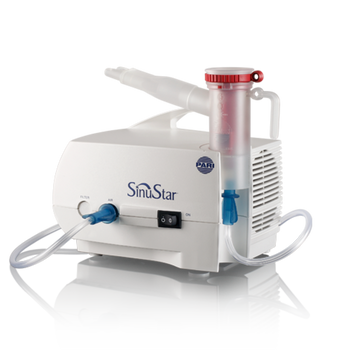
PARI SinuStar
 PARI · Model SinuStar
Designed for intranasal delivery of aerosol medication. PARI SinuStar™ is specifically designed for nasal and intranasal delivery of aerosol. PARI SinuStar™ directs aerosol toward the upper airway and produces small particles that can easily navigate the nasal cavity.
Key tips
- ·Never disable a low-pressure/circuit-disconnect alarm while troubleshooting - silence it, don't disable it.
- ·Verify the O2 supply source and pressure before assuming an internal fault.
- ·Circuit type must match the patient population (adult/pediatric/neonatal) - a mismatched circuit invalidates delivered volumes.
Typical Failure Modes
Compiled for this model from its own documentation and established engineering knowledge for this equipment class - not from a verified service record. Confirm against the manufacturer's service manual.
Does not reach or hold set pressure
HighSymptoms: Therapy pressure low or unstable, cannot titrate, pressure-error alarm.
Root cause: Worn blower, an internal leak, a pressure-sensor fault, or a large mask / circuit leak.
Blower noisy / failing
MediumSymptoms: Loud or rattling blower, cannot meet flow demand, blower-error code.
Root cause: Worn blower bearings / motor.
Humidifier fault
MediumSymptoms: No or excessive humidity, water in the tubing, humidifier not heating, leak at the chamber.
Root cause: Humidifier heater plate, a chamber-seal fault, or a heated-tube fault.
Flow / pressure sensor drift
MediumSymptoms: Reported pressure or leak / AHI data implausible, fails verification.
Root cause: Sensor drift or a blocked sensing line.
Data / compliance download fault
LowSymptoms: SD card or modem data will not read, therapy data missing.
Root cause: SD card / slot fault or the wireless module.
Serviceable Parts & Consumables
Serviceable items for this model, compiled from its documentation and engineering knowledge for this equipment class. Service class and relative cost are estimates, not manufacturer figures; no part numbers are given. Confirm intervals and pricing against the manufacturer.
Blower / motor assembly
Class Periodic replacementRel. cost $$$R&R Difficult
Pressure / flow sensor
Class Major service partRel. cost $$R&R Moderate
Humidifier heater plate / chamber seal
Class Periodic replacementRel. cost $$R&R Fairly easy
Inlet air filter
Class ConsumableRel. cost $R&R Easy
SD card / wireless module
Class Periodic replacementRel. cost $R&R Fairly easy
| Part | Service class | Relative cost | R&R difficulty |
|---|---|---|---|
| Blower / motor assembly | Periodic replacement | $$$ | Difficult |
| Pressure / flow sensor | Major service part | $$ | Moderate |
| Humidifier heater plate / chamber seal | Periodic replacement | $$ | Fairly easy |
| Inlet air filter | Consumable | $ | Easy |
| SD card / wireless module | Periodic replacement | $ | Fairly easy |
Relative cost: $ lowest · $$$$ highest service-part cost for this equipment class. Not a price.
PM Checklist
Preventive-maintenance tasks typical of this equipment class. Perform to the manufacturer's procedure and your facility's policy - this is general reference, not a schedule for this specific unit.
- ·Daily pre-use check: self-test, circuit integrity, alarm function
- ·Scheduled circuit and inspiratory filter replacement per manufacturer interval
- ·Flow and pressure sensor calibration verification
- ·Battery load test and runtime check
- ·Annual full PM and electrical safety test
Troubleshooting Approach
A starting sequence for this model, compiled from its documentation and engineering knowledge for this equipment class. Follow the manufacturer's service documentation for the actual procedure.
Symptom: Does not reach or hold the set pressure
- Run the device's pressure-verification against a calibrated manometer with a test lung / cap.
- Check for internal leaks and a blocked pressure-sensing line.
- Confirm the mask / circuit is not the leak source.
- Replace the pressure sensor if it fails verification.
- Replace the blower if it cannot meet flow demand.
Symptom: Blower noisy / failing / cannot meet flow
- Listen for bearing rumble or rattle from the blower.
- Check the inlet air filter is clean.
- Confirm no internal air leak.
- Replace the blower / motor assembly.
- Re-verify pressure and flow after replacement.
Symptom: Humidifier fault (no / excessive humidity, water in the tubing)
- Confirm the heater plate warms and the chamber seats fully.
- Inspect the chamber seal and the heated-tube connector.
- Check the humidity setting against ambient conditions.
- Replace the chamber seal or the heated tube.
- Replace the humidifier heater assembly if it will not heat.
Symptom: Therapy / compliance data will not download
- Try a known-good SD card in the correct slot.
- Check the card is not write-protected or corrupt.
- Confirm the wireless module / modem where fitted.
- Read the card on a PC to confirm data is being written.
- Replace the SD card / slot or the wireless module as isolated.
Typical Location
Where this class of equipment is typically deployed - general reference, not this unit's own placement record.
- ICU / CCU
- Emergency Department
- Operating Room (anesthesia-adjacent)
- NICU
- Respiratory Therapy department
- Patient transport
Documents & Manuals
Troubleshoot this device with Bio
Describe a symptom or error code. Bio answers from this device's own documented error codes, failure modes, parts, and guides.
Ask Bio