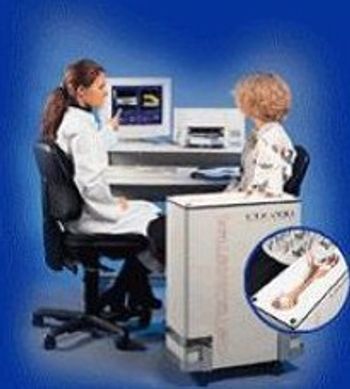
Osteometer Meditech DTX-200 DexaCare
 Osteometer Meditech · Model DTX-200 DexaCare
The DTX-200 DexaCare assesses forearm bone density with optimised precision and accuracy. The DTX-200 DexaCare is a unique x-ray densitometer for the assessment of bone density in the distal part of the forearm. The forearm is an excellent site because the forearm is representative of the total body bone mass. The DTX-200 DexaCare has won world-wide recognition for enabling fast, easy, reliable, inexpensive and cost-effective assessment as well as follow-up of bone density. This has led to several thousand units being installed throughout the world. The DTX-200 DexaCare is a unique dual energy X-ray bone densitometer that gives you the opportunity to assess and follow up on the patients' bone density. With the DTX-200 DexaCare the physician has an easy and cost-effective method with a throughput of up to 50 examinations per working day. One of the unique features of the DTX-200 DexaCare is the automatic identification of the 8 mm distance between ulna and radius. This ensures that the same area is assessed every time. The excellent in vivo accuracy (>97%) and in vivo precision (>99%) makes DTX-200 DexaCare highly suitable for assessment of bone density and follow-up. The DTX-200 DexaCare is a truly automated system. Every calibration, positioning, assessment and calculation is performed automatically, minimising operator errors. The straight forward procedures together with minimal operator intervention make the DTX-200 DexaCare instantly operational. The extensive database allows comparison with age-matched peers (Z-score) and premenopausal peers (T-score). The DTX-200 DexaCare can be placed in the examination room without special installation and shielding requirements. The outstanding calibration system makes it possible to finish an examination within 4.5 minutes. Due to its integrated, dynamic approach, the DTX-200 DexaCare provides the facility to give the answer to the patient today.
Key tips
- ·Never bypass a radiation interlock to "just get the image" - this is one of the few true zero-tolerance rules in BMET work.
- ·Trend image-quality phantom results over time - drift shows up before an outright failure does.
- ·Portable/mobile units take real physical abuse from transport - check wheel locks and cable strain reliefs more often than fixed units.
Typical Failure Modes
Compiled for this model from its own documentation and established engineering knowledge for this equipment class - not from a verified service record. Confirm against the manufacturer's service manual.
QC / calibration phantom out of tolerance
HighSymptoms: Daily spine / block phantom BMD trends out of control limits, or calibration fails.
Root cause: X-ray source output drift, detector degradation, or a calibration-drum / reference fault.
C-arm / table scanning-drive fault
MediumSymptoms: The scanning arm or table will not move smoothly, position error, scan aborts, image geometry wrong.
Root cause: Drive motor, belt, or an encoder / limit-sensor fault.
X-ray generation fault
MediumSymptoms: Exposure inhibited, kV error, no counts / very noisy scan.
Root cause: X-ray tube / HV supply, or the filter-wheel / calibration-drum.
Detector fault
MediumSymptoms: Missing scan lines, non-uniform image, detector-error message.
Root cause: Detector element / electronics degradation.
Workstation / software fault
LowSymptoms: Analysis software hangs, scans will not archive or transfer.
Root cause: Workstation PC or software fault.
Serviceable Parts & Consumables
Serviceable items for this model, compiled from its documentation and engineering knowledge for this equipment class. Service class and relative cost are estimates, not manufacturer figures; no part numbers are given. Confirm intervals and pricing against the manufacturer.
X-ray tube / HV supply
Class Major service partRel. cost $$$$R&R Expert-level
Detector assembly
Class Major service partRel. cost $$$$R&R Difficult
Scanning-drive motor / belt / encoder
Class Major service partRel. cost $$$R&R Difficult
Calibration drum / filter wheel
Class Major service partRel. cost $$$R&R Difficult
Workstation PC
Class Major service partRel. cost $$$R&R Moderate
| Part | Service class | Relative cost | R&R difficulty |
|---|---|---|---|
| X-ray tube / HV supply | Major service part | $$$$ | Expert-level |
| Detector assembly | Major service part | $$$$ | Difficult |
| Scanning-drive motor / belt / encoder | Major service part | $$$ | Difficult |
| Calibration drum / filter wheel | Major service part | $$$ | Difficult |
| Workstation PC | Major service part | $$$ | Moderate |
Relative cost: $ lowest · $$$$ highest service-part cost for this equipment class. Not a price.
PM Checklist
Preventive-maintenance tasks typical of this equipment class. Perform to the manufacturer's procedure and your facility's policy - this is general reference, not a schedule for this specific unit.
- ·Daily QC per modality: image-quality phantom test
- ·Tube and detector inspection
- ·Annual state-required radiation safety survey
- ·Vendor-scheduled preventive maintenance
Troubleshooting Approach
A starting sequence for this model, compiled from its documentation and engineering knowledge for this equipment class. Follow the manufacturer's service documentation for the actual procedure.
Symptom: QC phantom out of tolerance
- Repeat the daily phantom scan and apply the shift / drift rules.
- Confirm the phantom is correct and correctly positioned.
- Run the system calibration.
- Review the source / detector trend.
- Escalate a confirmed source or detector drift to the OEM; do not scan patients until QC is back in control.
Symptom: Scanning-drive / geometry fault
- Note the position / geometry error.
- Check for a mechanical obstruction on the arm / table.
- Run the drive self-test / calibration.
- Inspect the drive belt and encoder.
- Replace the drive component or refer as isolated.
Technical Specs
- Height
- 31 in
- Length
- 11 in
- Scan Protocols
- Forearm - Included
- Swing Away C-arm Capability
- N/A
- Bone Density Imaging Mode
- DEXA
- Width
- 23 in
Typical Location
Where this class of equipment is typically deployed - general reference, not this unit's own placement record.
- Radiology / Imaging department
- Emergency Department (portable units)
- Operating Room (C-arms)
- Cath lab
- Bedside ICU (portable X-ray)
Documents & Manuals
No documents available for this device yet.
Troubleshoot this device with Bio
Describe a symptom or error code. Bio answers from this device's own documented error codes, failure modes, parts, and guides.
Ask Bio