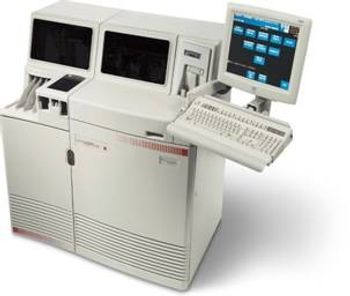
Ortho Clinical Diagnostics VITROS 350
 Ortho Clinical Diagnostics · Model VITROS 350
The VITROS 350 doesn’t require highly-trained operators - simple procedures allow around-the-clock availability to all members of the lab staff Easy to train and cross train operators Walk-away operation Quality control procedures are required just once each day and calibration intervals up to 6 months Ergonomically designed, flat low-glare LCD touch screen monitor Keyboard platform and support arm Flexible, customized positioning On-board documentation and help function Up to 300 results per hour On-board capacity for all 45 assays Primary tube sampling On-board dilution Flexible processing for manual, stat or automated testing Unique sample processing capabilities like disposable tips, bubble and clot detection assure confidence in results Self-monitoring alerts operators to prompt action, avoiding testing delays No plumbing, drains, vents, deionized water is required; all “waste” is contained in used test slides which are disposed daily.
Key tips
- ·Run QC controls before trusting any repair - an analyzer that passes self-test can still report clinically wrong results.
- ·Rule out a reagent lot change before opening the instrument - it can look exactly like a hardware fault.
- ·Centrifuge rotors have a hard retirement age/cycle limit regardless of visible condition - don't eyeball it.
Typical Failure Modes
Compiled for this model from its own documentation and established engineering knowledge for this equipment class - not from a verified service record. Confirm against the manufacturer's service manual.
Assay / QC failure across a channel or the whole system
HighSymptoms: Controls out of range, calibration fails, flagged results, drift over a shift.
Root cause: Reagent or cuvette issue, lamp ageing, a probe / mixer / wash-station fault, or ISE-module problems.
Sample / reagent probe clog or crash
MediumSymptoms: Short aspiration, no dispense, clot detection, probe-position error.
Root cause: Clogged or bent probe, or a clot in the sample.
Cuvette / reaction-rotor fault
MediumSymptoms: High cuvette blanks, non-uniform results by position, rotor-drive error.
Root cause: Worn / scratched cuvettes or a wash fault, or a rotor-drive fault.
ISE module fault (Na / K / Cl)
MediumSymptoms: Electrolyte results biased or noisy, ISE calibration fails.
Root cause: Aged ISE electrodes / reference, or a pinch-valve / tubing fault.
Water / vacuum / pressure system fault
MediumSymptoms: Multiple station alarms, priming failures, poor wash.
Root cause: Water / DI supply quality, a pump, or a vacuum / pressure regulator.
Serviceable Parts & Consumables
Serviceable items for this model, compiled from its documentation and engineering knowledge for this equipment class. Service class and relative cost are estimates, not manufacturer figures; no part numbers are given. Confirm intervals and pricing against the manufacturer.
Sample / reagent probes
Class Periodic replacementRel. cost $$R&R Moderate
Photometer lamp
Class Frequent wear itemRel. cost $$R&R Moderate
Reaction cuvettes / segment
Class Frequent wear itemRel. cost $$R&R Easy
ISE electrodes (Na / K / Cl) & reference
Class Frequent wear itemRel. cost $$R&R Fairly easy
Peristaltic / pinch-valve tubing
Class Frequent wear itemRel. cost $R&R Moderate
| Part | Service class | Relative cost | R&R difficulty |
|---|---|---|---|
| Sample / reagent probes | Periodic replacement | $$ | Moderate |
| Photometer lamp | Frequent wear item | $$ | Moderate |
| Reaction cuvettes / segment | Frequent wear item | $$ | Easy |
| ISE electrodes (Na / K / Cl) & reference | Frequent wear item | $$ | Fairly easy |
| Peristaltic / pinch-valve tubing | Frequent wear item | $ | Moderate |
Relative cost: $ lowest · $$$$ highest service-part cost for this equipment class. Not a price.
PM Checklist
Preventive-maintenance tasks typical of this equipment class. Perform to the manufacturer's procedure and your facility's policy - this is general reference, not a schedule for this specific unit.
- ·Daily QC controls run and reviewed
- ·Calibration verification per assay
- ·Routine cleaning and decontamination
- ·Scheduled reagent-path and pump-tubing maintenance
Troubleshooting Approach
A starting sequence for this model, compiled from its documentation and engineering knowledge for this equipment class. Follow the manufacturer's service documentation for the actual procedure.
Symptom: Assay or QC failure
- Run fresh controls at all levels.
- Confirm reagents are in date, correctly loaded and mixed.
- Run the photometer check and replace the lamp if energy is low.
- Clean the probes, mixers and wash stations.
- Recalibrate the affected assay / ISE module and re-run QC.
Symptom: Probe clog or crash
- Inspect the probe for a bend or blockage and clear it.
- Run the fluidics prime / wash cycle.
- Check for a clot in the sample.
- Verify liquid-level sensing and probe positioning.
- Replace the probe if aspiration is still short.
Technical Specs
- Sample Capacity
- 40 (4 trays of 10 samples)
- Throughput
- 3600 samples/hr
- Sample Types
- Serum, Plasma, Urine, CSF
- Sample Volume
- 5 to 11 µL
Typical Location
Where this class of equipment is typically deployed - general reference, not this unit's own placement record.
- Central / core laboratory
- Point-of-care testing stations
- Blood bank
- Microbiology lab
Documents & Manuals
Safety & Recalls
Synced live from the FDA openFDA API.
- RECALL
Multiple coatings of VITROS Chemistry Products AMYL Slides are showing imprecision on control fluids when compared to the expected within lab SD as listed on the Performance Verifier (PV) Assay Sheets.
- RECALL
Potentially Biased Results using VITROS Chemistry Products GLU Slides
- RECALL
Imprecision in the affected lot may produce negatively or positively biased patient sample and quality control fluid results.
- RECALL
The slides do not meet the maximum allowable interference (MAI) claims for triglyceride interference when using serum samples. Triglyceride interference on the Cl- Slide was observed around a triglyceride concentration 600mg/dL, however the current triglyceride interference claim states interference should not occur below 800mg/dL of triglyceride.
- RECALL
The slides failed to meet current claims for Limit of Blank (LoB), Limit of Detection (LoD) and Limit of Quantification (LoQ) for urine samples. The measuring range (15-300 mmol/L) for urine samples when tested with the Cl- slide is not affected. The current Cl- LoQ is 5 mmol/L and the LoQ determined by this investigation is 15 mmol/L.
- RECALL
The slides did not meet the current claims for Limit of Blank (LoB), Limit of Detection (LoD) and Limit of Quantification (LoQ) for serum and urine samples and therefore affecting the low end of the measuring range for this assay. The current low end measuring range is 0.05mg/dL for serum and 1.2mg/dL for urine. Based on the CREA testing results for the LoQ, the revised low end CREA measuring range is 0.15mg/dL for serum and 3.2mg/dL for urine.
- RECALL
There is a potential for biased results to be generated over the 10 day on-analyzer storage limit when using VITROS Na+ Slide cartridges warmed at room temperature and loaded onto the analyzer after using the minimum warm up requirements stated in the IFU. If Quality Control (QC) results are within acceptable limits, reported results are acceptable and were not affected by this issue.
- RECALL
Ortho Clinical Diagnostics confirmed that N-Acetylcysteine (NAC), a drug used for acetaminophen overdose, mucolytic therapy and is used as nutritional supplement, can interfere with VITROS GLU, LAC, TRIG, and URIC Slides assays. Ortho also tested several compounds following industry standard CLSI EP7-A2 for potential interference on VITROS GLU Slides during validation testing for a proposed change and confirmed Dextran 40 and Glutathione may interfere with current VITROS GLU Slides.
- RECALL
The firm is conducting a product correction due to an increase in U90-382 or 6LU condition codes (wash errors) when using VITROS Calibrator Kit 9, Lot 0954.
- RECALL
Potential for biased results using the specific lot of VITROS CHEMISTRY PRODUCTS TRIG slides.
- RECALL
Ortho Clinical Diagnostics identified a potential for biased results to be generated when using VITROS PHYT Slides, Lot 2613-0150-4913. Some positively biased results were identified during testing of a different VITROS PHYT Slide lot; the affected slides were not released for distribution. Since Lot 2613-0150-4913 was manufactured in the same event, there is the potential for slides from this lot to also be affected.
- RECALL
The firm identified a potential for biased carbamazepine (CRBM) results to be generated when using VITROS CRBM Slides, Lot 3920-0080-8403.
- RECALL
Ortho Clinical Diagnostics has recalled VITROS Chemistry Products Na+ Slides and the Calibrator Kit 2 due to false positive serum and plasma sample results.
- RECALL
Ortho Clinical Diagnostics issued a product correction notification for VITROS Chemistry Mixing Cup Arrays utilized on VITROS 250 and VITROS 350 Chemistry Systems. Increase in Software error due to affected Mixing Cup Arrays.
- RECALL
While performing interval testing, Ortho Clinical Diagnostics (OCD) determined that a surfactant was unintentionally added to VITROS Chemistry Products K+ Slides during the manufacturing process.
- RECALL
Ortho Clinical Diagnostics revised the VITROS Chemistry Products DGXN Slides Instructions for Use (IFU) and removed heparin plasma as a recommended specimen type for VITROS DGXN Slides
- RECALL
Ortho Clinical Diagnostics received complaints of lower than expected results (< 6 U/L) for samples that were known to be outside of the measuring (reportable) range (> 1000 U/L) when using Calibration Diskette/Assay Data Diskette Data Release Version (DRV) 5653 through 5666 and VITROS Chemistry Products ALT Slides, Generation (GEN) 26 (Product Code 1655281).
- RECALL
Ortho Clinical Diagnostics (OCD) received customer complaints of intermittent imprecision, outliers, or shifts in control fluid values when using various lots of VITROS Chemistry Products PHBR Slides (Phenobarbital) from Coating 0053.
Related calculators
From BioLab, for work done with this kind of equipment.
Troubleshoot this device with Bio
Describe a symptom or error code. Bio answers from this device's own documented error codes, failure modes, parts, and guides.
Ask Bio