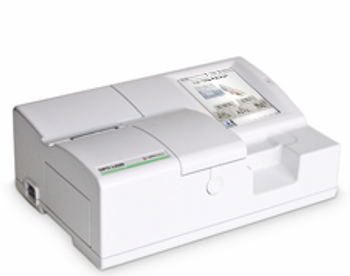
OPTI Medical Systems OptiLion
 OPTI Medical Systems · Model OptiLion
Calibration of cassette before sampling - avoids sample loss Test parameters - Na+, K+, Cl–, Ca++ and pH Safe disposal - waste is stored in cassette Maintenance-free operation - no electrodes Zero standby cost - no reagents required.
Key tips
- ·Run QC controls before trusting any repair - an analyzer that passes self-test can still report clinically wrong results.
- ·Rule out a reagent lot change before opening the instrument - it can look exactly like a hardware fault.
- ·Centrifuge rotors have a hard retirement age/cycle limit regardless of visible condition - don't eyeball it.
Typical Failure Modes
Compiled for this model from its own documentation and established engineering knowledge for this equipment class - not from a verified service record. Confirm against the manufacturer's service manual.
Cassette read / barcode fault
MediumSymptoms: Cassette barcode not read, wrong lot applied, cassette-error message.
Root cause: Damaged or unreadable barcode (use Manual Entry), or a barcode-reader / optics fault.
Result flagged / QC failure
HighSymptoms: Electrolyte / metabolite result flagged, QC out of range, calibration fails.
Root cause: Expired or mishandled cassette, an air bubble / short sample, or an optical / measurement fault.
Sample Measurement Chamber (SMC) / cover fault
MediumSymptoms: Cover will not open / close, cassette not seated, SMC error.
Root cause: Worn cover-release mechanism or the SMC seating.
Optics / measurement fault
MediumSymptoms: Repeated optical errors across cassettes.
Root cause: Optics contamination or an LED / detector fault.
Battery / power fault
LowSymptoms: Short battery life, will not power on.
Root cause: Aged battery.
Serviceable Parts & Consumables
Serviceable items for this model, compiled from its documentation and engineering knowledge for this equipment class. Service class and relative cost are estimates, not manufacturer figures; no part numbers are given. Confirm intervals and pricing against the manufacturer.
Test cassettes
Store per the insert; expiry / heat degrade them.
Class Frequent wear itemRel. cost $$R&R Easy
QC controls
Class Frequent wear itemRel. cost $$R&R Easy
SMC cover-release mechanism
Class Periodic replacementRel. cost $$R&R Moderate
Barcode reader / optics
Class Major service partRel. cost $$R&R Moderate
Battery
Class Periodic replacementRel. cost $$R&R Fairly easy
| Part | Service class | Relative cost | R&R difficulty |
|---|---|---|---|
| Test cassettes Store per the insert; expiry / heat degrade them. | Frequent wear item | $$ | Easy |
| QC controls | Frequent wear item | $$ | Easy |
| SMC cover-release mechanism | Periodic replacement | $$ | Moderate |
| Barcode reader / optics | Major service part | $$ | Moderate |
| Battery | Periodic replacement | $$ | Fairly easy |
Relative cost: $ lowest · $$$$ highest service-part cost for this equipment class. Not a price.
PM Checklist
Preventive-maintenance tasks typical of this equipment class. Perform to the manufacturer's procedure and your facility's policy - this is general reference, not a schedule for this specific unit.
- ·Daily QC controls run and reviewed
- ·Calibration verification per assay
- ·Routine cleaning and decontamination
- ·Scheduled reagent-path and pump-tubing maintenance
Error Codes
Extracted directly from this unit's own service manual.
ERROR! - Short SampleDiscard Cassette.
Discard Cassette.
ERROR! - Invalid BarcodeCheck Time and Date.
Check Time and Date.
ERROR! - Invalid Calibration CassetteThe cassette placed in the SMC is invalid. Verify that the cassette placed in the SMC is a valid calibration cassette.
Verify that the cassette placed in the SMC is a valid calibration cassette.
ERROR! - Invalid QC LotThe QC lot is invalid.
Configure the control material under <Setup> and retry.
ERROR! - Invalid SRCThe SRC type is invalid.
Remove the SRC. Configure the SRC data in <Setup> and retry.
ERROR! - Expired SRCThe SRC expiration date has been reached.
Press and remove the SRC. If the error message appears again, check the date in <System ->Time and Date>. Configure a new SRC under <Setup> and retry.
ERROR! - No ResponseThe OPTI LION received no response from the host computer.
Retry. If the problem persists: Check connection between the OPTI LION and the host computer. Check the OPTI LION's communication configuration under <System -> Hardware>. Check the host computer.
ERROR! - Host not ReadyThe OPTI LION received a negative (NAK) response from the host computer.
Retry. If the problem persists: Check the host computer or contact the facility IT manager.
ERROR! - Need Setup QCA measurement of QC materials, either liquid or SRCs, was attempted prior to setting up.
Press to continue. Configure the SRCs and/or liquid QC material under <Setup> and retry.
ERROR! - Dirty OpticsThe analyzer is unable to calibrate the sample light gates due to dirty optics or cassette.
Remove and discard the cassette. Inspect and clean the optics glass inside the sample measurement chamber. Press to continue. Check the LEDs (See Section 7.2.3).
ERROR! - Invalid PINThe PIN number does not exist in current Secure Op. ID database.
Press to continue. Retry with a valid PIN number.
STOP! - System ErrorThe instrument has detected an internal error.
Discard the cassette. Turn the power off, wait 30 seconds and then turn the power back on.
STOP! - Memory ErrorDatabase deleted.
Press and the instrument will reinitialize. Reenter System QC, SRC and setup information.
Troubleshooting Approach
A starting sequence for this model, compiled from its documentation and engineering knowledge for this equipment class. Follow the manufacturer's service documentation for the actual procedure.
Symptom: Cassette read fault
- If the barcode is damaged, press Manual Entry and key the barcode digits.
- Use Last Entry to recall the lot if it is the same as the previous sample.
- Clean the barcode-reader window.
- Retry with a fresh cassette.
- Refer the reader if it still will not scan.
Symptom: Result flagged / QC fails
- Repeat with a fresh cassette from a correctly stored, in-date box and a bubble-free, adequate sample.
- Run the QC controls.
- Clean the SMC and optics per the manual.
- Quarantine the cassette lot if QC fails; refer the analyzer if QC passes but a result still looks wrong.
- Contact OPTI support with any persistent error code.
Typical Location
Where this class of equipment is typically deployed - general reference, not this unit's own placement record.
- Central / core laboratory
- Point-of-care testing stations
- Blood bank
- Microbiology lab
Documents & Manuals
- OPTIMedical OptiLion Operator Manual.pdfUser Manual · External
- OPTIMedical OptiLion Quick Reference Guide.pdfUser Manual · External
- Quick Reference Guide.pdfUser Manual · External
- Operator Manual.pdfUser Manual · External
- OPTIMedical OptiLion Brochure.pdfBrochure · External
- Brochure.pdfBrochure · External
Safety & Recalls
Synced live from the FDA openFDA API.
- RECALL
Incorrect results/stability failure; Actual device stability studies show sodium and chloride sensors age differently than anticipated when stored at the high end of labeled storage, therefore subsequent measurements give results outside the allowed error allowance before the 6 month expiration date shown on the device.
Troubleshoot this device with Bio
Describe a symptom or error code. Bio answers from this device's own documented error codes, failure modes, parts, and guides.
Ask Bio