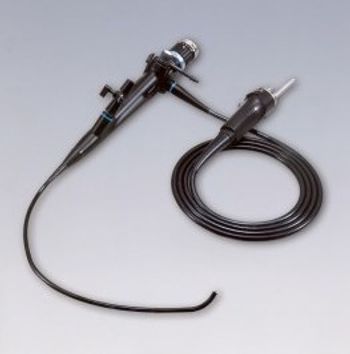
Olympus CHF-P60
 Olympus · Model CHF-P60
Better Image Quality -Even though the distal end is the same as the CHF-P20 (4.9mm) the number of image fibres has increased by 38% creating better image quality for improved visualisation. Large Instrument Channel for use with the largest range of accessories -The CHF-P60 has the largest instrument channel (2.2mm) of the Olympus range allowing a larger range of accessories to be used for retrieval of larger stones. Compatible with STERRAD® for compliance with new BSG Guidelines -Olympus CHF-P60 choledochofiberscope (with a special identification mark) has material compatibility with STERRAD® 100S/NX sterilization systems and STERRAD® 100NX (when operating on the ‘DUO’ cycle) to comply with the latest BSG guidelines for the sterilisation of invasive endoscopes.
Key tips
- ·A failed leak test means the scope does not get reprocessed or used - send it for repair, full stop.
- ·A shortened reprocessing cycle is a real infection-control failure, not a minor deviation - follow AAMI ST91 exactly.
- ·Track light-source lamp-hours against the manufacturer's limit rather than running to failure.
Typical Failure Modes
Compiled for this model from its own documentation and established engineering knowledge for this equipment class - not from a verified service record. Confirm against the manufacturer's service manual.
Fails the leak test
HighSymptoms: The manual or automated leak test fails; bubbles from the bending section, insertion tube, or a channel port.
Root cause: A pinhole in the bending-rubber, a channel breach, or a damaged distal cap - fluid invasion risk.
Poor or lost image
HighSymptoms: Blurred, dark, spotty, half-image or no image; colour cast that will not white-balance.
Root cause: Fluid invasion into the CCD / fibre bundle, a broken image bundle, or lens-surface damage / adhesive fog.
Angulation / bending-section fault
MediumSymptoms: Up/down or left/right angulation is loose, will not hold, over-tight, or limited range.
Root cause: Stretched or broken angulation wires, a worn brake, or bending-section damage.
Channel blockage / air-water or suction fault
MediumSymptoms: Poor suction, no or weak air / water, will not pass a cleaning brush.
Root cause: Debris or a kink in the channel, a worn air/water or suction valve seat, or a crushed channel.
Light-guide / connector fault
MediumSymptoms: Dim or no illumination from the scope with a known-good light source.
Root cause: Broken light-guide fibres or a damaged light-guide connector.
Serviceable Parts & Consumables
Serviceable items for this model, compiled from its documentation and engineering knowledge for this equipment class. Service class and relative cost are estimates, not manufacturer figures; no part numbers are given. Confirm intervals and pricing against the manufacturer.
Bending-rubber / distal cap
Class Frequent wear itemRel. cost $$R&R Moderate
Angulation wires / brake assembly
Class Periodic replacementRel. cost $$$R&R Difficult
Air/water & suction valves / seats
Class Frequent wear itemRel. cost $R&R Easy
Image bundle / CCD repair (OEM/3rd-party)
Class Periodic replacementRel. cost $$$$R&R Expert-level
Light-guide bundle / connector
Class Periodic replacementRel. cost $$$R&R Difficult
| Part | Service class | Relative cost | R&R difficulty |
|---|---|---|---|
| Bending-rubber / distal cap | Frequent wear item | $$ | Moderate |
| Angulation wires / brake assembly | Periodic replacement | $$$ | Difficult |
| Air/water & suction valves / seats | Frequent wear item | $ | Easy |
| Image bundle / CCD repair (OEM/3rd-party) | Periodic replacement | $$$$ | Expert-level |
| Light-guide bundle / connector | Periodic replacement | $$$ | Difficult |
Relative cost: $ lowest · $$$$ highest service-part cost for this equipment class. Not a price.
PM Checklist
Preventive-maintenance tasks typical of this equipment class. Perform to the manufacturer's procedure and your facility's policy - this is general reference, not a schedule for this specific unit.
- ·Leak testing before each reprocessing cycle
- ·Scope reprocessing per AAMI ST91
- ·Light source lamp-hour tracking
- ·Annual full PM
Troubleshooting Approach
A starting sequence for this model, compiled from its documentation and engineering knowledge for this equipment class. Follow the manufacturer's service documentation for the actual procedure.
Symptom: Fails the leak test
- Repeat the leak test, watching where bubbles originate (bending section, insertion tube, channels).
- Confirm the leak tester / connector itself holds pressure.
- Quarantine the scope immediately - do not reprocess a leaking scope in fluid.
- Send for channel / bending-section repair.
- Re-leak-test and re-image after repair before returning to service.
Symptom: Poor or lost image
- Confirm the processor, light source and monitor with a known-good scope.
- Inspect the distal lens for scratches, chips or adhesive fog.
- Check for fluid droplets behind the lens (invasion).
- White-balance and check all channels.
- Send for image-bundle / CCD repair if the fault is in the scope.
Technical Specs
- Length
- 570 mm total
Typical Location
Where this class of equipment is typically deployed - general reference, not this unit's own placement record.
- Endoscopy suite / GI lab
- Operating Room
- Bronchoscopy suite
Documents & Manuals
Troubleshoot this device with Bio
Describe a symptom or error code. Bio answers from this device's own documented error codes, failure modes, parts, and guides.
Ask Bio