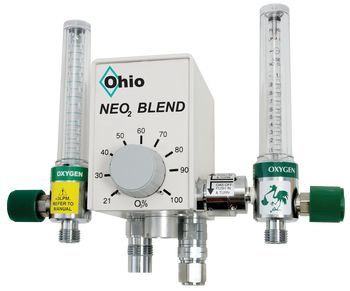
Ohio Medical NEO2 Blend
 Ohio Medical · Model NEO2 Blend
Respiratory gas blender This Blender is designed specifically for use in the Neonatal Intensive Care Unit (NICU). It comes with a built-in close fit left side Flowmeter which flows from 1-15 L/min, and a right side Flowmeter which flows from 0.1-1 L/min. It also has a unique Flowmeter Bleed Switch which allows you to turn off the low flow gas bleed without disconnecting anything - simply rotate the right Flowmeter forward 45 degrees to turn off the bleed. Rotate the Flowmeter back to vertical to turn it back on.
Key tips
- ·Don't extend filter/tubing replacement intervals to save cost - this is an infection-control issue, not just a performance one.
- ·Flow accuracy drift is often the earliest sign of a failing sensor, well before an outright alarm.
Typical Failure Modes
Compiled for this model from its own documentation and established engineering knowledge for this equipment class - not from a verified service record. Confirm against the manufacturer's service manual.
Delivered mix / flow incorrect
HighSymptoms: FiO2 or flow does not match the setting, mix alarm, hypoxic-guard trips.
Root cause: Blender proportioning valve, a supply-pressure imbalance, or a worn flowmeter / needle valve.
Supply-pressure alarm / imbalance
MediumSymptoms: Blender alarm, will not deliver at flow, one gas reads low.
Root cause: Wall / cylinder supply low or one gas missing, or an inlet filter / check-valve fault.
Leak at fittings / bleed noise
MediumSymptoms: Hiss, high gas consumption, will not hold set pressure.
Root cause: Worn O-rings / seals at inlet or outlet fittings, or the blender bleed.
Flowmeter float sticking / inaccurate
LowSymptoms: Float hangs up, flow does not track the knob.
Root cause: Dirty or scratched flow tube, or a worn needle valve.
Serviceable Parts & Consumables
Serviceable items for this model, compiled from its documentation and engineering knowledge for this equipment class. Service class and relative cost are estimates, not manufacturer figures; no part numbers are given. Confirm intervals and pricing against the manufacturer.
Proportioning valve / blender core
Class Major service partRel. cost $$$R&R Difficult
Inlet filters / check valves
Class Periodic replacementRel. cost $R&R Fairly easy
Flowmeter (flow tube / needle valve)
Class Major service partRel. cost $$R&R Moderate
O-ring / seal kit
Class Frequent wear itemRel. cost $R&R Fairly easy
| Part | Service class | Relative cost | R&R difficulty |
|---|---|---|---|
| Proportioning valve / blender core | Major service part | $$$ | Difficult |
| Inlet filters / check valves | Periodic replacement | $ | Fairly easy |
| Flowmeter (flow tube / needle valve) | Major service part | $$ | Moderate |
| O-ring / seal kit | Frequent wear item | $ | Fairly easy |
Relative cost: $ lowest · $$$$ highest service-part cost for this equipment class. Not a price.
PM Checklist
Preventive-maintenance tasks typical of this equipment class. Perform to the manufacturer's procedure and your facility's policy - this is general reference, not a schedule for this specific unit.
- ·Filter and tubing replacement
- ·Flow accuracy check
- ·Annual full PM
Troubleshooting Approach
A starting sequence for this model, compiled from its documentation and engineering knowledge for this equipment class. Follow the manufacturer's service documentation for the actual procedure.
Symptom: Delivered mix or flow wrong
- Verify the delivered O2 / flow with a calibrated analyser at the outlet.
- Confirm both inlet supply pressures are equal and within spec.
- Check the inlet filters and check valves.
- Calibrate / service the blender per the manual.
- Replace the proportioning valve / flowmeter if still out of spec.
Symptom: Supply-pressure alarm
- Confirm both gas supplies are connected and at pressure.
- Check the inlet filters for blockage.
- Inspect the inlet check valves.
- Reseat / replace the supply hoses.
- Clear the alarm and re-verify the delivered mix.
Typical Location
Where this class of equipment is typically deployed - general reference, not this unit's own placement record.
- Respiratory Therapy department
- Patient floors
- Emergency Department
- Home care (portable units)
Documents & Manuals
Troubleshoot this device with Bio
Describe a symptom or error code. Bio answers from this device's own documented error codes, failure modes, parts, and guides.
Ask Bio