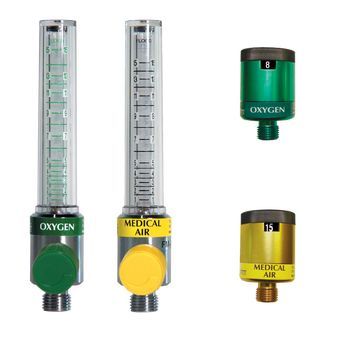
Ohio Medical Amvex Dial and Thorpe Style Flowmeters
 Ohio Medical · Model Amvex Dial and Thorpe Style Flowmeters
Thorpe Style Features. Available in Oxygen, Medical Air, Heliox and CO2 and N2O. Easy to service. No strip D shape knob. Includes an inlet filter and inlet extension. Back pressure compensated so flow accuracy is not affected by restrictions Dial Style Features. Available in Oxygen in 25, 15, 8 and 4 LPM. Available in Medical Air in 25 and 15 LPM. Smallest and lightest in the industry. Color coded labeling for specific gas. Encased in an anodized aluminum housing. Easy to read flow window.
Key tips
- ·Don't extend filter/tubing replacement intervals to save cost - this is an infection-control issue, not just a performance one.
- ·Flow accuracy drift is often the earliest sign of a failing sensor, well before an outright alarm.
Typical Failure Modes
Compiled for this model from its own documentation and established engineering knowledge for this equipment class - not from a verified service record. Confirm against the manufacturer's service manual.
Delivered mix / flow incorrect
HighSymptoms: FiO2 or flow does not match the setting, mix alarm, hypoxic-guard trips.
Root cause: Blender proportioning valve, a supply-pressure imbalance, or a worn flowmeter / needle valve.
Supply-pressure alarm / imbalance
MediumSymptoms: Blender alarm, will not deliver at flow, one gas reads low.
Root cause: Wall / cylinder supply low or one gas missing, or an inlet filter / check-valve fault.
Leak at fittings / bleed noise
MediumSymptoms: Hiss, high gas consumption, will not hold set pressure.
Root cause: Worn O-rings / seals at inlet or outlet fittings, or the blender bleed.
Flowmeter float sticking / inaccurate
LowSymptoms: Float hangs up, flow does not track the knob.
Root cause: Dirty or scratched flow tube, or a worn needle valve.
Serviceable Parts & Consumables
Serviceable items for this model, compiled from its documentation and engineering knowledge for this equipment class. Service class and relative cost are estimates, not manufacturer figures; no part numbers are given. Confirm intervals and pricing against the manufacturer.
Proportioning valve / blender core
Class Major service partRel. cost $$$R&R Difficult
Inlet filters / check valves
Class Periodic replacementRel. cost $R&R Fairly easy
Flowmeter (flow tube / needle valve)
Class Major service partRel. cost $$R&R Moderate
O-ring / seal kit
Class Frequent wear itemRel. cost $R&R Fairly easy
| Part | Service class | Relative cost | R&R difficulty |
|---|---|---|---|
| Proportioning valve / blender core | Major service part | $$$ | Difficult |
| Inlet filters / check valves | Periodic replacement | $ | Fairly easy |
| Flowmeter (flow tube / needle valve) | Major service part | $$ | Moderate |
| O-ring / seal kit | Frequent wear item | $ | Fairly easy |
Relative cost: $ lowest · $$$$ highest service-part cost for this equipment class. Not a price.
PM Checklist
Preventive-maintenance tasks typical of this equipment class. Perform to the manufacturer's procedure and your facility's policy - this is general reference, not a schedule for this specific unit.
- ·Filter and tubing replacement
- ·Flow accuracy check
- ·Annual full PM
Troubleshooting Approach
A starting sequence for this model, compiled from its documentation and engineering knowledge for this equipment class. Follow the manufacturer's service documentation for the actual procedure.
Symptom: Delivered mix or flow wrong
- Verify the delivered O2 / flow with a calibrated analyser at the outlet.
- Confirm both inlet supply pressures are equal and within spec.
- Check the inlet filters and check valves.
- Calibrate / service the blender per the manual.
- Replace the proportioning valve / flowmeter if still out of spec.
Symptom: Supply-pressure alarm
- Confirm both gas supplies are connected and at pressure.
- Check the inlet filters for blockage.
- Inspect the inlet check valves.
- Reseat / replace the supply hoses.
- Clear the alarm and re-verify the delivered mix.
Typical Location
Where this class of equipment is typically deployed - general reference, not this unit's own placement record.
- Respiratory Therapy department
- Patient floors
- Emergency Department
- Home care (portable units)
Documents & Manuals
No documents available for this device yet.
Troubleshoot this device with Bio
Describe a symptom or error code. Bio answers from this device's own documented error codes, failure modes, parts, and guides.
Ask Bio