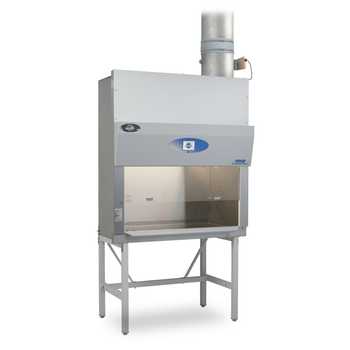
NuAire NU-430-400E
 NuAire · Model NU-430-400E
Exhaust interlock TouchLink2 electronic control Intelli airflow control For non-flammable/explosive chemicals 100% exhaust.
Key tips
- ·When no category-specific guidance fits, default to the manufacturer's own service manual and the general troubleshooting method in the Engineer's Guide.
- ·Run an incoming and annual electrical safety test regardless of how niche the device is.
Typical Failure Modes
Compiled for this model from its own documentation and established engineering knowledge for this equipment class - not from a verified service record. Confirm against the manufacturer's service manual.
Airflow out of specification / alarm
HighSymptoms: Inflow or downflow velocity alarm, failed annual certification, unsafe containment.
Root cause: Loaded HEPA / ULPA filter, a worn blower, or a failing airflow sensor / control.
HEPA / ULPA filter loaded or leaking
HighSymptoms: Rising blower speed to hold setpoint, failed DOP / PAO leak test.
Root cause: Filter at end of life or a filter-seal breach.
Sash / window fault
MediumSymptoms: Sash alarm, sash will not stay at the working height, sash-position sensor error.
Root cause: Sash counterbalance cable / spring or the sash sensor.
Blower / motor fault
MediumSymptoms: Noise, cannot reach set airflow, blower alarm.
Root cause: Worn blower bearing or a failing ECM motor.
UV lamp / interior light fault
LowSymptoms: UV decontamination lamp or the fluorescent / LED work light not working.
Root cause: Lamp at end of life or a ballast / driver fault.
Serviceable Parts & Consumables
Serviceable items for this model, compiled from its documentation and engineering knowledge for this equipment class. Service class and relative cost are estimates, not manufacturer figures; no part numbers are given. Confirm intervals and pricing against the manufacturer.
HEPA / ULPA filter set
Requires certification after replacement.
Class Periodic replacementRel. cost $$$R&R Difficult
Blower / ECM motor
Class Major service partRel. cost $$$R&R Difficult
Airflow sensor
Class Major service partRel. cost $$R&R Moderate
Sash counterbalance cable / spring
Class Major service partRel. cost $$R&R Moderate
UV lamp / work light
Class Frequent wear itemRel. cost $R&R Fairly easy
| Part | Service class | Relative cost | R&R difficulty |
|---|---|---|---|
| HEPA / ULPA filter set Requires certification after replacement. | Periodic replacement | $$$ | Difficult |
| Blower / ECM motor | Major service part | $$$ | Difficult |
| Airflow sensor | Major service part | $$ | Moderate |
| Sash counterbalance cable / spring | Major service part | $$ | Moderate |
| UV lamp / work light | Frequent wear item | $ | Fairly easy |
Relative cost: $ lowest · $$$$ highest service-part cost for this equipment class. Not a price.
PM Checklist
Preventive-maintenance tasks typical of this equipment class. Perform to the manufacturer's procedure and your facility's policy - this is general reference, not a schedule for this specific unit.
- ·Follow the manufacturer's PM schedule
- ·Perform incoming and annual electrical safety testing per facility biomedical program
Troubleshooting Approach
A starting sequence for this model, compiled from its documentation and engineering knowledge for this equipment class. Follow the manufacturer's service documentation for the actual procedure.
Symptom: Airflow alarm / fails certification
- Do not use the cabinet for aseptic / containment work until airflow is confirmed.
- Check the filter-loading indicator and blower speed trend.
- Replace the HEPA / ULPA filters if loaded.
- Have a certifier measure inflow / downflow and perform the filter leak test.
- Recalibrate the airflow sensor / control if it disagrees with the certifier.
Symptom: Sash alarm / will not stay put
- Check the sash-position sensor and its wiring.
- Inspect the sash counterbalance cable / spring for wear.
- Replace the counterbalance components.
- Confirm the sash holds at the working height.
- Re-check the airflow alarms clear at the correct sash position.
Typical Location
Where this class of equipment is typically deployed - general reference, not this unit's own placement record.
- Varies by device - check the unit's own manual for facility placement guidance
Documents & Manuals
No documents available for this device yet.
Troubleshoot this device with Bio
Describe a symptom or error code. Bio answers from this device's own documented error codes, failure modes, parts, and guides.
Ask Bio