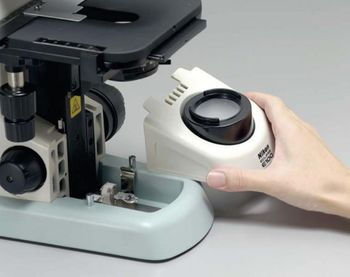
Nikon Instruments Eclipse E100-LED
 Nikon Instruments · Model Eclipse E100-LED
The E100 incorporates a high-intensity LED eco-illumination system that is IR-free, virtually eliminating eyestrain for users. Eco-illumination boasts a long lifetime of 60,000 hours, and reduces the need for frequent lamp changes. LED illumination also offers very low power consumption and heat generation and eliminates color temperature changes that occur with halogen light sources. Siedentopf-type eyepiece tube inclined at a comfortable 30 degrees. Interpupillary distance of 47-75mm is largest in its class. 180 degree rotatable eyepoint adjustment to accommodate operators of different builds. Wide 18mm field of view with built-in diopter adjustment on both eyepieces provides easy parfocality adjustment. Eyepieces lock to prevent theft, damage, or vandalism. Allows the user to set the upper limit of the stage movement so objective does not hit the specimen slide, protecting both from damage. Turning the microscope upside-down to replace lamp is no longer necessary. Simply open the top corner on the base to replace the 6V/20W halogen lamp safely and easily. Microscope comes standard with 4x, 10x, 40x, and 100x objectives. 20x and 60x Dry objectives are also available. Utilizing a lightweight design, the Eclipse E100 was created with a small footprint that is compact and easily fits into a storage cabinet. Specially designed for the E100, CFI BE Plan objectives provide a bright, high contrast and flat-field image over the entire 18mm field of view. The Eclipse E100 incorporates Nikon’s revolutionary CFI Infinity Corrected Optical System with advanced specifications for crisp, bright images at every magnification at a modest price. Anti-mold paint and an anti-mold tablet are used in the objective lenses, eyepiece lenses and eyepiece tubes to prevent mold forming in high-humidity environments. To further assure quality control of the lenses and design versatility, Nikon manufactures its own glass from raw silica to the final optical coatings.
Typical Failure Modes
Compiled for this model from its own documentation and established engineering knowledge for this equipment class - not from a verified service record. Confirm against the manufacturer's service manual.
Uneven or dark illumination
MediumSymptoms: Vignetting, dark edges, uneven brightness across the field.
Root cause: Condenser height/aperture wrong, field diaphragm not centred, nosepiece not clicked in, or dirty optics; lamp/LED aging.
Poor image quality / low contrast
MediumSymptoms: Blurry or low-contrast image.
Root cause: Wrong or missing 0.17 mm cover glass, immersion oil on a dry objective, air bubbles in the oil, or condenser aperture mis-set.
Illuminator lamp / LED failure
MediumSymptoms: No or dim light, will not brighten.
Root cause: Lamp / LED at end of life, or a rheostat / driver fault.
Focus / stage / nosepiece wear
LowSymptoms: Focus slips or binds, stage stiff or slips, nosepiece detent worn.
Root cause: Worn focus clutch or dried stage grease.
Serviceable Parts & Consumables
Serviceable items for this model, compiled from its documentation and engineering knowledge for this equipment class. Service class and relative cost are estimates, not manufacturer figures; no part numbers are given. Confirm intervals and pricing against the manufacturer.
Illuminator lamp / LED module
Class Periodic replacementRel. cost $R&R Fairly easy
Rheostat / illuminator driver
Class Major service partRel. cost $R&R Moderate
Focus mechanism / clutch kit
Class Major service partRel. cost $$R&R Difficult
Objective lens (DIN achromat)
Class Major service partRel. cost $$$R&R Fairly easy
Mains fuse
Class Major service partRel. cost $R&R Fairly easy
| Part | Service class | Relative cost | R&R difficulty |
|---|---|---|---|
| Illuminator lamp / LED module | Periodic replacement | $ | Fairly easy |
| Rheostat / illuminator driver | Major service part | $ | Moderate |
| Focus mechanism / clutch kit | Major service part | $$ | Difficult |
| Objective lens (DIN achromat) | Major service part | $$$ | Fairly easy |
| Mains fuse | Major service part | $ | Fairly easy |
Relative cost: $ lowest · $$$$ highest service-part cost for this equipment class. Not a price.
Troubleshooting Approach
A starting sequence for this model, compiled from its documentation and engineering knowledge for this equipment class. Follow the manufacturer's service documentation for the actual procedure.
Symptom: Dark or uneven field
- Click the nosepiece fully into a detent.
- Set the condenser height and aperture and centre the field diaphragm (Kohler).
- Clean the objective, condenser, eyepieces and collector.
- Check / replace the lamp or LED if dim.
- Re-check across objectives.
Symptom: Blurry image
- Fit a 0.17 mm cover glass, slide right-side up.
- Remove immersion oil from dry objectives; use oil only with oil objectives and clear bubbles.
- Set the condenser aperture.
- Clean all optical surfaces.
- Re-evaluate the image.