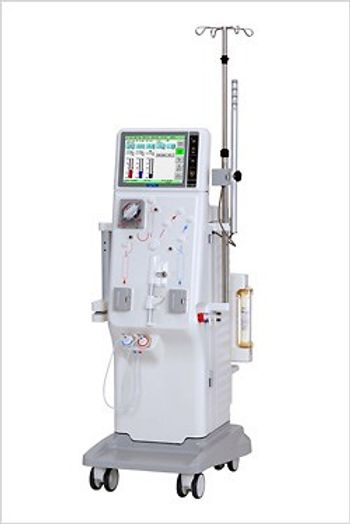
Nikkiso DBB-06
 Nikkiso · Model DBB-06
The DBB-06 offers Haemo-Master® Blood Volume Monitor that does not require additional disposables or added cost per treatment. The BVM aids in fluid removal, lowering complications during the session as well as long-term by helping to correct patient dry weight targets. A self-prompting touchscreen interface allows easy data entry. The storage and easy recall of up to 16 patient prescriptions saves time setting up treatment. An automatic battery backup system for up to 30 minutes during power failures is a standard feature to allow for automated and safe return of the patient’s blood. The DBB-06 conducts a pre-treatment check and a continuous check of the balancing system and UF removal pump during treatment.
Key tips
- ·Conductivity and water-quality checks are non-negotiable before every shift - dialysate chemistry errors are a direct patient-harm mechanism.
- ·Confirm disinfection cycle completion, never assume it, after every use.
- ·Treat a blood-leak detector fault as real until proven otherwise - never silence and continue.
Typical Failure Modes
Compiled for this model from its own documentation and established engineering knowledge for this equipment class - not from a verified service record. Confirm against the manufacturer's service manual.
Conductivity / temperature / dialysate-prep alarm
HighSymptoms: Conductivity or temperature out of range, dialysate-preparation alarm, treatment will not start.
Root cause: Concentrate connection / supply, a heater fault, a conductivity-cell fault, or a proportioning-pump / valve fault.
Blood or dialysate pump fault
MediumSymptoms: Pump will not run at set speed, occlusion or flow alarms, tubing walking in the raceway.
Root cause: Worn pump rotor / rollers or a motor / control fault.
Pressure-monitoring / air-detector fault
MediumSymptoms: Venous / arterial / TMP pressure implausible, air-detector false alarms or fails to detect.
Root cause: Transducer-protector wetting, a pressure-sensor fault, or an air-detector fault.
UF / balancing-chamber fault
MediumSymptoms: Fluid-balance / UF alarms, weight loss inaccurate, balancing-chamber leak.
Root cause: Balancing-chamber diaphragm / valve wear or a flow-sensor fault.
Disinfection / rinse fault
MediumSymptoms: Heat or chemical disinfection will not complete, residual disinfectant test fails.
Root cause: Heater, a dosing / rinse valve, or a conductivity-verification fault.
Serviceable Parts & Consumables
Serviceable items for this model, compiled from its documentation and engineering knowledge for this equipment class. Service class and relative cost are estimates, not manufacturer figures; no part numbers are given. Confirm intervals and pricing against the manufacturer.
Blood / dialysate pump rotor & rollers
Class Periodic replacementRel. cost $$R&R Moderate
Conductivity cell / temperature sensor
Class Periodic replacementRel. cost $$R&R Moderate
Pressure sensors / transducer protectors
Class Periodic replacementRel. cost $$R&R Fairly easy
Balancing-chamber diaphragm / valve kit
Class Periodic replacementRel. cost $$$R&R Difficult
Proportioning pump / valves
Class Major service partRel. cost $$$R&R Difficult
| Part | Service class | Relative cost | R&R difficulty |
|---|---|---|---|
| Blood / dialysate pump rotor & rollers | Periodic replacement | $$ | Moderate |
| Conductivity cell / temperature sensor | Periodic replacement | $$ | Moderate |
| Pressure sensors / transducer protectors | Periodic replacement | $$ | Fairly easy |
| Balancing-chamber diaphragm / valve kit | Periodic replacement | $$$ | Difficult |
| Proportioning pump / valves | Major service part | $$$ | Difficult |
Relative cost: $ lowest · $$$$ highest service-part cost for this equipment class. Not a price.
PM Checklist
Preventive-maintenance tasks typical of this equipment class. Perform to the manufacturer's procedure and your facility's policy - this is general reference, not a schedule for this specific unit.
- ·Disinfection cycle verification
- ·Conductivity and water-quality check
- ·Blood-leak detector test
- ·Scheduled tubing / filter replacement
- ·Annual full PM
Troubleshooting Approach
A starting sequence for this model, compiled from its documentation and engineering knowledge for this equipment class. Follow the manufacturer's service documentation for the actual procedure.
Symptom: Conductivity or temperature alarm
- Confirm the concentrate is connected, correct and not empty.
- Verify dialysate conductivity and temperature with independent calibrated meters.
- Check / calibrate the conductivity cell and temperature sensor.
- Inspect the proportioning pumps / valves and de-air the hydraulics.
- Do not treat until conductivity and temperature are verified in range.
Symptom: Pump or pressure fault
- Inspect the pump rotor and rollers for wear and correct occlusion.
- Reseat the tubing segment in the raceway.
- Check the pressure transducers and protectors for wetting.
- Calibrate the pressure channels.
- Replace the rotor / rollers or a faulty sensor as isolated.
Typical Location
Where this class of equipment is typically deployed - general reference, not this unit's own placement record.
- Dialysis unit / clinic
- ICU (acute dialysis)
- Home hemodialysis
Documents & Manuals
Troubleshoot this device with Bio
Describe a symptom or error code. Bio answers from this device's own documented error codes, failure modes, parts, and guides.
Ask Bio