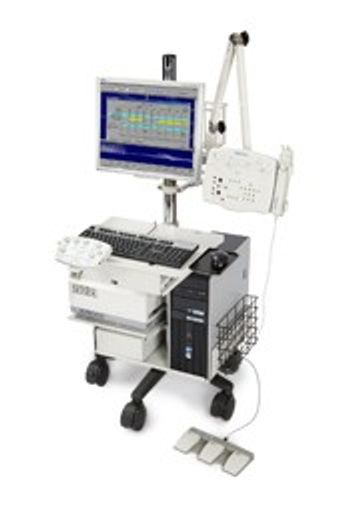
Nicolet Synergy
 Nicolet · Model Synergy
Synergy Plinth. Designed to achieve the perfect balance of reliability, ease-of-use and flexibility. Dual SEP Stimulators for simultaneous bilateral studies. Advanced Single EMG and Q EMG packages. Up to 8 channel EMG with LivePlay up to 360 secs for reanalysis. Simple set up with the powerful test configuration wizard and montaging via software. Share your data across a network via NicVue and V-Link. Generates customized reports. Advanced Single Fiber EMG and QEMG packages.
Key tips
- ·Electrode impedance drives data quality more than almost any other single factor - check it before assuming an amplifier fault.
- ·Pre-case verification of intraoperative monitoring equipment isn't optional - a mid-case failure has direct surgical-decision consequences.
Typical Failure Modes
Compiled for this model from its own documentation and established engineering knowledge for this equipment class - not from a verified service record. Confirm against the manufacturer's service manual.
Excessive noise / poor signal on a channel
HighSymptoms: 50/60 Hz or broadband noise, flat or noisy trace on one or more channels, high electrode impedance.
Root cause: Electrode / lead-wire fault, a headbox / amplifier input fault, or a grounding / environment problem.
Stimulator output fault
MediumSymptoms: No or weak electrical stimulation, no patient response, stimulator-error message.
Root cause: Stimulator probe / bar-electrode fault, its cable, or the stimulator output stage.
Headbox / amplifier fault
MediumSymptoms: One or more channels dead or saturated on all inputs, calibration fails.
Root cause: Headbox / amplifier module fault.
Acquisition PC / software fault
MediumSymptoms: Acquisition hangs, studies will not save or export, license / dongle error.
Root cause: Workstation PC, software, or the license key.
Audio / stim-artefact / trigger fault
LowSymptoms: No audio monitor, trigger not registering (evoked potentials).
Root cause: Speaker / audio board or the trigger input.
Serviceable Parts & Consumables
Serviceable items for this model, compiled from its documentation and engineering knowledge for this equipment class. Service class and relative cost are estimates, not manufacturer figures; no part numbers are given. Confirm intervals and pricing against the manufacturer.
Patient lead set / electrode leads
Class Frequent wear itemRel. cost $$R&R Easy
Stimulator probe / bar electrode & cable
Class Frequent wear itemRel. cost $$R&R Fairly easy
Headbox / amplifier module
Class Major service partRel. cost $$$R&R Moderate
Acquisition PC
Class Major service partRel. cost $$$R&R Moderate
Audio / speaker board
Class Major service partRel. cost $R&R Moderate
| Part | Service class | Relative cost | R&R difficulty |
|---|---|---|---|
| Patient lead set / electrode leads | Frequent wear item | $$ | Easy |
| Stimulator probe / bar electrode & cable | Frequent wear item | $$ | Fairly easy |
| Headbox / amplifier module | Major service part | $$$ | Moderate |
| Acquisition PC | Major service part | $$$ | Moderate |
| Audio / speaker board | Major service part | $ | Moderate |
Relative cost: $ lowest · $$$$ highest service-part cost for this equipment class. Not a price.
PM Checklist
Preventive-maintenance tasks typical of this equipment class. Perform to the manufacturer's procedure and your facility's policy - this is general reference, not a schedule for this specific unit.
- ·Electrode / lead impedance check
- ·Amplifier calibration
- ·Annual electrical safety test
Troubleshooting Approach
A starting sequence for this model, compiled from its documentation and engineering knowledge for this equipment class. Follow the manufacturer's service documentation for the actual procedure.
Symptom: Noisy channel or poor signal
- Check electrode impedances and re-prep the skin.
- Swap the lead wires and try a different headbox input.
- Move away from mains-powered equipment and confirm the ground / reference.
- Run the amplifier calibration / impedance check.
- Replace the lead set or headbox as isolated.
Symptom: Stimulator gives no response
- Confirm the stimulator settings and that intensity ramps.
- Swap the stimulator probe and cable.
- Test on a saline / test load per the manual.
- Check the stimulator output on a second channel.
- Refer the stimulator output stage if a good probe still gives nothing.
Typical Location
Where this class of equipment is typically deployed - general reference, not this unit's own placement record.
- Neurology / EEG lab
- ICU (continuous EEG monitoring)
- Operating Room (intraoperative monitoring)
Documents & Manuals
Troubleshoot this device with Bio
Describe a symptom or error code. Bio answers from this device's own documented error codes, failure modes, parts, and guides.
Ask Bio